- java.lang.Object
- io.reactivex.Flowable<T>
- io.reactivex.processors.FlowableProcessor<T>
- io.reactivex.processors.BehaviorProcessor<T>
- Type Parameters:
T- the type of item expected to be observed and emitted by the Processor
- All Implemented Interfaces:
- FlowableSubscriber<T>,Processor<T,T>,Publisher<T>,Subscriber<T>
public final classBehaviorProcessor<T>extendsFlowableProcessor<T>
Processor that emits the most recent item it has observed and all subsequent observed items to each subscribedSubscriber.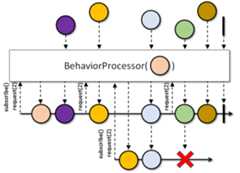
This processor does not have a public constructor by design; a new empty instance of this
BehaviorProcessorcan be created via thecreate()method and a new non-empty instance can be created viacreateDefault(Object)(named as such to avoid overload resolution conflict withFlowable.createthat creates a Flowable, not aBehaviorProcessor).In accordance with the Reactive Streams specification (Rule 2.13)
nulls are not allowed as default initial values increateDefault(Object)or as parameters toonNext(Object)andonError(Throwable).When this
BehaviorProcessoris terminated viaonError(Throwable)oronComplete(), the last observed item (if any) is cleared and lateSubscribers only receive the respective terminal event.The
BehaviorProcessordoes not support clearing its cached value (to appear empty again), however, the effect can be achieved by using a special item and making sureSubscribers subscribe through a filter whose predicate filters out this special item:BehaviorProcessor<Integer> processor = BehaviorProcessor.create(); final Integer EMPTY = Integer.MIN_VALUE; Flowable<Integer> flowable = processor.filter(v -> v != EMPTY); TestSubscriber<Integer> ts1 = flowable.test(); processor.onNext(1); // this will "clear" the cache processor.onNext(EMPTY); TestSubscriber<Integer> ts2 = flowable.test(); processor.onNext(2); processor.onComplete(); // ts1 received both non-empty items ts1.assertResult(1, 2); // ts2 received only 2 even though the current item was EMPTY // when it got subscribed ts2.assertResult(2); // Subscribers coming after the processor was terminated receive // no items and only the onComplete event in this case. flowable.test().assertResult();Even though
BehaviorProcessorimplements theSubscriberinterface, callingonSubscribeis not required (Rule 2.12) if the processor is used as a standalone source. However, callingonSubscribeafter theBehaviorProcessorreached its terminal state will result in the givenSubscriptionbeing cancelled immediately.Calling
onNext(Object),offer(Object),onError(Throwable)andonComplete()is required to be serialized (called from the same thread or called non-overlappingly from different threads through external means of serialization). TheFlowableProcessor.toSerialized()method available to allFlowableProcessors provides such serialization and also protects against reentrance (i.e., when a downstreamSubscriberconsuming this processor also wants to callonNext(Object)on this processor recursively). Note that serializing overoffer(Object)is not supported throughtoSerialized()because it is a method available on thePublishProcessorandBehaviorProcessorclasses only.This
BehaviorProcessorsupports the standard state-peeking methodshasComplete(),hasThrowable(),getThrowable()andhasSubscribers()as well as means to read the latest observed value in a non-blocking and thread-safe manner viahasValue(),getValue(),getValues()orgetValues(Object[]).Note that this processor signals
MissingBackpressureExceptionif a particularSubscriberis not ready to receiveonNextevents. To avoid this exception being signaled, useoffer(Object)to only try to emit an item when allSubscribers have requested item(s).- Backpressure:
- The
BehaviorProcessordoes not coordinate requests of its downstreamSubscribers and expects each individualSubscriberis ready to receiveonNextitems whenonNext(Object)is called. If aSubscriberis not ready, aMissingBackpressureExceptionis signalled to it. To avoid overflowing the currentSubscribers, the conditionaloffer(Object)method is available that returns true if any of theSubscribers is not ready to receiveonNextevents. If there are noSubscribers to the processor,offer()always succeeds. If theBehaviorProcessoris (optionally) subscribed to anotherPublisher, this upstreamPublisheris consumed in an unbounded fashion (requestingLong.MAX_VALUE). - Scheduler:
BehaviorProcessordoes not operate by default on a particularSchedulerand theSubscribers get notified on the thread the respectiveonXXXmethods were invoked.- Error handling:
- When the
onError(Throwable)is called, theBehaviorProcessorenters into a terminal state and emits the sameThrowableinstance to the last set ofSubscribers. During this emission, if one or moreSubscribers cancel their respectiveSubscriptions, theThrowableis delivered to the global error handler viaRxJavaPlugins.onError(Throwable)(multiple times if multipleSubscribers cancel at once). If there were noSubscribers subscribed to thisBehaviorProcessorwhen theonError()was called, the global error handler is not invoked.
Example usage:
// subscriber will receive all events. BehaviorProcessor<Object> processor = BehaviorProcessor.create("default"); processor.subscribe(subscriber); processor.onNext("one"); processor.onNext("two"); processor.onNext("three"); // subscriber will receive the "one", "two" and "three" events, but not "zero" BehaviorProcessor<Object> processor = BehaviorProcessor.create("default"); processor.onNext("zero"); processor.onNext("one"); processor.subscribe(subscriber); processor.onNext("two"); processor.onNext("three"); // subscriber will receive only onComplete BehaviorProcessor<Object> processor = BehaviorProcessor.create("default"); processor.onNext("zero"); processor.onNext("one"); processor.onComplete(); processor.subscribe(subscriber); // subscriber will receive only onError BehaviorProcessor<Object> processor = BehaviorProcessor.create("default"); processor.onNext("zero"); processor.onNext("one"); processor.onError(new RuntimeException("error")); processor.subscribe(subscriber);
Method Summary
All Methods Static Methods Instance Methods Concrete Methods Deprecated Methods Modifier and Type Method and Description static <T> BehaviorProcessor<T>create()Creates aBehaviorProcessorwithout a default item.static <T> BehaviorProcessor<T>createDefault(T defaultValue)Creates aBehaviorProcessorthat emits the last item it observed and all subsequent items to eachSubscriberthat subscribes to it.ThrowablegetThrowable()Returns the error that caused the FlowableProcessor to terminate or null if the FlowableProcessor hasn't terminated yet.TgetValue()Returns a single value the BehaviorProcessor currently has or null if no such value exists.Object[]getValues()Deprecated.in 2.1.14; put the result ofgetValue()into an array manually, will be removed in 3.xT[]getValues(T[] array)Deprecated.in 2.1.14; put the result ofgetValue()into an array manually, will be removed in 3.xbooleanhasComplete()Returns true if the FlowableProcessor has reached a terminal state through a complete event.booleanhasSubscribers()Returns true if the FlowableProcessor has subscribers.booleanhasThrowable()Returns true if the FlowableProcessor has reached a terminal state through an error event.booleanhasValue()Returns true if the BehaviorProcessor has any value.booleanoffer(T t)Tries to emit the item to all currently subscribed Subscribers if all of them has requested some value, returns false otherwise.voidonComplete()voidonError(Throwable t)voidonNext(T t)voidonSubscribe(Subscription s)Implementors of this method should make sure everything that needs to be visible inSubscriber.onNext(Object)is established before callingSubscription.request(long).protected voidsubscribeActual(Subscriber<? superT> s)Operator implementations (both source and intermediate) should implement this method that performs the necessary business logic and handles the incomingSubscribers.Methods inherited from class io.reactivex.processors.FlowableProcessor
toSerialized
Methods inherited from class io.reactivex.Flowable
all,amb,ambArray,ambWith,any,as,blockingFirst,blockingFirst,blockingForEach,blockingIterable,blockingIterable,blockingLast,blockingLast,blockingLatest,blockingMostRecent,blockingNext,blockingSingle,blockingSingle,blockingSubscribe,blockingSubscribe,blockingSubscribe,blockingSubscribe,blockingSubscribe,blockingSubscribe,blockingSubscribe,blockingSubscribe,buffer,buffer,buffer,buffer,buffer,buffer,buffer,buffer,buffer,buffer,buffer,buffer,buffer,buffer,buffer,buffer,buffer,buffer,buffer,bufferSize,cache,cacheWithInitialCapacity,cast,collect,collectInto,combineLatest,combineLatest,combineLatest,combineLatest,combineLatest,combineLatest,combineLatest,combineLatest,combineLatest,combineLatest,combineLatest,combineLatest,combineLatest,combineLatestDelayError,combineLatestDelayError,combineLatestDelayError,combineLatestDelayError,combineLatestDelayError,combineLatestDelayError,compose,concat,concat,concat,concat,concat,concat,concatArray,concatArrayDelayError,concatArrayEager,concatArrayEager,concatArrayEagerDelayError,concatArrayEagerDelayError,concatDelayError,concatDelayError,concatDelayError,concatEager,concatEager,concatEager,concatEager,concatMap,concatMap,concatMapCompletable,concatMapCompletable,concatMapCompletableDelayError,concatMapCompletableDelayError,concatMapCompletableDelayError,concatMapDelayError,concatMapDelayError,concatMapEager,concatMapEager,concatMapEagerDelayError,concatMapEagerDelayError,concatMapIterable,concatMapIterable,concatMapMaybe,concatMapMaybe,concatMapMaybeDelayError,concatMapMaybeDelayError,concatMapMaybeDelayError,concatMapSingle,concatMapSingle,concatMapSingleDelayError,concatMapSingleDelayError,concatMapSingleDelayError,concatWith,concatWith,concatWith,concatWith,contains,count,create,debounce,debounce,debounce,defaultIfEmpty,defer,delay,delay,delay,delay,delay,delay,delaySubscription,delaySubscription,delaySubscription,dematerialize,dematerialize,distinct,distinct,distinct,distinctUntilChanged,distinctUntilChanged,distinctUntilChanged,doAfterNext,doAfterTerminate,doFinally,doOnCancel,doOnComplete,doOnEach,doOnEach,doOnError,doOnLifecycle,doOnNext,doOnRequest,doOnSubscribe,doOnTerminate,elementAt,elementAt,elementAtOrError,empty,error,error,filter,first,firstElement,firstOrError,flatMap,flatMap,flatMap,flatMap,flatMap,flatMap,flatMap,flatMap,flatMap,flatMap,flatMap,flatMap,flatMapCompletable,flatMapCompletable,flatMapIterable,flatMapIterable,flatMapIterable,flatMapIterable,flatMapMaybe,flatMapMaybe,flatMapSingle,flatMapSingle,forEach,forEachWhile,forEachWhile,forEachWhile,fromArray,fromCallable,fromFuture,fromFuture,fromFuture,fromFuture,fromIterable,fromPublisher,generate,generate,generate,generate,generate,groupBy,groupBy,groupBy,groupBy,groupBy,groupBy,groupJoin,hide,ignoreElements,interval,interval,interval,interval,intervalRange,intervalRange,isEmpty,join,just,just,just,just,just,just,just,just,just,just,last,lastElement,lastOrError,lift,limit,map,materialize,merge,merge,merge,merge,merge,merge,merge,merge,mergeArray,mergeArray,mergeArrayDelayError,mergeArrayDelayError,mergeDelayError,mergeDelayError,mergeDelayError,mergeDelayError,mergeDelayError,mergeDelayError,mergeDelayError,mergeDelayError,mergeWith,mergeWith,mergeWith,mergeWith,never,observeOn,observeOn,observeOn,ofType,onBackpressureBuffer,onBackpressureBuffer,onBackpressureBuffer,onBackpressureBuffer,onBackpressureBuffer,onBackpressureBuffer,onBackpressureBuffer,onBackpressureBuffer,onBackpressureDrop,onBackpressureDrop,onBackpressureLatest,onErrorResumeNext,onErrorResumeNext,onErrorReturn,onErrorReturnItem,onExceptionResumeNext,onTerminateDetach,parallel,parallel,parallel,publish,publish,publish,publish,range,rangeLong,rebatchRequests,reduce,reduce,reduceWith,repeat,repeat,repeatUntil,repeatWhen,replay,replay,replay,replay,replay,replay,replay,replay,replay,replay,replay,replay,replay,replay,replay,replay,retry,retry,retry,retry,retry,retryUntil,retryWhen,safeSubscribe,sample,sample,sample,sample,sample,sample,scan,scan,scanWith,sequenceEqual,sequenceEqual,sequenceEqual,sequenceEqual,serialize,share,single,singleElement,singleOrError,skip,skip,skip,skipLast,skipLast,skipLast,skipLast,skipLast,skipLast,skipUntil,skipWhile,sorted,sorted,startWith,startWith,startWith,startWithArray,subscribe,subscribe,subscribe,subscribe,subscribe,subscribe,subscribe,subscribeOn,subscribeOn,subscribeWith,switchIfEmpty,switchMap,switchMap,switchMapCompletable,switchMapCompletableDelayError,switchMapDelayError,switchMapDelayError,switchMapMaybe,switchMapMaybeDelayError,switchMapSingle,switchMapSingleDelayError,switchOnNext,switchOnNext,switchOnNextDelayError,switchOnNextDelayError,take,take,take,takeLast,takeLast,takeLast,takeLast,takeLast,takeLast,takeLast,takeLast,takeLast,takeUntil,takeUntil,takeWhile,test,test,test,throttleFirst,throttleFirst,throttleLast,throttleLast,throttleLatest,throttleLatest,throttleLatest,throttleLatest,throttleWithTimeout,throttleWithTimeout,timeInterval,timeInterval,timeInterval,timeInterval,timeout,timeout,timeout,timeout,timeout,timeout,timeout,timeout,timer,timer,timestamp,timestamp,timestamp,timestamp,to,toFuture,toList,toList,toList,toMap,toMap,toMap,toMultimap,toMultimap,toMultimap,toMultimap,toObservable,toSortedList,toSortedList,toSortedList,toSortedList,unsafeCreate,unsubscribeOn,using,using,window,window,window,window,window,window,window,window,window,window,window,window,window,window,window,window,window,window,window,withLatestFrom,withLatestFrom,withLatestFrom,withLatestFrom,withLatestFrom,withLatestFrom,zip,zip,zip,zip,zip,zip,zip,zip,zip,zip,zip,zip,zipArray,zipIterable,zipWith,zipWith,zipWith,zipWith
Method Detail
create
@CheckReturnValue@NonNullpublic static <T> BehaviorProcessor<T> create()
Creates aBehaviorProcessorwithout a default item.- Type Parameters:
T- the type of item the BehaviorProcessor will emit- Returns:
- the constructed
BehaviorProcessor
createDefault
@CheckReturnValue@NonNullpublic static <T> BehaviorProcessor<T> createDefault(T defaultValue)
Creates aBehaviorProcessorthat emits the last item it observed and all subsequent items to eachSubscriberthat subscribes to it.- Type Parameters:
T- the type of item the BehaviorProcessor will emit- Parameters:
defaultValue- the item that will be emitted first to anySubscriberas long as theBehaviorProcessorhas not yet observed any items from its sourceObservable- Returns:
- the constructed
BehaviorProcessor
subscribeActual
protected void subscribeActual(Subscriber<? superT> s)
Description copied from class:FlowableOperator implementations (both source and intermediate) should implement this method that performs the necessary business logic and handles the incomingSubscribers.There is no need to call any of the plugin hooks on the current
Flowableinstance or theSubscriber; all hooks and basic safeguards have been applied byFlowable.subscribe(Subscriber)before this method gets called.- Specified by:
subscribeActualin classFlowable<T>- Parameters:
s- the incoming Subscriber, never null
onSubscribe
public void onSubscribe(Subscription s)
Description copied from interface:FlowableSubscriberImplementors of this method should make sure everything that needs to be visible inSubscriber.onNext(Object)is established before callingSubscription.request(long). In practice this means no initialization should happen after therequest()call and additional behavior is thread safe in respect toonNext.
onNext
public void onNext(T t)
onError
public void onError(Throwable t)
onComplete
public void onComplete()
offer
public boolean offer(T t)
Tries to emit the item to all currently subscribed Subscribers if all of them has requested some value, returns false otherwise.This method should be called in a sequential manner just like the onXXX methods of the PublishProcessor.
Calling with null will terminate the PublishProcessor and a NullPointerException is signalled to the Subscribers.
History: 2.0.8 - experimental
- Parameters:
t- the item to emit, not null- Returns:
- true if the item was emitted to all Subscribers
- Since:
- 2.2
hasSubscribers
public boolean hasSubscribers()
Description copied from class:FlowableProcessorReturns true if the FlowableProcessor has subscribers.The method is thread-safe.
- Specified by:
hasSubscribersin classFlowableProcessor<T>- Returns:
- true if the FlowableProcessor has subscribers
getThrowable
@Nullablepublic Throwable getThrowable()
Description copied from class:FlowableProcessorReturns the error that caused the FlowableProcessor to terminate or null if the FlowableProcessor hasn't terminated yet.The method is thread-safe.
- Specified by:
getThrowablein classFlowableProcessor<T>- Returns:
- the error that caused the FlowableProcessor to terminate or null if the FlowableProcessor hasn't terminated yet
getValue
@Nullablepublic T getValue()
Returns a single value the BehaviorProcessor currently has or null if no such value exists.The method is thread-safe.
- Returns:
- a single value the BehaviorProcessor currently has or null if no such value exists
getValues
@Deprecatedpublic Object[] getValues()
Deprecated. in 2.1.14; put the result ofgetValue()into an array manually, will be removed in 3.xReturns an Object array containing snapshot all values of the BehaviorProcessor.The method is thread-safe.
- Returns:
- the array containing the snapshot of all values of the BehaviorProcessor
getValues
@Deprecatedpublic T[] getValues(T[] array)
Deprecated. in 2.1.14; put the result ofgetValue()into an array manually, will be removed in 3.xReturns a typed array containing a snapshot of all values of the BehaviorProcessor.The method follows the conventions of Collection.toArray by setting the array element after the last value to null (if the capacity permits).
The method is thread-safe.
- Parameters:
array- the target array to copy values into if it fits- Returns:
- the given array if the values fit into it or a new array containing all values
hasComplete
public boolean hasComplete()
Description copied from class:FlowableProcessorReturns true if the FlowableProcessor has reached a terminal state through a complete event.The method is thread-safe.
- Specified by:
hasCompletein classFlowableProcessor<T>- Returns:
- true if the FlowableProcessor has reached a terminal state through a complete event
- See Also:
FlowableProcessor.hasThrowable()
hasThrowable
public boolean hasThrowable()
Description copied from class:FlowableProcessorReturns true if the FlowableProcessor has reached a terminal state through an error event.The method is thread-safe.
- Specified by:
hasThrowablein classFlowableProcessor<T>- Returns:
- true if the FlowableProcessor has reached a terminal state through an error event
- See Also:
FlowableProcessor.getThrowable(),FlowableProcessor.hasComplete()
hasValue
public boolean hasValue()
Returns true if the BehaviorProcessor has any value.The method is thread-safe.
- Returns:
- true if the BehaviorProcessor has any value