- java.lang.Object
- io.reactivex.Single<T>
- Type Parameters:
T- the type of the item emitted by the Single
- All Implemented Interfaces:
- SingleSource<T>
- Direct Known Subclasses:
- SingleSubject
public abstract classSingle<T>extendsObjectimplementsSingleSource<T>
TheSingleclass implements the Reactive Pattern for a single value response.Singlebehaves similarly toObservableexcept that it can only emit either a single successful value or an error (there is no "onComplete" notification as there is for anObservable).The
Singleclass implements theSingleSourcebase interface and the default consumer type it interacts with is theSingleObservervia thesubscribe(SingleObserver)method.The
Singleoperates with the following sequential protocol:onSubscribe (onSuccess | onError)?Note that
onSuccessandonErrorare mutually exclusive events; unlikeObservable,onSuccessis never followed byonError.Like
Observable, a runningSinglecan be stopped through theDisposableinstance provided to consumers throughSingleObserver.onSubscribe(io.reactivex.disposables.Disposable).Like an
Observable, aSingleis lazy, can be either "hot" or "cold", synchronous or asynchronous.Singleinstances returned by the methods of this class arecold and there is a standardhot implementation in the form of a subject:SingleSubject.The documentation for this class makes use of marble diagrams. The following legend explains these diagrams:
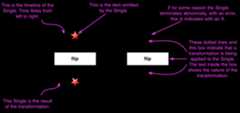
See
FlowableorObservablefor the implementation of the Reactive Pattern for a stream or vector of values.For more information see theReactiveX documentation.
Example:
Disposable d = Single.just("Hello World") .delay(10, TimeUnit.SECONDS, Schedulers.io()) .subscribeWith(new DisposableSingleObserver<String>() { @Override public void onStart() { System.out.println("Started"); } @Override public void onSuccess(String value) { System.out.println("Success: " + value); } @Override public void onError(Throwable error) { error.printStackTrace(); } }); Thread.sleep(5000); d.dispose();Note that by design, subscriptions via
subscribe(SingleObserver)can't be disposed from the outside (hence thevoidreturn of thesubscribe(SingleObserver)method) and it is the responsibility of the implementor of theSingleObserverto allow this to happen. RxJava supports such usage with the standardDisposableSingleObserverinstance. For convenience, thesubscribeWith(SingleObserver)method is provided as well to allow working with aSingleObserver(or subclass) instance to be applied with in a fluent manner (such as in the example above).- Since:
- 2.0
- See Also:
DisposableSingleObserver
Constructor Summary
Constructors Constructor and Description Single()
Method Summary
All Methods Static Methods Instance Methods Abstract Methods Concrete Methods Deprecated Methods Modifier and Type Method and Description static <T> Single<T>amb(Iterable<? extendsSingleSource<? extends T>> sources)Runs multiple SingleSources and signals the events of the first one that signals (disposing the rest).static <T> Single<T>ambArray(SingleSource<? extends T>... sources)Runs multiple SingleSources and signals the events of the first one that signals (disposing the rest).Single<T>ambWith(SingleSource<? extendsT> other)Signals the event of this or the other SingleSource whichever signals first.<R> Ras(SingleConverter<T,? extends R> converter)Calls the specified converter function during assembly time and returns its resulting value.TblockingGet()Waits in a blocking fashion until the current Single signals a success value (which is returned) or an exception (which is propagated).Single<T>cache()Stores the success value or exception from the current Single and replays it to late SingleObservers.<U> Single<U>cast(Class<? extends U> clazz)Casts the success value of the current Single into the target type or signals a ClassCastException if not compatible.<R> Single<R>compose(SingleTransformer<? superT,? extends R> transformer)Transform a Single by applying a particular Transformer function to it.static <T> Flowable<T>concat(Iterable<? extendsSingleSource<? extends T>> sources)Concatenate the single values, in a non-overlapping fashion, of the SingleSources provided by an Iterable sequence.static <T> Observable<T>concat(ObservableSource<? extendsSingleSource<? extends T>> sources)Concatenate the single values, in a non-overlapping fashion, of the SingleSources provided by an Observable sequence.static <T> Flowable<T>concat(Publisher<? extendsSingleSource<? extends T>> sources)Concatenate the single values, in a non-overlapping fashion, of the SingleSources provided by a Publisher sequence.static <T> Flowable<T>concat(Publisher<? extendsSingleSource<? extends T>> sources, int prefetch)Concatenate the single values, in a non-overlapping fashion, of the SingleSources provided by a Publisher sequence and prefetched by the specified amount.static <T> Flowable<T>concat(SingleSource<? extends T> source1,SingleSource<? extends T> source2)Returns a Flowable that emits the items emitted by two Singles, one after the other.static <T> Flowable<T>concat(SingleSource<? extends T> source1,SingleSource<? extends T> source2,SingleSource<? extends T> source3)Returns a Flowable that emits the items emitted by three Singles, one after the other.static <T> Flowable<T>concat(SingleSource<? extends T> source1,SingleSource<? extends T> source2,SingleSource<? extends T> source3,SingleSource<? extends T> source4)Returns a Flowable that emits the items emitted by four Singles, one after the other.static <T> Flowable<T>concatArray(SingleSource<? extends T>... sources)Concatenate the single values, in a non-overlapping fashion, of the SingleSources provided in an array.static <T> Flowable<T>concatArrayEager(SingleSource<? extends T>... sources)Concatenates a sequence of SingleSource eagerly into a single stream of values.static <T> Flowable<T>concatEager(Iterable<? extendsSingleSource<? extends T>> sources)Concatenates a sequence of SingleSources eagerly into a single stream of values.static <T> Flowable<T>concatEager(Publisher<? extendsSingleSource<? extends T>> sources)Concatenates a Publisher sequence of SingleSources eagerly into a single stream of values.Flowable<T>concatWith(SingleSource<? extendsT> other)Returns a Flowable that emits the item emitted by the source Single, then the item emitted by the specified Single.Single<Boolean>contains(Object value)Signals true if the current Single signals a success value that is Object-equals with the value provided.Single<Boolean>contains(Object value,BiPredicate<Object,Object> comparer)Signals true if the current Single signals a success value that is equal with the value provided by calling a bi-predicate.static <T> Single<T>create(SingleOnSubscribe<T> source)Provides an API (via a cold Single) that bridges the reactive world with the callback-style world.static <T> Single<T>defer(Callable<? extendsSingleSource<? extends T>> singleSupplier)Calls aCallablefor each individualSingleObserverto return the actualSingleSourceto be subscribed to.Single<T>delay(long time,TimeUnit unit)Delays the emission of the success signal from the current Single by the specified amount.Single<T>delay(long time,TimeUnit unit, boolean delayError)Delays the emission of the success or error signal from the current Single by the specified amount.Single<T>delay(long time,TimeUnit unit,Scheduler scheduler)Delays the emission of the success signal from the current Single by the specified amount.Single<T>delay(long time,TimeUnit unit,Scheduler scheduler, boolean delayError)Delays the emission of the success or error signal from the current Single by the specified amount.Single<T>delaySubscription(CompletableSource other)Delays the actual subscription to the current Single until the given other CompletableSource completes.Single<T>delaySubscription(long time,TimeUnit unit)Delays the actual subscription to the current Single until the given time delay elapsed.Single<T>delaySubscription(long time,TimeUnit unit,Scheduler scheduler)Delays the actual subscription to the current Single until the given time delay elapsed.<U> Single<T>delaySubscription(ObservableSource<U> other)Delays the actual subscription to the current Single until the given other ObservableSource signals its first value or completes.<U> Single<T>delaySubscription(Publisher<U> other)Delays the actual subscription to the current Single until the given other Publisher signals its first value or completes.<U> Single<T>delaySubscription(SingleSource<U> other)Delays the actual subscription to the current Single until the given other SingleSource signals success.<R> Maybe<R>dematerialize(Function<? superT,Notification<R>> selector)Maps theNotificationsuccess value of this Single back into normalonSuccess,onErrororonCompletesignals as aMaybesource.Single<T>doAfterSuccess(Consumer<? superT> onAfterSuccess)Calls the specified consumer with the success item after this item has been emitted to the downstream.Single<T>doAfterTerminate(Action onAfterTerminate)Registers anActionto be called after this Single invokes either onSuccess or onError.Single<T>doFinally(Action onFinally)Calls the specified action after this Single signals onSuccess or onError or gets disposed by the downstream.Single<T>doOnDispose(Action onDispose)Calls the sharedActionif a SingleObserver subscribed to the current Single disposes the common Disposable it received via onSubscribe.Single<T>doOnError(Consumer<? superThrowable> onError)Calls the shared consumer with the error sent via onError for each SingleObserver that subscribes to the current Single.Single<T>doOnEvent(BiConsumer<? superT,? superThrowable> onEvent)Calls the shared consumer with the error sent via onError or the value via onSuccess for each SingleObserver that subscribes to the current Single.Single<T>doOnSubscribe(Consumer<? superDisposable> onSubscribe)Calls the shared consumer with the Disposable sent through the onSubscribe for each SingleObserver that subscribes to the current Single.Single<T>doOnSuccess(Consumer<? superT> onSuccess)Calls the shared consumer with the success value sent via onSuccess for each SingleObserver that subscribes to the current Single.Single<T>doOnTerminate(Action onTerminate)Returns a Single instance that calls the given onTerminate callback just before this Single completes normally or with an exception.static <T> Single<Boolean>equals(SingleSource<? extends T> first,SingleSource<? extends T> second)Compares two SingleSources and emits true if they emit the same value (compared via Object.equals).static <T> Single<T>error(Callable<? extendsThrowable> errorSupplier)Signals a Throwable returned by the callback function for each individual SingleObserver.static <T> Single<T>error(Throwable exception)Returns a Single that invokes a subscriber'sonErrormethod when the subscriber subscribes to it.Maybe<T>filter(Predicate<? superT> predicate)Filters the success item of the Single via a predicate function and emitting it if the predicate returns true, completing otherwise.<R> Single<R>flatMap(Function<? superT,? extendsSingleSource<? extends R>> mapper)Returns a Single that is based on applying a specified function to the item emitted by the source Single, where that function returns a SingleSource.CompletableflatMapCompletable(Function<? superT,? extendsCompletableSource> mapper)Returns aCompletablethat completes based on applying a specified function to the item emitted by the sourceSingle, where that function returns aCompletable.<R> Maybe<R>flatMapMaybe(Function<? superT,? extendsMaybeSource<? extends R>> mapper)Returns a Maybe that is based on applying a specified function to the item emitted by the source Single, where that function returns a MaybeSource.<R> Observable<R>flatMapObservable(Function<? superT,? extendsObservableSource<? extends R>> mapper)Returns an Observable that is based on applying a specified function to the item emitted by the source Single, where that function returns an ObservableSource.<R> Flowable<R>flatMapPublisher(Function<? superT,? extendsPublisher<? extends R>> mapper)Returns a Flowable that emits items based on applying a specified function to the item emitted by the source Single, where that function returns a Publisher.<U> Flowable<U>flattenAsFlowable(Function<? superT,? extendsIterable<? extends U>> mapper)<U> Observable<U>flattenAsObservable(Function<? superT,? extendsIterable<? extends U>> mapper)Maps the success value of the upstreamSingleinto anIterableand emits its items as anObservablesequence.static <T> Single<T>fromCallable(Callable<? extends T> callable)Returns aSinglethat invokes passed function and emits its result for each new SingleObserver that subscribes.static <T> Single<T>fromFuture(Future<? extends T> future)Converts aFutureinto aSingle.static <T> Single<T>fromFuture(Future<? extends T> future, long timeout,TimeUnit unit)Converts aFutureinto aSingle, with a timeout on the Future.static <T> Single<T>fromFuture(Future<? extends T> future, long timeout,TimeUnit unit,Scheduler scheduler)Converts aFutureinto aSingle, with a timeout on the Future.static <T> Single<T>fromFuture(Future<? extends T> future,Scheduler scheduler)static <T> Single<T>fromObservable(ObservableSource<? extends T> observableSource)Wraps a specific ObservableSource into a Single and signals its single element or error.static <T> Single<T>fromPublisher(Publisher<? extends T> publisher)Wraps a specific Publisher into a Single and signals its single element or error.Single<T>hide()Hides the identity of the current Single, including the Disposable that is sent to the downstream viaonSubscribe().CompletableignoreElement()Returns aCompletablethat ignores the success value of thisSingleand callsonCompleteinstead on the returnedCompletable.static <T> Single<T>just(T item)Returns aSinglethat emits a specified item.<R> Single<R>lift(SingleOperator<? extends R,? superT> lift)This method requires advanced knowledge about building operators, please consider other standard composition methods first; Returns aSinglewhich, when subscribed to, invokes theapply(SingleObserver)method of the providedSingleOperatorfor each individual downstreamSingleand allows the insertion of a custom operator by accessing the downstream'sSingleObserverduring this subscription phase and providing a newSingleObserver, containing the custom operator's intended business logic, that will be used in the subscription process going further upstream.<R> Single<R>map(Function<? superT,? extends R> mapper)Returns a Single that applies a specified function to the item emitted by the source Single and emits the result of this function application.Single<Notification<T>>materialize()Maps the signal types of this Single into aNotificationof the same kind and emits it as a single success value to downstream.static <T> Flowable<T>merge(Iterable<? extendsSingleSource<? extends T>> sources)Merges an Iterable sequence of SingleSource instances into a single Flowable sequence, running all SingleSources at once.static <T> Flowable<T>merge(Publisher<? extendsSingleSource<? extends T>> sources)Merges a Flowable sequence of SingleSource instances into a single Flowable sequence, running all SingleSources at once.static <T> Single<T>merge(SingleSource<? extendsSingleSource<? extends T>> source)Flattens aSinglethat emits aSingleinto a singleSinglethat emits the item emitted by the nestedSingle, without any transformation.static <T> Flowable<T>merge(SingleSource<? extends T> source1,SingleSource<? extends T> source2)Flattens two Singles into a single Flowable, without any transformation.static <T> Flowable<T>merge(SingleSource<? extends T> source1,SingleSource<? extends T> source2,SingleSource<? extends T> source3)Flattens three Singles into a single Flowable, without any transformation.static <T> Flowable<T>merge(SingleSource<? extends T> source1,SingleSource<? extends T> source2,SingleSource<? extends T> source3,SingleSource<? extends T> source4)Flattens four Singles into a single Flowable, without any transformation.static <T> Flowable<T>mergeDelayError(Iterable<? extendsSingleSource<? extends T>> sources)Merges an Iterable sequence of SingleSource instances into a single Flowable sequence, running all SingleSources at once and delaying any error(s) until all sources succeed or fail.static <T> Flowable<T>mergeDelayError(Publisher<? extendsSingleSource<? extends T>> sources)Merges a Flowable sequence of SingleSource instances into a single Flowable sequence, running all SingleSources at once and delaying any error(s) until all sources succeed or fail.static <T> Flowable<T>mergeDelayError(SingleSource<? extends T> source1,SingleSource<? extends T> source2)Flattens two Singles into a single Flowable, without any transformation, delaying any error(s) until all sources succeed or fail.static <T> Flowable<T>mergeDelayError(SingleSource<? extends T> source1,SingleSource<? extends T> source2,SingleSource<? extends T> source3)Flattens three Singles into a single Flowable, without any transformation, delaying any error(s) until all sources succeed or fail.static <T> Flowable<T>mergeDelayError(SingleSource<? extends T> source1,SingleSource<? extends T> source2,SingleSource<? extends T> source3,SingleSource<? extends T> source4)Flattens four Singles into a single Flowable, without any transformation, delaying any error(s) until all sources succeed or fail.Flowable<T>mergeWith(SingleSource<? extendsT> other)Flattens this and another Single into a single Flowable, without any transformation.static <T> Single<T>never()Returns a singleton instance of a never-signalling Single (only calls onSubscribe).Single<T>observeOn(Scheduler scheduler)Modifies a Single to emit its item (or notify of its error) on a specifiedScheduler, asynchronously.Single<T>onErrorResumeNext(Function<? superThrowable,? extendsSingleSource<? extendsT>> resumeFunctionInCaseOfError)Instructs a Single to pass control to another Single rather than invokingSingleObserver.onError(Throwable)if it encounters an error.Single<T>onErrorResumeNext(Single<? extendsT> resumeSingleInCaseOfError)Instructs a Single to pass control to another Single rather than invokingSingleObserver.onError(Throwable)if it encounters an error.Single<T>onErrorReturn(Function<Throwable,? extendsT> resumeFunction)Instructs a Single to emit an item (returned by a specified function) rather than invokingonErrorif it encounters an error.Single<T>onErrorReturnItem(T value)Signals the specified value as success in case the current Single signals an error.Single<T>onTerminateDetach()Nulls out references to the upstream producer and downstream SingleObserver if the sequence is terminated or downstream calls dispose().Flowable<T>repeat()Repeatedly re-subscribes to the current Single and emits each success value.Flowable<T>repeat(long times)Re-subscribes to the current Single at most the given number of times and emits each success value.Flowable<T>repeatUntil(BooleanSupplier stop)Re-subscribes to the current Single until the given BooleanSupplier returns true.Flowable<T>repeatWhen(Function<? superFlowable<Object>,? extendsPublisher<?>> handler)Re-subscribes to the current Single if the Publisher returned by the handler function signals a value in response to a value signalled through the Flowable the handle receives.Single<T>retry()Repeatedly re-subscribes to the current Single indefinitely if it fails with an onError.Single<T>retry(BiPredicate<? superInteger,? superThrowable> predicate)Re-subscribe to the current Single if the given predicate returns true when the Single fails with an onError.Single<T>retry(long times)Repeatedly re-subscribe at most the specified times to the current Single if it fails with an onError.Single<T>retry(long times,Predicate<? superThrowable> predicate)Repeatedly re-subscribe at most times or until the predicate returns false, whichever happens first if it fails with an onError.Single<T>retry(Predicate<? superThrowable> predicate)Re-subscribe to the current Single if the given predicate returns true when the Single fails with an onError.Single<T>retryWhen(Function<? superFlowable<Throwable>,? extendsPublisher<?>> handler)Re-subscribes to the current Single if and when the Publisher returned by the handler function signals a value.Disposablesubscribe()Subscribes to a Single but ignore its emission or notification.Disposablesubscribe(BiConsumer<? superT,? superThrowable> onCallback)Subscribes to a Single and provides a composite callback to handle the item it emits or any error notification it issues.Disposablesubscribe(Consumer<? superT> onSuccess)Subscribes to a Single and provides a callback to handle the item it emits.Disposablesubscribe(Consumer<? superT> onSuccess,Consumer<? superThrowable> onError)Subscribes to a Single and provides callbacks to handle the item it emits or any error notification it issues.voidsubscribe(SingleObserver<? superT> observer)Subscribes the given SingleObserver to this SingleSource instance.protected abstract voidsubscribeActual(SingleObserver<? superT> observer)Implement this method in subclasses to handle the incomingSingleObservers.Single<T>subscribeOn(Scheduler scheduler)Asynchronously subscribes subscribers to this Single on the specifiedScheduler.<E extendsSingleObserver<? superT>>
EsubscribeWith(E observer)Subscribes a given SingleObserver (subclass) to this Single and returns the given SingleObserver as is.Single<T>takeUntil(CompletableSource other)Returns a Single that emits the item emitted by the source Single until a Completable terminates.<E> Single<T>takeUntil(Publisher<E> other)Returns a Single that emits the item emitted by the source Single until a Publisher emits an item.<E> Single<T>takeUntil(SingleSource<? extends E> other)Returns a Single that emits the item emitted by the source Single until a second Single emits an item.TestObserver<T>test()Creates a TestObserver and subscribes it to this Single.TestObserver<T>test(boolean cancelled)Creates a TestObserver optionally in cancelled state, then subscribes it to this Single.Single<T>timeout(long timeout,TimeUnit unit)Signals a TimeoutException if the current Single doesn't signal a success value within the specified timeout window.Single<T>timeout(long timeout,TimeUnit unit,Scheduler scheduler)Signals a TimeoutException if the current Single doesn't signal a success value within the specified timeout window.Single<T>timeout(long timeout,TimeUnit unit,Scheduler scheduler,SingleSource<? extendsT> other)Runs the current Single and if it doesn't signal within the specified timeout window, it is disposed and the other SingleSource subscribed to.Single<T>timeout(long timeout,TimeUnit unit,SingleSource<? extendsT> other)Runs the current Single and if it doesn't signal within the specified timeout window, it is disposed and the other SingleSource subscribed to.staticSingle<Long>timer(long delay,TimeUnit unit)Signals success with 0L value after the given delay for each SingleObserver.staticSingle<Long>timer(long delay,TimeUnit unit,Scheduler scheduler)Signals success with 0L value after the given delay for each SingleObserver.<R> Rto(Function<? superSingle<T>,R> convert)Calls the specified converter function with the current Single instance during assembly time and returns its result.CompletabletoCompletable()Deprecated.seeignoreElement()instead, will be removed in 3.0Flowable<T>toFlowable()Converts this Single into aFlowable.Future<T>toFuture()Returns aFuturerepresenting the single value emitted by thisSingle.Maybe<T>toMaybe()Converts this Single into aMaybe.Observable<T>toObservable()Converts this Single into anObservable.static <T> Single<T>unsafeCreate(SingleSource<T> onSubscribe)Advanced use only: creates a Single instance without any safeguards by using a callback that is called with a SingleObserver.Single<T>unsubscribeOn(Scheduler scheduler)Returns a Single which makes sure when a SingleObserver disposes the Disposable, that call is propagated up on the specified scheduler.static <T,U> Single<T>using(Callable<U> resourceSupplier,Function<? super U,? extendsSingleSource<? extends T>> singleFunction,Consumer<? super U> disposer)Allows using and disposing a resource while running a SingleSource instance generated from that resource (similar to a try-with-resources).static <T,U> Single<T>using(Callable<U> resourceSupplier,Function<? super U,? extendsSingleSource<? extends T>> singleFunction,Consumer<? super U> disposer, boolean eager)Allows using and disposing a resource while running a SingleSource instance generated from that resource (similar to a try-with-resources).static <T> Single<T>wrap(SingleSource<T> source)Wraps a SingleSource instance into a new Single instance if not already a Single instance.static <T,R> Single<R>zip(Iterable<? extendsSingleSource<? extends T>> sources,Function<? superObject[],? extends R> zipper)Waits until all SingleSource sources provided by the Iterable sequence signal a success value and calls a zipper function with an array of these values to return a result to be emitted to downstream.static <T1,T2,R> Single<R>zip(SingleSource<? extends T1> source1,SingleSource<? extends T2> source2,BiFunction<? super T1,? super T2,? extends R> zipper)Returns a Single that emits the results of a specified combiner function applied to two items emitted by two other Singles.static <T1,T2,T3,R>
Single<R>zip(SingleSource<? extends T1> source1,SingleSource<? extends T2> source2,SingleSource<? extends T3> source3,Function3<? super T1,? super T2,? super T3,? extends R> zipper)Returns a Single that emits the results of a specified combiner function applied to three items emitted by three other Singles.static <T1,T2,T3,T4,R>
Single<R>zip(SingleSource<? extends T1> source1,SingleSource<? extends T2> source2,SingleSource<? extends T3> source3,SingleSource<? extends T4> source4,Function4<? super T1,? super T2,? super T3,? super T4,? extends R> zipper)Returns a Single that emits the results of a specified combiner function applied to four items emitted by four other Singles.static <T1,T2,T3,T4,T5,R>
Single<R>zip(SingleSource<? extends T1> source1,SingleSource<? extends T2> source2,SingleSource<? extends T3> source3,SingleSource<? extends T4> source4,SingleSource<? extends T5> source5,Function5<? super T1,? super T2,? super T3,? super T4,? super T5,? extends R> zipper)Returns a Single that emits the results of a specified combiner function applied to five items emitted by five other Singles.static <T1,T2,T3,T4,T5,T6,R>
Single<R>zip(SingleSource<? extends T1> source1,SingleSource<? extends T2> source2,SingleSource<? extends T3> source3,SingleSource<? extends T4> source4,SingleSource<? extends T5> source5,SingleSource<? extends T6> source6,Function6<? super T1,? super T2,? super T3,? super T4,? super T5,? super T6,? extends R> zipper)Returns a Single that emits the results of a specified combiner function applied to six items emitted by six other Singles.static <T1,T2,T3,T4,T5,T6,T7,R>
Single<R>zip(SingleSource<? extends T1> source1,SingleSource<? extends T2> source2,SingleSource<? extends T3> source3,SingleSource<? extends T4> source4,SingleSource<? extends T5> source5,SingleSource<? extends T6> source6,SingleSource<? extends T7> source7,Function7<? super T1,? super T2,? super T3,? super T4,? super T5,? super T6,? super T7,? extends R> zipper)Returns a Single that emits the results of a specified combiner function applied to seven items emitted by seven other Singles.static <T1,T2,T3,T4,T5,T6,T7,T8,R>
Single<R>zip(SingleSource<? extends T1> source1,SingleSource<? extends T2> source2,SingleSource<? extends T3> source3,SingleSource<? extends T4> source4,SingleSource<? extends T5> source5,SingleSource<? extends T6> source6,SingleSource<? extends T7> source7,SingleSource<? extends T8> source8,Function8<? super T1,? super T2,? super T3,? super T4,? super T5,? super T6,? super T7,? super T8,? extends R> zipper)Returns a Single that emits the results of a specified combiner function applied to eight items emitted by eight other Singles.static <T1,T2,T3,T4,T5,T6,T7,T8,T9,R>
Single<R>zip(SingleSource<? extends T1> source1,SingleSource<? extends T2> source2,SingleSource<? extends T3> source3,SingleSource<? extends T4> source4,SingleSource<? extends T5> source5,SingleSource<? extends T6> source6,SingleSource<? extends T7> source7,SingleSource<? extends T8> source8,SingleSource<? extends T9> source9,Function9<? super T1,? super T2,? super T3,? super T4,? super T5,? super T6,? super T7,? super T8,? super T9,? extends R> zipper)Returns a Single that emits the results of a specified combiner function applied to nine items emitted by nine other Singles.static <T,R> Single<R>zipArray(Function<? superObject[],? extends R> zipper,SingleSource<? extends T>... sources)Waits until all SingleSource sources provided via an array signal a success value and calls a zipper function with an array of these values to return a result to be emitted to downstream.<U,R> Single<R>zipWith(SingleSource<U> other,BiFunction<? superT,? super U,? extends R> zipper)Returns a Single that emits the result of applying a specified function to the pair of items emitted by the source Single and another specified Single.
Method Detail
amb
@CheckReturnValue@NonNull@SchedulerSupport(value="none")public static <T> Single<T> amb(Iterable<? extendsSingleSource<? extends T>> sources)
Runs multiple SingleSources and signals the events of the first one that signals (disposing the rest).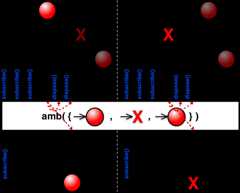
- Scheduler:
ambdoes not operate by default on a particularScheduler.
- Type Parameters:
T- the value type- Parameters:
sources- the Iterable sequence of sources. A subscription to each source will occur in the same order as in this Iterable.- Returns:
- the new Single instance
- Since:
- 2.0
ambArray
@CheckReturnValue@SchedulerSupport(value="none")public static <T> Single<T> ambArray(SingleSource<? extends T>... sources)
Runs multiple SingleSources and signals the events of the first one that signals (disposing the rest).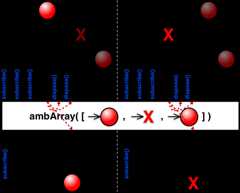
- Scheduler:
ambArraydoes not operate by default on a particularScheduler.
- Type Parameters:
T- the value type- Parameters:
sources- the array of sources. A subscription to each source will occur in the same order as in this array.- Returns:
- the new Single instance
- Since:
- 2.0
concat
@CheckReturnValue@NonNull@SchedulerSupport(value="none")@BackpressureSupport(value=FULL)public static <T> Flowable<T> concat(Iterable<? extendsSingleSource<? extends T>> sources)
Concatenate the single values, in a non-overlapping fashion, of the SingleSources provided by an Iterable sequence.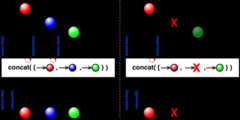
- Backpressure:
- The returned
Flowablehonors the backpressure of the downstream consumer. - Scheduler:
concatdoes not operate by default on a particularScheduler.
- Type Parameters:
T- the value type- Parameters:
sources- the Iterable sequence of SingleSource instances- Returns:
- the new Flowable instance
- Since:
- 2.0
concat
@CheckReturnValue@NonNull@SchedulerSupport(value="none")public static <T> Observable<T> concat(ObservableSource<? extendsSingleSource<? extends T>> sources)
Concatenate the single values, in a non-overlapping fashion, of the SingleSources provided by an Observable sequence.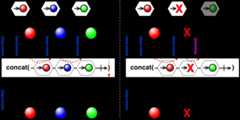
- Scheduler:
concatdoes not operate by default on a particularScheduler.
- Type Parameters:
T- the value type- Parameters:
sources- the ObservableSource of SingleSource instances- Returns:
- the new Observable instance
- Since:
- 2.0
concat
@CheckReturnValue@NonNull@BackpressureSupport(value=FULL)@SchedulerSupport(value="none")public static <T> Flowable<T> concat(Publisher<? extendsSingleSource<? extends T>> sources)
Concatenate the single values, in a non-overlapping fashion, of the SingleSources provided by a Publisher sequence.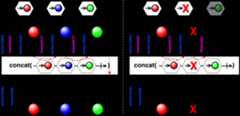
- Backpressure:
- The returned
Flowablehonors the backpressure of the downstream consumer and the sourcesPublisheris expected to honor it as well. - Scheduler:
concatdoes not operate by default on a particularScheduler.
- Type Parameters:
T- the value type- Parameters:
sources- the Publisher of SingleSource instances- Returns:
- the new Flowable instance
- Since:
- 2.0
concat
@CheckReturnValue@NonNull@BackpressureSupport(value=FULL)@SchedulerSupport(value="none")public static <T> Flowable<T> concat(Publisher<? extendsSingleSource<? extends T>> sources, int prefetch)
Concatenate the single values, in a non-overlapping fashion, of the SingleSources provided by a Publisher sequence and prefetched by the specified amount.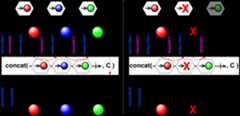
- Backpressure:
- The returned
Flowablehonors the backpressure of the downstream consumer and the sourcesPublisheris expected to honor it as well. - Scheduler:
concatdoes not operate by default on a particularScheduler.
- Type Parameters:
T- the value type- Parameters:
sources- the Publisher of SingleSource instancesprefetch- the number of SingleSources to prefetch from the Publisher- Returns:
- the new Flowable instance
- Since:
- 2.0
concat
@CheckReturnValue@NonNull@BackpressureSupport(value=FULL)@SchedulerSupport(value="none")public static <T> Flowable<T> concat(SingleSource<? extends T> source1,SingleSource<? extends T> source2)
Returns a Flowable that emits the items emitted by two Singles, one after the other.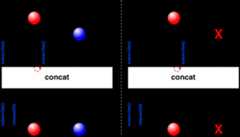
- Backpressure:
- The returned
Flowablehonors the backpressure of the downstream consumer. - Scheduler:
concatdoes not operate by default on a particularScheduler.
- Type Parameters:
T- the common value type- Parameters:
source1- a Single to be concatenatedsource2- a Single to be concatenated- Returns:
- a Flowable that emits items emitted by the two source Singles, one after the other.
- See Also:
- ReactiveX operators documentation: Concat
concat
@CheckReturnValue@NonNull@BackpressureSupport(value=FULL)@SchedulerSupport(value="none")public static <T> Flowable<T> concat(SingleSource<? extends T> source1,SingleSource<? extends T> source2,SingleSource<? extends T> source3)
Returns a Flowable that emits the items emitted by three Singles, one after the other.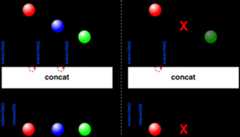
- Backpressure:
- The returned
Flowablehonors the backpressure of the downstream consumer. - Scheduler:
concatdoes not operate by default on a particularScheduler.
- Type Parameters:
T- the common value type- Parameters:
source1- a Single to be concatenatedsource2- a Single to be concatenatedsource3- a Single to be concatenated- Returns:
- a Flowable that emits items emitted by the three source Singles, one after the other.
- See Also:
- ReactiveX operators documentation: Concat
concat
@CheckReturnValue@NonNull@BackpressureSupport(value=FULL)@SchedulerSupport(value="none")public static <T> Flowable<T> concat(SingleSource<? extends T> source1,SingleSource<? extends T> source2,SingleSource<? extends T> source3,SingleSource<? extends T> source4)
Returns a Flowable that emits the items emitted by four Singles, one after the other.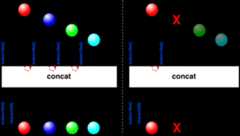
- Backpressure:
- The returned
Flowablehonors the backpressure of the downstream consumer. - Scheduler:
concatdoes not operate by default on a particularScheduler.
- Type Parameters:
T- the common value type- Parameters:
source1- a Single to be concatenatedsource2- a Single to be concatenatedsource3- a Single to be concatenatedsource4- a Single to be concatenated- Returns:
- a Flowable that emits items emitted by the four source Singles, one after the other.
- See Also:
- ReactiveX operators documentation: Concat
concatArray
@CheckReturnValue@NonNull@BackpressureSupport(value=FULL)@SchedulerSupport(value="none")public static <T> Flowable<T> concatArray(SingleSource<? extends T>... sources)
Concatenate the single values, in a non-overlapping fashion, of the SingleSources provided in an array.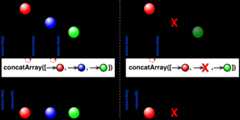
- Backpressure:
- The returned
Flowablehonors the backpressure of the downstream consumer. - Scheduler:
concatArraydoes not operate by default on a particularScheduler.
- Type Parameters:
T- the value type- Parameters:
sources- the array of SingleSource instances- Returns:
- the new Flowable instance
- Since:
- 2.0
concatArrayEager
@BackpressureSupport(value=FULL)@CheckReturnValue@NonNull@SchedulerSupport(value="none")public static <T> Flowable<T> concatArrayEager(SingleSource<? extends T>... sources)
Concatenates a sequence of SingleSource eagerly into a single stream of values.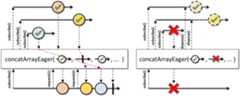
Eager concatenation means that once a subscriber subscribes, this operator subscribes to all of the source SingleSources. The operator buffers the value emitted by these SingleSources and then drains them in order, each one after the previous one completes.
- Backpressure:
- The operator honors backpressure from downstream.
- Scheduler:
- This method does not operate by default on a particular
Scheduler.
- Type Parameters:
T- the value type- Parameters:
sources- a sequence of Single that need to be eagerly concatenated- Returns:
- the new Flowable instance with the specified concatenation behavior
concatEager
@BackpressureSupport(value=FULL)@CheckReturnValue@NonNull@SchedulerSupport(value="none")public static <T> Flowable<T> concatEager(Publisher<? extendsSingleSource<? extends T>> sources)
Concatenates a Publisher sequence of SingleSources eagerly into a single stream of values.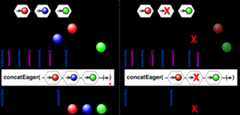
Eager concatenation means that once a subscriber subscribes, this operator subscribes to all of the emitted source Publishers as they are observed. The operator buffers the values emitted by these Publishers and then drains them in order, each one after the previous one completes.
- Backpressure:
- Backpressure is honored towards the downstream and the outer Publisher is expected to support backpressure. Violating this assumption, the operator will signal
MissingBackpressureException. - Scheduler:
- This method does not operate by default on a particular
Scheduler.
- Type Parameters:
T- the value type- Parameters:
sources- a sequence of Publishers that need to be eagerly concatenated- Returns:
- the new Publisher instance with the specified concatenation behavior
concatEager
@BackpressureSupport(value=FULL)@CheckReturnValue@NonNull@SchedulerSupport(value="none")public static <T> Flowable<T> concatEager(Iterable<? extendsSingleSource<? extends T>> sources)
Concatenates a sequence of SingleSources eagerly into a single stream of values.
Eager concatenation means that once a subscriber subscribes, this operator subscribes to all of the source SingleSources. The operator buffers the values emitted by these SingleSources and then drains them in order, each one after the previous one completes.
- Backpressure:
- Backpressure is honored towards the downstream.
- Scheduler:
- This method does not operate by default on a particular
Scheduler.
- Type Parameters:
T- the value type- Parameters:
sources- a sequence of SingleSource that need to be eagerly concatenated- Returns:
- the new Flowable instance with the specified concatenation behavior
create
@CheckReturnValue@NonNull@SchedulerSupport(value="none")public static <T> Single<T> create(SingleOnSubscribe<T> source)
Provides an API (via a cold Single) that bridges the reactive world with the callback-style world.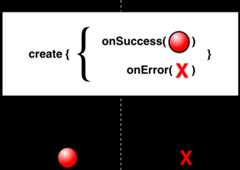
Example:
Single.<Event>create(emitter -> { Callback listener = new Callback() { @Override public void onEvent(Event e) { emitter.onSuccess(e); } @Override public void onFailure(Exception e) { emitter.onError(e); } }; AutoCloseable c = api.someMethod(listener); emitter.setCancellable(c::close); });- Scheduler:
createdoes not operate by default on a particularScheduler.
- Type Parameters:
T- the value type- Parameters:
source- the emitter that is called when a SingleObserver subscribes to the returnedSingle- Returns:
- the new Single instance
- See Also:
SingleOnSubscribe,Cancellable
defer
@CheckReturnValue@NonNull@SchedulerSupport(value="none")public static <T> Single<T> defer(Callable<? extendsSingleSource<? extends T>> singleSupplier)
Calls aCallablefor each individualSingleObserverto return the actualSingleSourceto be subscribed to.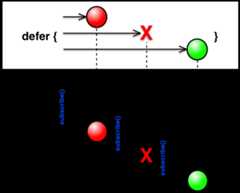
- Scheduler:
deferdoes not operate by default on a particularScheduler.
- Type Parameters:
T- the value type- Parameters:
singleSupplier- theCallablethat is called for each individualSingleObserverand returns a SingleSource instance to subscribe to- Returns:
- the new Single instance
error
@CheckReturnValue@NonNull@SchedulerSupport(value="none")public static <T> Single<T> error(Callable<? extendsThrowable> errorSupplier)
Signals a Throwable returned by the callback function for each individual SingleObserver.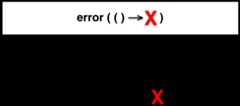
- Scheduler:
errordoes not operate by default on a particularScheduler.
- Type Parameters:
T- the value type- Parameters:
errorSupplier- the callable that is called for each individual SingleObserver and returns a Throwable instance to be emitted.- Returns:
- the new Single instance
error
@CheckReturnValue@NonNull@SchedulerSupport(value="none")public static <T> Single<T> error(Throwable exception)
Returns a Single that invokes a subscriber'sonErrormethod when the subscriber subscribes to it.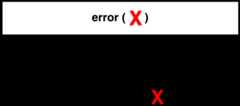
- Scheduler:
errordoes not operate by default on a particularScheduler.
- Type Parameters:
T- the type of the item (ostensibly) emitted by the Single- Parameters:
exception- the particular Throwable to pass toonError- Returns:
- a Single that invokes the subscriber's
onErrormethod when the subscriber subscribes to it - See Also:
- ReactiveX operators documentation: Throw
fromCallable
@CheckReturnValue@NonNull@SchedulerSupport(value="none")public static <T> Single<T> fromCallable(Callable<? extends T> callable)
Returns aSinglethat invokes passed function and emits its result for each new SingleObserver that subscribes.Allows you to defer execution of passed function until SingleObserver subscribes to the
Single. It makes passed function "lazy". Result of the function invocation will be emitted by theSingle.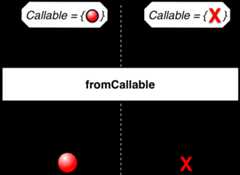
- Scheduler:
fromCallabledoes not operate by default on a particularScheduler.- Error handling:
- If the
Callablethrows an exception, the respectiveThrowableis delivered to the downstream viaSingleObserver.onError(Throwable), except when the downstream has disposed thisSinglesource. In this latter case, theThrowableis delivered to the global error handler viaRxJavaPlugins.onError(Throwable)as anUndeliverableException.
- Type Parameters:
T- the type of the item emitted by theSingle.- Parameters:
callable- function which execution should be deferred, it will be invoked when SingleObserver will subscribe to theSingle.- Returns:
- a
SinglewhoseSingleObservers' subscriptions trigger an invocation of the given function.
fromFuture
@CheckReturnValue@SchedulerSupport(value="none")public static <T> Single<T> fromFuture(Future<? extends T> future)
Converts aFutureinto aSingle.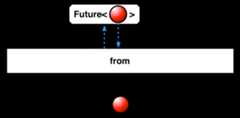
You can convert any object that supports the
Futureinterface into a Single that emits the return value of theFuture.get()method of that object, by passing the object into thefrommethod.Important note: This Single is blocking; you cannot dispose it.
- Scheduler:
fromFuturedoes not operate by default on a particularScheduler.
- Type Parameters:
T- the type of object that theFuturereturns, and also the type of item to be emitted by the resultingSingle- Parameters:
future- the sourceFuture- Returns:
- a
Singlethat emits the item from the sourceFuture - See Also:
- ReactiveX operators documentation: From
fromFuture
@CheckReturnValue@SchedulerSupport(value="none")public static <T> Single<T> fromFuture(Future<? extends T> future, long timeout,TimeUnit unit)
Converts aFutureinto aSingle, with a timeout on the Future.You can convert any object that supports the
Futureinterface into aSinglethat emits the return value of theFuture.get()method of that object, by passing the object into thefrommethod.Important note: This
Singleis blocking; you cannot dispose it.- Scheduler:
fromFuturedoes not operate by default on a particularScheduler.
- Type Parameters:
T- the type of object that theFuturereturns, and also the type of item to be emitted by the resultingSingle- Parameters:
future- the sourceFuturetimeout- the maximum time to wait before callinggetunit- theTimeUnitof thetimeoutargument- Returns:
- a
Singlethat emits the item from the sourceFuture - See Also:
- ReactiveX operators documentation: From
fromFuture
@CheckReturnValue@SchedulerSupport(value="custom")public static <T> Single<T> fromFuture(Future<? extends T> future, long timeout,TimeUnit unit,Scheduler scheduler)
Converts aFutureinto aSingle, with a timeout on the Future.You can convert any object that supports the
Futureinterface into aSinglethat emits the return value of theFuture.get()method of that object, by passing the object into thefrommethod.Important note: This
Singleis blocking; you cannot dispose it.- Scheduler:
- You specify the
Schedulerwhere the blocking wait will happen.
- Type Parameters:
T- the type of object that theFuturereturns, and also the type of item to be emitted by the resultingSingle- Parameters:
future- the sourceFuturetimeout- the maximum time to wait before callinggetunit- theTimeUnitof thetimeoutargumentscheduler- the Scheduler to use for the blocking wait- Returns:
- a
Singlethat emits the item from the sourceFuture - See Also:
- ReactiveX operators documentation: From
fromFuture
@CheckReturnValue@SchedulerSupport(value="custom")public static <T> Single<T> fromFuture(Future<? extends T> future,Scheduler scheduler)
Converts aFuture, operating on a specifiedScheduler, into aSingle.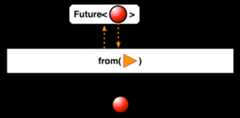
You can convert any object that supports the
Futureinterface into aSinglethat emits the return value of theFuture.get()method of that object, by passing the object into thefrommethod.- Scheduler:
- You specify which
Schedulerthis operator will use.
- Type Parameters:
T- the type of object that theFuturereturns, and also the type of item to be emitted by the resultingSingle- Parameters:
future- the sourceFuturescheduler- theSchedulerto wait for the Future on. Use a Scheduler such asSchedulers.io()that can block and wait on the Future- Returns:
- a
Singlethat emits the item from the sourceFuture - See Also:
- ReactiveX operators documentation: From
fromPublisher
@BackpressureSupport(value=UNBOUNDED_IN)@CheckReturnValue@NonNull@SchedulerSupport(value="none")public static <T> Single<T> fromPublisher(Publisher<? extends T> publisher)
Wraps a specific Publisher into a Single and signals its single element or error.If the source Publisher is empty, a NoSuchElementException is signalled. If the source has more than one element, an IndexOutOfBoundsException is signalled.
The
Publishermust follow theReactive Streams specification. Violating the specification may result in undefined behavior.If possible, use
create(SingleOnSubscribe)to create a source-likeSingleinstead.Note that even though
Publisherappears to be a functional interface, it is not recommended to implement it through a lambda as the specification requires state management that is not achievable with a stateless lambda.
- Backpressure:
- The
publisheris consumed in an unbounded fashion but will be cancelled if it produced more than one item. - Scheduler:
fromPublisherdoes not operate by default on a particularScheduler.
- Type Parameters:
T- the value type- Parameters:
publisher- the source Publisher instance, not null- Returns:
- the new Single instance
- See Also:
create(SingleOnSubscribe)
fromObservable
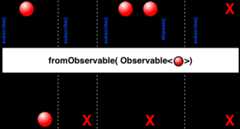
@CheckReturnValue@NonNull@SchedulerSupport(value="none")public static <T> Single<T> fromObservable(ObservableSource<? extends T> observableSource)
Wraps a specific ObservableSource into a Single and signals its single element or error.If the ObservableSource is empty, a NoSuchElementException is signalled. If the source has more than one element, an IndexOutOfBoundsException is signalled.
- Scheduler:
fromObservabledoes not operate by default on a particularScheduler.
- Type Parameters:
T- the type of the item emitted by theSingle.- Parameters:
observableSource- the source Observable, not null- Returns:
- the new Single instance
just
@CheckReturnValue@SchedulerSupport(value="none")@NonNullpublic static <T> Single<T> just(T item)
Returns aSinglethat emits a specified item.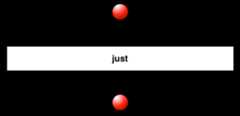
To convert any object into a
Singlethat emits that object, pass that object into thejustmethod.- Scheduler:
justdoes not operate by default on a particularScheduler.
- Type Parameters:
T- the type of that item- Parameters:
item- the item to emit- Returns:
- a
Singlethat emitsitem - See Also:
- ReactiveX operators documentation: Just
merge
@CheckReturnValue@NonNull@BackpressureSupport(value=FULL)@SchedulerSupport(value="none")public static <T> Flowable<T> merge(Iterable<? extendsSingleSource<? extends T>> sources)
Merges an Iterable sequence of SingleSource instances into a single Flowable sequence, running all SingleSources at once.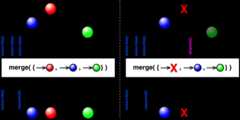
- Backpressure:
- The returned
Flowablehonors the backpressure of the downstream consumer. - Scheduler:
mergedoes not operate by default on a particularScheduler.- Error handling:
- If any of the source
SingleSources signal aThrowableviaonError, the resultingFlowableterminates with thatThrowableand all other sourceSingleSources are disposed. If more than oneSingleSourcesignals an error, the resultingFlowablemay terminate with the first one's error or, depending on the concurrency of the sources, may terminate with aCompositeExceptioncontaining two or more of the various error signals.Throwables that didn't make into the composite will be sent (individually) to the global error handler viaRxJavaPlugins.onError(Throwable)method asUndeliverableExceptionerrors. Similarly,Throwables signaled by source(s) after the returnedFlowablehas been cancelled or terminated with a (composite) error will be sent to the same global error handler. UsemergeDelayError(Iterable)to merge sources and terminate only when all sourceSingleSources have completed or failed with an error.
- Type Parameters:
T- the common and resulting value type- Parameters:
sources- the Iterable sequence of SingleSource sources- Returns:
- the new Flowable instance
- Since:
- 2.0
- See Also:
mergeDelayError(Iterable)
merge
@CheckReturnValue@NonNull@BackpressureSupport(value=FULL)@SchedulerSupport(value="none")public static <T> Flowable<T> merge(Publisher<? extendsSingleSource<? extends T>> sources)
Merges a Flowable sequence of SingleSource instances into a single Flowable sequence, running all SingleSources at once.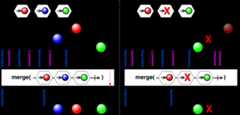
- Backpressure:
- The returned
Flowablehonors the backpressure of the downstream consumer. - Scheduler:
mergedoes not operate by default on a particularScheduler.- Error handling:
- If any of the source
SingleSources signal aThrowableviaonError, the resultingFlowableterminates with thatThrowableand all other sourceSingleSources are disposed. If more than oneSingleSourcesignals an error, the resultingFlowablemay terminate with the first one's error or, depending on the concurrency of the sources, may terminate with aCompositeExceptioncontaining two or more of the various error signals.Throwables that didn't make into the composite will be sent (individually) to the global error handler viaRxJavaPlugins.onError(Throwable)method asUndeliverableExceptionerrors. Similarly,Throwables signaled by source(s) after the returnedFlowablehas been cancelled or terminated with a (composite) error will be sent to the same global error handler. UsemergeDelayError(Publisher)to merge sources and terminate only when all sourceSingleSources have completed or failed with an error.
- Type Parameters:
T- the common and resulting value type- Parameters:
sources- the Flowable sequence of SingleSource sources- Returns:
- the new Flowable instance
- Since:
- 2.0
- See Also:
mergeDelayError(Publisher)
merge
@CheckReturnValue@NonNull@SchedulerSupport(value="none")public static <T> Single<T> merge(SingleSource<? extendsSingleSource<? extends T>> source)
Flattens aSinglethat emits aSingleinto a singleSinglethat emits the item emitted by the nestedSingle, without any transformation.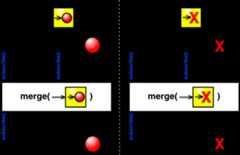
- Scheduler:
mergedoes not operate by default on a particularScheduler.- The resulting
Singleemits the outer source's or the innerSingleSource'sThrowableas is. Unlike the othermerge()operators, this operator won't and can't produce aCompositeExceptionbecause there is only one possibility for the outer or the innerSingleSourceto emit anonErrorsignal. Therefore, there is no need for amergeDelayError(SingleSource<SingleSource<T>>)operator.
- Type Parameters:
T- the value type of the sources and the output- Parameters:
source- aSinglethat emits aSingle- Returns:
- a
Singlethat emits the item that is the result of flattening theSingleemitted bysource - See Also:
- ReactiveX operators documentation: Merge
merge
@CheckReturnValue@NonNull@BackpressureSupport(value=FULL)@SchedulerSupport(value="none")public static <T> Flowable<T> merge(SingleSource<? extends T> source1,SingleSource<? extends T> source2)
Flattens two Singles into a single Flowable, without any transformation.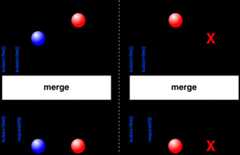
You can combine items emitted by multiple Singles so that they appear as a single Flowable, by using the
mergemethod.- Backpressure:
- The returned
Flowablehonors the backpressure of the downstream consumer. - Scheduler:
mergedoes not operate by default on a particularScheduler.- Error handling:
- If any of the source
SingleSources signal aThrowableviaonError, the resultingFlowableterminates with thatThrowableand all other sourceSingleSources are disposed. If more than oneSingleSourcesignals an error, the resultingFlowablemay terminate with the first one's error or, depending on the concurrency of the sources, may terminate with aCompositeExceptioncontaining two or more of the various error signals.Throwables that didn't make into the composite will be sent (individually) to the global error handler viaRxJavaPlugins.onError(Throwable)method asUndeliverableExceptionerrors. Similarly,Throwables signaled by source(s) after the returnedFlowablehas been cancelled or terminated with a (composite) error will be sent to the same global error handler. UsemergeDelayError(SingleSource, SingleSource)to merge sources and terminate only when all sourceSingleSources have completed or failed with an error.
- Type Parameters:
T- the common value type- Parameters:
source1- a SingleSource to be mergedsource2- a SingleSource to be merged- Returns:
- a Flowable that emits all of the items emitted by the source Singles
- See Also:
- ReactiveX operators documentation: Merge,
mergeDelayError(SingleSource, SingleSource)
merge
@CheckReturnValue@NonNull@BackpressureSupport(value=FULL)@SchedulerSupport(value="none")public static <T> Flowable<T> merge(SingleSource<? extends T> source1,SingleSource<? extends T> source2,SingleSource<? extends T> source3)
Flattens three Singles into a single Flowable, without any transformation.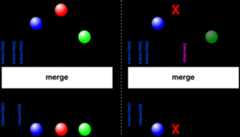
You can combine items emitted by multiple Singles so that they appear as a single Flowable, by using the
mergemethod.- Backpressure:
- The returned
Flowablehonors the backpressure of the downstream consumer. - Scheduler:
mergedoes not operate by default on a particularScheduler.- Error handling:
- If any of the source
SingleSources signal aThrowableviaonError, the resultingFlowableterminates with thatThrowableand all other sourceSingleSources are disposed. If more than oneSingleSourcesignals an error, the resultingFlowablemay terminate with the first one's error or, depending on the concurrency of the sources, may terminate with aCompositeExceptioncontaining two or more of the various error signals.Throwables that didn't make into the composite will be sent (individually) to the global error handler viaRxJavaPlugins.onError(Throwable)method asUndeliverableExceptionerrors. Similarly,Throwables signaled by source(s) after the returnedFlowablehas been cancelled or terminated with a (composite) error will be sent to the same global error handler. UsemergeDelayError(SingleSource, SingleSource, SingleSource)to merge sources and terminate only when all sourceSingleSources have completed or failed with an error.
- Type Parameters:
T- the common value type- Parameters:
source1- a SingleSource to be mergedsource2- a SingleSource to be mergedsource3- a SingleSource to be merged- Returns:
- a Flowable that emits all of the items emitted by the source Singles
- See Also:
- ReactiveX operators documentation: Merge,
mergeDelayError(SingleSource, SingleSource, SingleSource)
merge
@CheckReturnValue@NonNull@BackpressureSupport(value=FULL)@SchedulerSupport(value="none")public static <T> Flowable<T> merge(SingleSource<? extends T> source1,SingleSource<? extends T> source2,SingleSource<? extends T> source3,SingleSource<? extends T> source4)
Flattens four Singles into a single Flowable, without any transformation.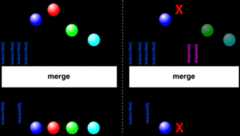
You can combine items emitted by multiple Singles so that they appear as a single Flowable, by using the
mergemethod.- Backpressure:
- The returned
Flowablehonors the backpressure of the downstream consumer. - Scheduler:
mergedoes not operate by default on a particularScheduler.- Error handling:
- If any of the source
SingleSources signal aThrowableviaonError, the resultingFlowableterminates with thatThrowableand all other sourceSingleSources are disposed. If more than oneSingleSourcesignals an error, the resultingFlowablemay terminate with the first one's error or, depending on the concurrency of the sources, may terminate with aCompositeExceptioncontaining two or more of the various error signals.Throwables that didn't make into the composite will be sent (individually) to the global error handler viaRxJavaPlugins.onError(Throwable)method asUndeliverableExceptionerrors. Similarly,Throwables signaled by source(s) after the returnedFlowablehas been cancelled or terminated with a (composite) error will be sent to the same global error handler. UsemergeDelayError(SingleSource, SingleSource, SingleSource, SingleSource)to merge sources and terminate only when all sourceSingleSources have completed or failed with an error.
- Type Parameters:
T- the common value type- Parameters:
source1- a SingleSource to be mergedsource2- a SingleSource to be mergedsource3- a SingleSource to be mergedsource4- a SingleSource to be merged- Returns:
- a Flowable that emits all of the items emitted by the source Singles
- See Also:
- ReactiveX operators documentation: Merge,
mergeDelayError(SingleSource, SingleSource, SingleSource, SingleSource)
mergeDelayError
@CheckReturnValue@NonNull@BackpressureSupport(value=FULL)@SchedulerSupport(value="none")public static <T> Flowable<T> mergeDelayError(Iterable<? extendsSingleSource<? extends T>> sources)
Merges an Iterable sequence of SingleSource instances into a single Flowable sequence, running all SingleSources at once and delaying any error(s) until all sources succeed or fail.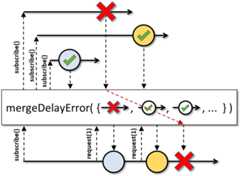
- Backpressure:
- The returned
Flowablehonors the backpressure of the downstream consumer. - Scheduler:
mergeDelayErrordoes not operate by default on a particularScheduler.
History: 2.1.9 - experimental
- Type Parameters:
T- the common and resulting value type- Parameters:
sources- the Iterable sequence of SingleSource sources- Returns:
- the new Flowable instance
- Since:
- 2.2
- See Also:
merge(Iterable)
mergeDelayError
@CheckReturnValue@NonNull@BackpressureSupport(value=FULL)@SchedulerSupport(value="none")public static <T> Flowable<T> mergeDelayError(Publisher<? extendsSingleSource<? extends T>> sources)
Merges a Flowable sequence of SingleSource instances into a single Flowable sequence, running all SingleSources at once and delaying any error(s) until all sources succeed or fail.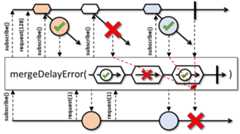
- Backpressure:
- The returned
Flowablehonors the backpressure of the downstream consumer. - Scheduler:
mergeDelayErrordoes not operate by default on a particularScheduler.
History: 2.1.9 - experimental
- Type Parameters:
T- the common and resulting value type- Parameters:
sources- the Flowable sequence of SingleSource sources- Returns:
- the new Flowable instance
- Since:
- 2.2
- See Also:
merge(Publisher)
mergeDelayError
@CheckReturnValue@NonNull@BackpressureSupport(value=FULL)@SchedulerSupport(value="none")public static <T> Flowable<T> mergeDelayError(SingleSource<? extends T> source1,SingleSource<? extends T> source2)
Flattens two Singles into a single Flowable, without any transformation, delaying any error(s) until all sources succeed or fail.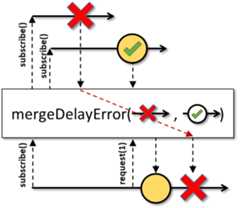
You can combine items emitted by multiple Singles so that they appear as a single Flowable, by using the
mergeDelayErrormethod.- Backpressure:
- The returned
Flowablehonors the backpressure of the downstream consumer. - Scheduler:
mergeDelayErrordoes not operate by default on a particularScheduler.
History: 2.1.9 - experimental
- Type Parameters:
T- the common value type- Parameters:
source1- a SingleSource to be mergedsource2- a SingleSource to be merged- Returns:
- a Flowable that emits all of the items emitted by the source Singles
- Since:
- 2.2
- See Also:
- ReactiveX operators documentation: Merge,
merge(SingleSource, SingleSource)
mergeDelayError
@CheckReturnValue@NonNull@BackpressureSupport(value=FULL)@SchedulerSupport(value="none")public static <T> Flowable<T> mergeDelayError(SingleSource<? extends T> source1,SingleSource<? extends T> source2,SingleSource<? extends T> source3)
Flattens three Singles into a single Flowable, without any transformation, delaying any error(s) until all sources succeed or fail.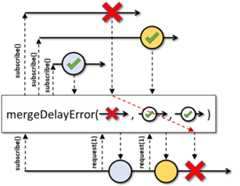
You can combine items emitted by multiple Singles so that they appear as a single Flowable, by using the
mergeDelayErrormethod.- Backpressure:
- The returned
Flowablehonors the backpressure of the downstream consumer. - Scheduler:
mergeDelayErrordoes not operate by default on a particularScheduler.
History: 2.1.9 - experimental
- Type Parameters:
T- the common value type- Parameters:
source1- a SingleSource to be mergedsource2- a SingleSource to be mergedsource3- a SingleSource to be merged- Returns:
- a Flowable that emits all of the items emitted by the source Singles
- Since:
- 2.2
- See Also:
- ReactiveX operators documentation: Merge,
merge(SingleSource, SingleSource, SingleSource)
mergeDelayError
@CheckReturnValue@NonNull@BackpressureSupport(value=FULL)@SchedulerSupport(value="none")public static <T> Flowable<T> mergeDelayError(SingleSource<? extends T> source1,SingleSource<? extends T> source2,SingleSource<? extends T> source3,SingleSource<? extends T> source4)
Flattens four Singles into a single Flowable, without any transformation, delaying any error(s) until all sources succeed or fail.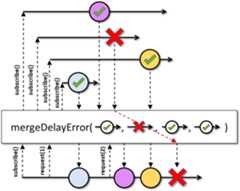
You can combine items emitted by multiple Singles so that they appear as a single Flowable, by using the
mergeDelayErrormethod.- Backpressure:
- The returned
Flowablehonors the backpressure of the downstream consumer. - Scheduler:
mergeDelayErrordoes not operate by default on a particularScheduler.
History: 2.1.9 - experimental
- Type Parameters:
T- the common value type- Parameters:
source1- a SingleSource to be mergedsource2- a SingleSource to be mergedsource3- a SingleSource to be mergedsource4- a SingleSource to be merged- Returns:
- a Flowable that emits all of the items emitted by the source Singles
- Since:
- 2.2
- See Also:
- ReactiveX operators documentation: Merge,
merge(SingleSource, SingleSource, SingleSource, SingleSource)
never
@CheckReturnValue@SchedulerSupport(value="none")public static <T> Single<T> never()
Returns a singleton instance of a never-signalling Single (only calls onSubscribe).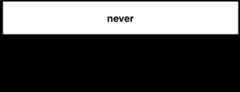
- Scheduler:
neverdoes not operate by default on a particularScheduler.
- Type Parameters:
T- the target value type- Returns:
- the singleton never instance
- Since:
- 2.0
timer
@CheckReturnValue@SchedulerSupport(value="io.reactivex:computation")public static Single<Long> timer(long delay,TimeUnit unit)
Signals success with 0L value after the given delay for each SingleObserver.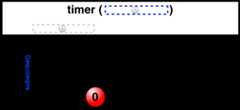
- Scheduler:
timeroperates by default on thecomputationScheduler.
- Parameters:
delay- the delay amountunit- the time unit of the delay- Returns:
- the new Single instance
- Since:
- 2.0
timer
@CheckReturnValue@NonNull@SchedulerSupport(value="custom")public static Single<Long> timer(long delay,TimeUnit unit,Scheduler scheduler)
Signals success with 0L value after the given delay for each SingleObserver.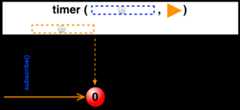
- Scheduler:
- you specify the
Schedulerto signal on.
- Parameters:
delay- the delay amountunit- the time unit of the delayscheduler- the scheduler where the single 0L will be emitted- Returns:
- the new Single instance
- Throws:
NullPointerException- if unit is null, or if scheduler is null- Since:
- 2.0
equals
@CheckReturnValue@NonNull@SchedulerSupport(value="none")public static <T> Single<Boolean> equals(SingleSource<? extends T> first,SingleSource<? extends T> second)
Compares two SingleSources and emits true if they emit the same value (compared via Object.equals).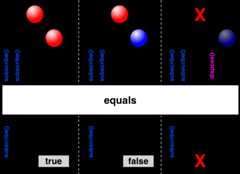
- Scheduler:
equalsdoes not operate by default on a particularScheduler.
- Type Parameters:
T- the common value type- Parameters:
first- the first SingleSource instancesecond- the second SingleSource instance- Returns:
- the new Single instance
- Since:
- 2.0
unsafeCreate
@CheckReturnValue@NonNull@SchedulerSupport(value="none")public static <T> Single<T> unsafeCreate(SingleSource<T> onSubscribe)
Advanced use only: creates a Single instance without any safeguards by using a callback that is called with a SingleObserver.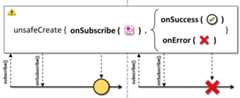
- Scheduler:
unsafeCreatedoes not operate by default on a particularScheduler.
- Type Parameters:
T- the value type- Parameters:
onSubscribe- the function that is called with the subscribing SingleObserver- Returns:
- the new Single instance
- Throws:
IllegalArgumentException- ifsourceis a subclass ofSingle; such instances don't need conversion and is possibly a port remnant from 1.x or one should usehide()instead.- Since:
- 2.0
using
@CheckReturnValue@SchedulerSupport(value="none")public static <T,U> Single<T> using(Callable<U> resourceSupplier,Function<? super U,? extendsSingleSource<? extends T>> singleFunction,Consumer<? super U> disposer)
Allows using and disposing a resource while running a SingleSource instance generated from that resource (similar to a try-with-resources).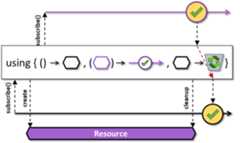
- Scheduler:
usingdoes not operate by default on a particularScheduler.
- Type Parameters:
T- the value type of the SingleSource generatedU- the resource type- Parameters:
resourceSupplier- the Callable called for each SingleObserver to generate a resource ObjectsingleFunction- the function called with the returned resource Object fromresourceSupplierand should return a SingleSource instance to be run by the operatordisposer- the consumer of the generated resource that is called exactly once for that particular resource when the generated SingleSource terminates (successfully or with an error) or gets disposed.- Returns:
- the new Single instance
- Since:
- 2.0
using
@CheckReturnValue@NonNull@SchedulerSupport(value="none")public static <T,U> Single<T> using(Callable<U> resourceSupplier,Function<? super U,? extendsSingleSource<? extends T>> singleFunction,Consumer<? super U> disposer, boolean eager)
Allows using and disposing a resource while running a SingleSource instance generated from that resource (similar to a try-with-resources).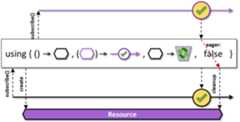
- Scheduler:
usingdoes not operate by default on a particularScheduler.
- Type Parameters:
T- the value type of the SingleSource generatedU- the resource type- Parameters:
resourceSupplier- the Callable called for each SingleObserver to generate a resource ObjectsingleFunction- the function called with the returned resource Object fromresourceSupplierand should return a SingleSource instance to be run by the operatordisposer- the consumer of the generated resource that is called exactly once for that particular resource when the generated SingleSource terminates (successfully or with an error) or gets disposed.eager- if true, the disposer is called before the terminal event is signalled if false, the disposer is called after the terminal event is delivered to downstream- Returns:
- the new Single instance
- Since:
- 2.0
wrap
@CheckReturnValue@NonNull@SchedulerSupport(value="none")public static <T> Single<T> wrap(SingleSource<T> source)
Wraps a SingleSource instance into a new Single instance if not already a Single instance.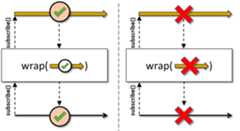
- Scheduler:
wrapdoes not operate by default on a particularScheduler.
- Type Parameters:
T- the value type- Parameters:
source- the source to wrap- Returns:
- the Single wrapper or the source cast to Single (if possible)
zip
@CheckReturnValue@NonNull@SchedulerSupport(value="none")public static <T,R> Single<R> zip(Iterable<? extendsSingleSource<? extends T>> sources,Function<? superObject[],? extends R> zipper)
Waits until all SingleSource sources provided by the Iterable sequence signal a success value and calls a zipper function with an array of these values to return a result to be emitted to downstream.If the
IterableofSingleSources is empty aNoSuchElementExceptionerror is signalled after subscription.Note on method signature: since Java doesn't allow creating a generic array with
new T[], the implementation of this operator has to create anObject[]instead. Unfortunately, aFunction<Integer[], R>passed to the method would trigger aClassCastException.
If any of the SingleSources signal an error, all other SingleSources get disposed and the error emitted to downstream immediately.
- Scheduler:
zipdoes not operate by default on a particularScheduler.
- Type Parameters:
T- the common value typeR- the result value type- Parameters:
sources- the Iterable sequence of SingleSource instances. An empty sequence will result in anonErrorsignal ofNoSuchElementException.zipper- the function that receives an array with values from each SingleSource and should return a value to be emitted to downstream- Returns:
- the new Single instance
- Since:
- 2.0
zip
@CheckReturnValue@NonNull@SchedulerSupport(value="none")public static <T1,T2,R> Single<R> zip(SingleSource<? extends T1> source1,SingleSource<? extends T2> source2,BiFunction<? super T1,? super T2,? extends R> zipper)
Returns a Single that emits the results of a specified combiner function applied to two items emitted by two other Singles.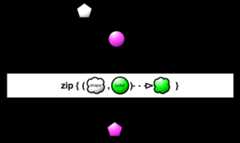
- Scheduler:
zipdoes not operate by default on a particularScheduler.
- Type Parameters:
T1- the first source Single's value typeT2- the second source Single's value typeR- the result value type- Parameters:
source1- the first source Singlesource2- a second source Singlezipper- a function that, when applied to the item emitted by each of the source Singles, results in an item that will be emitted by the resulting Single- Returns:
- a Single that emits the zipped results
- See Also:
- ReactiveX operators documentation: Zip
zip
@CheckReturnValue@NonNull@SchedulerSupport(value="none")public static <T1,T2,T3,R> Single<R> zip(SingleSource<? extends T1> source1,SingleSource<? extends T2> source2,SingleSource<? extends T3> source3,Function3<? super T1,? super T2,? super T3,? extends R> zipper)
Returns a Single that emits the results of a specified combiner function applied to three items emitted by three other Singles.- Scheduler:
zipdoes not operate by default on a particularScheduler.
- Type Parameters:
T1- the first source Single's value typeT2- the second source Single's value typeT3- the third source Single's value typeR- the result value type- Parameters:
source1- the first source Singlesource2- a second source Singlesource3- a third source Singlezipper- a function that, when applied to the item emitted by each of the source Singles, results in an item that will be emitted by the resulting Single- Returns:
- a Single that emits the zipped results
- See Also:
- ReactiveX operators documentation: Zip
zip
@CheckReturnValue@NonNull@SchedulerSupport(value="none")public static <T1,T2,T3,T4,R> Single<R> zip(SingleSource<? extends T1> source1,SingleSource<? extends T2> source2,SingleSource<? extends T3> source3,SingleSource<? extends T4> source4,Function4<? super T1,? super T2,? super T3,? super T4,? extends R> zipper)
Returns a Single that emits the results of a specified combiner function applied to four items emitted by four other Singles.- Scheduler:
zipdoes not operate by default on a particularScheduler.
- Type Parameters:
T1- the first source Single's value typeT2- the second source Single's value typeT3- the third source Single's value typeT4- the fourth source Single's value typeR- the result value type- Parameters:
source1- the first source Singlesource2- a second source Singlesource3- a third source Singlesource4- a fourth source Singlezipper- a function that, when applied to the item emitted by each of the source Singles, results in an item that will be emitted by the resulting Single- Returns:
- a Single that emits the zipped results
- See Also:
- ReactiveX operators documentation: Zip
zip
@CheckReturnValue@NonNull@SchedulerSupport(value="none")public static <T1,T2,T3,T4,T5,R> Single<R> zip(SingleSource<? extends T1> source1,SingleSource<? extends T2> source2,SingleSource<? extends T3> source3,SingleSource<? extends T4> source4,SingleSource<? extends T5> source5,Function5<? super T1,? super T2,? super T3,? super T4,? super T5,? extends R> zipper)
Returns a Single that emits the results of a specified combiner function applied to five items emitted by five other Singles.- Scheduler:
zipdoes not operate by default on a particularScheduler.
- Type Parameters:
T1- the first source Single's value typeT2- the second source Single's value typeT3- the third source Single's value typeT4- the fourth source Single's value typeT5- the fifth source Single's value typeR- the result value type- Parameters:
source1- the first source Singlesource2- a second source Singlesource3- a third source Singlesource4- a fourth source Singlesource5- a fifth source Singlezipper- a function that, when applied to the item emitted by each of the source Singles, results in an item that will be emitted by the resulting Single- Returns:
- a Single that emits the zipped results
- See Also:
- ReactiveX operators documentation: Zip
zip
@CheckReturnValue@NonNull@SchedulerSupport(value="none")public static <T1,T2,T3,T4,T5,T6,R> Single<R> zip(SingleSource<? extends T1> source1,SingleSource<? extends T2> source2,SingleSource<? extends T3> source3,SingleSource<? extends T4> source4,SingleSource<? extends T5> source5,SingleSource<? extends T6> source6,Function6<? super T1,? super T2,? super T3,? super T4,? super T5,? super T6,? extends R> zipper)
Returns a Single that emits the results of a specified combiner function applied to six items emitted by six other Singles.- Scheduler:
zipdoes not operate by default on a particularScheduler.
- Type Parameters:
T1- the first source Single's value typeT2- the second source Single's value typeT3- the third source Single's value typeT4- the fourth source Single's value typeT5- the fifth source Single's value typeT6- the sixth source Single's value typeR- the result value type- Parameters:
source1- the first source Singlesource2- a second source Singlesource3- a third source Singlesource4- a fourth source Singlesource5- a fifth source Singlesource6- a sixth source Singlezipper- a function that, when applied to the item emitted by each of the source Singles, results in an item that will be emitted by the resulting Single- Returns:
- a Single that emits the zipped results
- See Also:
- ReactiveX operators documentation: Zip
zip
@CheckReturnValue@NonNull@SchedulerSupport(value="none")public static <T1,T2,T3,T4,T5,T6,T7,R> Single<R> zip(SingleSource<? extends T1> source1,SingleSource<? extends T2> source2,SingleSource<? extends T3> source3,SingleSource<? extends T4> source4,SingleSource<? extends T5> source5,SingleSource<? extends T6> source6,SingleSource<? extends T7> source7,Function7<? super T1,? super T2,? super T3,? super T4,? super T5,? super T6,? super T7,? extends R> zipper)
Returns a Single that emits the results of a specified combiner function applied to seven items emitted by seven other Singles.- Scheduler:
zipdoes not operate by default on a particularScheduler.
- Type Parameters:
T1- the first source Single's value typeT2- the second source Single's value typeT3- the third source Single's value typeT4- the fourth source Single's value typeT5- the fifth source Single's value typeT6- the sixth source Single's value typeT7- the seventh source Single's value typeR- the result value type- Parameters:
source1- the first source Singlesource2- a second source Singlesource3- a third source Singlesource4- a fourth source Singlesource5- a fifth source Singlesource6- a sixth source Singlesource7- a seventh source Singlezipper- a function that, when applied to the item emitted by each of the source Singles, results in an item that will be emitted by the resulting Single- Returns:
- a Single that emits the zipped results
- See Also:
- ReactiveX operators documentation: Zip
zip
@CheckReturnValue@NonNull@SchedulerSupport(value="none")public static <T1,T2,T3,T4,T5,T6,T7,T8,R> Single<R> zip(SingleSource<? extends T1> source1,SingleSource<? extends T2> source2,SingleSource<? extends T3> source3,SingleSource<? extends T4> source4,SingleSource<? extends T5> source5,SingleSource<? extends T6> source6,SingleSource<? extends T7> source7,SingleSource<? extends T8> source8,Function8<? super T1,? super T2,? super T3,? super T4,? super T5,? super T6,? super T7,? super T8,? extends R> zipper)
Returns a Single that emits the results of a specified combiner function applied to eight items emitted by eight other Singles.- Scheduler:
zipdoes not operate by default on a particularScheduler.
- Type Parameters:
T1- the first source Single's value typeT2- the second source Single's value typeT3- the third source Single's value typeT4- the fourth source Single's value typeT5- the fifth source Single's value typeT6- the sixth source Single's value typeT7- the seventh source Single's value typeT8- the eighth source Single's value typeR- the result value type- Parameters:
source1- the first source Singlesource2- a second source Singlesource3- a third source Singlesource4- a fourth source Singlesource5- a fifth source Singlesource6- a sixth source Singlesource7- a seventh source Singlesource8- an eighth source Singlezipper- a function that, when applied to the item emitted by each of the source Singles, results in an item that will be emitted by the resulting Single- Returns:
- a Single that emits the zipped results
- See Also:
- ReactiveX operators documentation: Zip
zip
@CheckReturnValue@NonNull@SchedulerSupport(value="none")public static <T1,T2,T3,T4,T5,T6,T7,T8,T9,R> Single<R> zip(SingleSource<? extends T1> source1,SingleSource<? extends T2> source2,SingleSource<? extends T3> source3,SingleSource<? extends T4> source4,SingleSource<? extends T5> source5,SingleSource<? extends T6> source6,SingleSource<? extends T7> source7,SingleSource<? extends T8> source8,SingleSource<? extends T9> source9,Function9<? super T1,? super T2,? super T3,? super T4,? super T5,? super T6,? super T7,? super T8,? super T9,? extends R> zipper)
Returns a Single that emits the results of a specified combiner function applied to nine items emitted by nine other Singles.- Scheduler:
zipdoes not operate by default on a particularScheduler.
- Type Parameters:
T1- the first source Single's value typeT2- the second source Single's value typeT3- the third source Single's value typeT4- the fourth source Single's value typeT5- the fifth source Single's value typeT6- the sixth source Single's value typeT7- the seventh source Single's value typeT8- the eighth source Single's value typeT9- the ninth source Single's value typeR- the result value type- Parameters:
source1- the first source Singlesource2- a second source Singlesource3- a third source Singlesource4- a fourth source Singlesource5- a fifth source Singlesource6- a sixth source Singlesource7- a seventh source Singlesource8- an eighth source Singlesource9- a ninth source Singlezipper- a function that, when applied to the item emitted by each of the source Singles, results in an item that will be emitted by the resulting Single- Returns:
- a Single that emits the zipped results
- See Also:
- ReactiveX operators documentation: Zip
zipArray
@CheckReturnValue@NonNull@SchedulerSupport(value="none")public static <T,R> Single<R> zipArray(Function<? superObject[],? extends R> zipper,SingleSource<? extends T>... sources)
Waits until all SingleSource sources provided via an array signal a success value and calls a zipper function with an array of these values to return a result to be emitted to downstream.If the array of
SingleSources is empty aNoSuchElementExceptionerror is signalled immediately.Note on method signature: since Java doesn't allow creating a generic array with
new T[], the implementation of this operator has to create anObject[]instead. Unfortunately, aFunction<Integer[], R>passed to the method would trigger aClassCastException.If any of the SingleSources signal an error, all other SingleSources get disposed and the error emitted to downstream immediately.
- Scheduler:
zipArraydoes not operate by default on a particularScheduler.
- Type Parameters:
T- the common value typeR- the result value type- Parameters:
sources- the array of SingleSource instances. An empty sequence will result in anonErrorsignal ofNoSuchElementException.zipper- the function that receives an array with values from each SingleSource and should return a value to be emitted to downstream- Returns:
- the new Single instance
- Since:
- 2.0
ambWith
@CheckReturnValue@NonNull@SchedulerSupport(value="none")public final Single<T> ambWith(SingleSource<? extendsT> other)
Signals the event of this or the other SingleSource whichever signals first.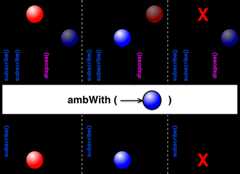
- Scheduler:
ambWithdoes not operate by default on a particularScheduler.
- Parameters:
other- the other SingleSource to race for the first emission of success or error- Returns:
- the new Single instance. A subscription to this provided source will occur after subscribing to the current source.
- Since:
- 2.0
as
@CheckReturnValue@SchedulerSupport(value="none")public final <R> R as(@NonNullSingleConverter<T,? extends R> converter)
Calls the specified converter function during assembly time and returns its resulting value.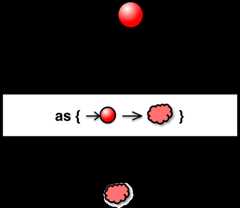
This allows fluent conversion to any other type.
- Scheduler:
asdoes not operate by default on a particularScheduler.
History: 2.1.7 - experimental
- Type Parameters:
R- the resulting object type- Parameters:
converter- the function that receives the current Single instance and returns a value- Returns:
- the converted value
- Throws:
NullPointerException- if converter is null- Since:
- 2.2
hide
@CheckReturnValue@SchedulerSupport(value="none")public final Single<T> hide()
Hides the identity of the current Single, including the Disposable that is sent to the downstream viaonSubscribe().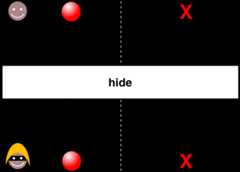
- Scheduler:
hidedoes not operate by default on a particularScheduler.
- Returns:
- the new Single instance
- Since:
- 2.0
compose
@CheckReturnValue@SchedulerSupport(value="none")public final <R> Single<R> compose(SingleTransformer<? superT,? extends R> transformer)
Transform a Single by applying a particular Transformer function to it.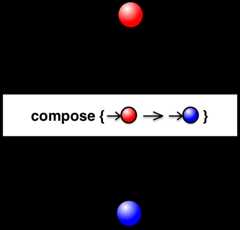
This method operates on the Single itself whereas
lift(io.reactivex.SingleOperator<? extends R, ? super T>)operates on the Single's SingleObservers.If the operator you are creating is designed to act on the individual item emitted by a Single, use
lift(io.reactivex.SingleOperator<? extends R, ? super T>). If your operator is designed to transform the source Single as a whole (for instance, by applying a particular set of existing RxJava operators to it) usecompose.- Scheduler:
composedoes not operate by default on a particularScheduler.
- Type Parameters:
R- the value type of the single returned by the transformer function- Parameters:
transformer- the transformer function, not null- Returns:
- the source Single, transformed by the transformer function
- See Also:
- RxJava wiki: Implementing Your Own Operators
cache
@CheckReturnValue@SchedulerSupport(value="none")public final Single<T> cache()
Stores the success value or exception from the current Single and replays it to late SingleObservers.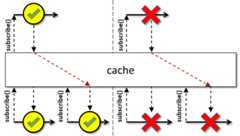 The returned Single subscribes to the current Single when the first SingleObserver subscribes.
- Scheduler:
cachedoes not operate by default on a particularScheduler.
- Returns:
- the new Single instance
- Since:
- 2.0
cast
@CheckReturnValue@NonNull@SchedulerSupport(value="none")public final <U> Single<U> cast(Class<? extends U> clazz)
Casts the success value of the current Single into the target type or signals a ClassCastException if not compatible.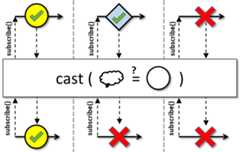
- Scheduler:
castdoes not operate by default on a particularScheduler.
- Type Parameters:
U- the target type- Parameters:
clazz- the type token to use for casting the success result from the current Single- Returns:
- the new Single instance
- Since:
- 2.0
concatWith
@BackpressureSupport(value=FULL)@CheckReturnValue@SchedulerSupport(value="none")public final Flowable<T> concatWith(SingleSource<? extendsT> other)
Returns a Flowable that emits the item emitted by the source Single, then the item emitted by the specified Single.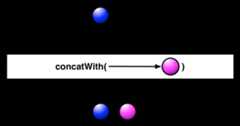
- Backpressure:
- The returned
Flowablehonors the backpressure of the downstream consumer. - Scheduler:
concatWithdoes not operate by default on a particularScheduler.
- Parameters:
other- a Single to be concatenated after the current- Returns:
- a Flowable that emits the item emitted by the source Single, followed by the item emitted by
t1 - See Also:
- ReactiveX operators documentation: Concat
delay
@CheckReturnValue@SchedulerSupport(value="io.reactivex:computation")public final Single<T> delay(long time,TimeUnit unit)
Delays the emission of the success signal from the current Single by the specified amount. An error signal will not be delayed.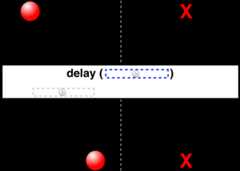
- Scheduler:
delayoperates by default on thecomputationScheduler.
- Parameters:
time- the amount of time the success signal should be delayed forunit- the time unit- Returns:
- the new Single instance
- Since:
- 2.0
delay
@CheckReturnValue@SchedulerSupport(value="io.reactivex:computation")public final Single<T> delay(long time,TimeUnit unit, boolean delayError)
Delays the emission of the success or error signal from the current Single by the specified amount.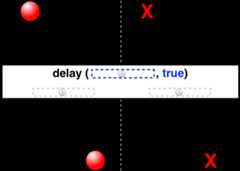
- Scheduler:
delayoperates by default on thecomputationScheduler.
History: 2.1.5 - experimental
- Parameters:
time- the amount of time the success or error signal should be delayed forunit- the time unitdelayError- if true, both success and error signals are delayed. if false, only success signals are delayed.- Returns:
- the new Single instance
- Since:
- 2.2
delay
@CheckReturnValue@SchedulerSupport(value="custom")public final Single<T> delay(long time,TimeUnit unit,Scheduler scheduler)
Delays the emission of the success signal from the current Single by the specified amount. An error signal will not be delayed.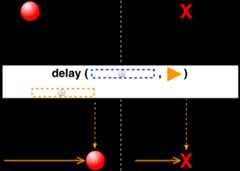
- Scheduler:
- you specify the
Schedulerwhere the non-blocking wait and emission happens
- Parameters:
time- the amount of time the success signal should be delayed forunit- the time unitscheduler- the target scheduler to use for the non-blocking wait and emission- Returns:
- the new Single instance
- Throws:
NullPointerException- if unit is null, or if scheduler is null- Since:
- 2.0
delay
@CheckReturnValue@NonNull@SchedulerSupport(value="custom")public final Single<T> delay(long time,TimeUnit unit,Scheduler scheduler, boolean delayError)
Delays the emission of the success or error signal from the current Single by the specified amount.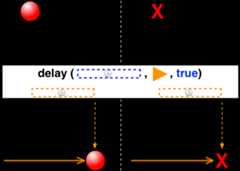
- Scheduler:
- you specify the
Schedulerwhere the non-blocking wait and emission happens
History: 2.1.5 - experimental
- Parameters:
time- the amount of time the success or error signal should be delayed forunit- the time unitscheduler- the target scheduler to use for the non-blocking wait and emissiondelayError- if true, both success and error signals are delayed. if false, only success signals are delayed.- Returns:
- the new Single instance
- Throws:
NullPointerException- if unit is null, or if scheduler is null- Since:
- 2.2
delaySubscription
@CheckReturnValue@NonNull@SchedulerSupport(value="none")public final Single<T> delaySubscription(CompletableSource other)
Delays the actual subscription to the current Single until the given other CompletableSource completes.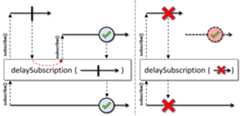
If the delaying source signals an error, that error is re-emitted and no subscription to the current Single happens.
- Scheduler:
delaySubscriptiondoes not operate by default on a particularScheduler.
- Parameters:
other- the CompletableSource that has to complete before the subscription to the current Single happens- Returns:
- the new Single instance
- Since:
- 2.0
delaySubscription
@CheckReturnValue@NonNull@SchedulerSupport(value="none")public final <U> Single<T> delaySubscription(SingleSource<U> other)
Delays the actual subscription to the current Single until the given other SingleSource signals success.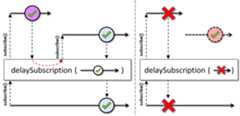
If the delaying source signals an error, that error is re-emitted and no subscription to the current Single happens.
- Scheduler:
delaySubscriptiondoes not operate by default on a particularScheduler.
- Type Parameters:
U- the element type of the other source- Parameters:
other- the SingleSource that has to complete before the subscription to the current Single happens- Returns:
- the new Single instance
- Since:
- 2.0
delaySubscription
@CheckReturnValue@NonNull@SchedulerSupport(value="none")public final <U> Single<T> delaySubscription(ObservableSource<U> other)
Delays the actual subscription to the current Single until the given other ObservableSource signals its first value or completes.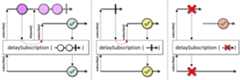
If the delaying source signals an error, that error is re-emitted and no subscription to the current Single happens.
- Scheduler:
delaySubscriptiondoes not operate by default on a particularScheduler.
- Type Parameters:
U- the element type of the other source- Parameters:
other- the ObservableSource that has to signal a value or complete before the subscription to the current Single happens- Returns:
- the new Single instance
- Since:
- 2.0
delaySubscription
@BackpressureSupport(value=FULL)@CheckReturnValue@NonNull@SchedulerSupport(value="none")public final <U> Single<T> delaySubscription(Publisher<U> other)
Delays the actual subscription to the current Single until the given other Publisher signals its first value or completes.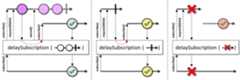
If the delaying source signals an error, that error is re-emitted and no subscription to the current Single happens.
The other source is consumed in an unbounded manner (requesting Long.MAX_VALUE from it).
- Backpressure:
- The
otherpublisher is consumed in an unbounded fashion but will be cancelled after the first item it produced. - Scheduler:
delaySubscriptiondoes not operate by default on a particularScheduler.
- Type Parameters:
U- the element type of the other source- Parameters:
other- the Publisher that has to signal a value or complete before the subscription to the current Single happens- Returns:
- the new Single instance
- Since:
- 2.0
delaySubscription
@CheckReturnValue@SchedulerSupport(value="io.reactivex:computation")public final Single<T> delaySubscription(long time,TimeUnit unit)
Delays the actual subscription to the current Single until the given time delay elapsed.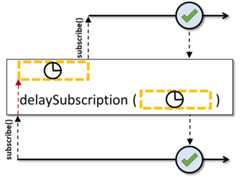
- Scheduler:
delaySubscriptiondoes by default subscribe to the current Single on thecomputationSchedulerafter the delay.
- Parameters:
time- the time amount to wait with the subscriptionunit- the time unit of the waiting- Returns:
- the new Single instance
- Since:
- 2.0
delaySubscription
@CheckReturnValue@SchedulerSupport(value="custom")public final Single<T> delaySubscription(long time,TimeUnit unit,Scheduler scheduler)
Delays the actual subscription to the current Single until the given time delay elapsed.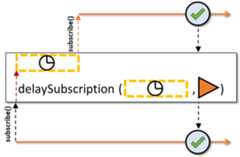
- Scheduler:
delaySubscriptiondoes by default subscribe to the current Single on theScheduleryou provided, after the delay.
- Parameters:
time- the time amount to wait with the subscriptionunit- the time unit of the waitingscheduler- the scheduler to wait on and subscribe on to the current Single- Returns:
- the new Single instance
- Since:
- 2.0
dematerialize
@CheckReturnValue@NonNull@SchedulerSupport(value="none")public final <R> Maybe<R> dematerialize(Function<? superT,Notification<R>> selector)
Maps theNotificationsuccess value of this Single back into normalonSuccess,onErrororonCompletesignals as aMaybesource.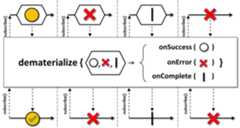
The intended use of the
selectorfunction is to perform a type-safe identity mapping (see example) on a source that is already of typeNotification<T>. The Java language doesn't allow limiting instance methods to a certain generic argument shape, therefore, a function is used to ensure the conversion remains type safe.- Scheduler:
dematerializedoes not operate by default on a particularScheduler.
Example:
Single.just(Notification.createOnNext(1)) .dematerialize(notification -> notification) .test() .assertResult(1);- Type Parameters:
R- the result type- Parameters:
selector- the function called with the success item and should return aNotificationinstance.- Returns:
- the new Maybe instance
- Since:
- 2.2.4 - experimental
- See Also:
materialize()
doAfterSuccess
@CheckReturnValue@NonNull@SchedulerSupport(value="none")public final Single<T> doAfterSuccess(Consumer<? superT> onAfterSuccess)
Calls the specified consumer with the success item after this item has been emitted to the downstream.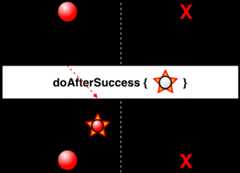
Note that the
doAfterSuccessaction is shared between subscriptions and as such should be thread-safe.- Scheduler:
doAfterSuccessdoes not operate by default on a particularScheduler.
History: 2.0.1 - experimental
- Parameters:
onAfterSuccess- the Consumer that will be called after emitting an item from upstream to the downstream- Returns:
- the new Single instance
- Since:
- 2.1
doAfterTerminate
@CheckReturnValue@NonNull@SchedulerSupport(value="none")public final Single<T> doAfterTerminate(Action onAfterTerminate)
Registers anActionto be called after this Single invokes either onSuccess or onError.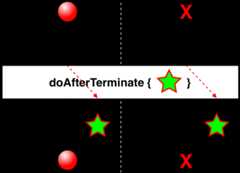
Note that the
doAfterTerminateaction is shared between subscriptions and as such should be thread-safe.- Scheduler:
doAfterTerminatedoes not operate by default on a particularScheduler.
History: 2.0.6 - experimental
- Parameters:
onAfterTerminate- anActionto be invoked when the source Single finishes- Returns:
- a Single that emits the same items as the source Single, then invokes the
Action - Since:
- 2.1
- See Also:
- ReactiveX operators documentation: Do
doFinally
@CheckReturnValue@NonNull@SchedulerSupport(value="none")public final Single<T> doFinally(Action onFinally)
Calls the specified action after this Single signals onSuccess or onError or gets disposed by the downstream.In case of a race between a terminal event and a dispose call, the provided
onFinallyaction is executed once per subscription.Note that the
onFinallyaction is shared between subscriptions and as such should be thread-safe.
- Scheduler:
doFinallydoes not operate by default on a particularScheduler.
History: 2.0.1 - experimental
- Parameters:
onFinally- the action called when this Single terminates or gets disposed- Returns:
- the new Single instance
- Since:
- 2.1
doOnSubscribe
@CheckReturnValue@NonNull@SchedulerSupport(value="none")public final Single<T> doOnSubscribe(Consumer<? superDisposable> onSubscribe)
Calls the shared consumer with the Disposable sent through the onSubscribe for each SingleObserver that subscribes to the current Single.
- Scheduler:
doOnSubscribedoes not operate by default on a particularScheduler.
- Parameters:
onSubscribe- the consumer called with the Disposable sent via onSubscribe- Returns:
- the new Single instance
- Since:
- 2.0
doOnTerminate
@CheckReturnValue@NonNull@SchedulerSupport(value="none")public final Single<T> doOnTerminate(Action onTerminate)
Returns a Single instance that calls the given onTerminate callback just before this Single completes normally or with an exception.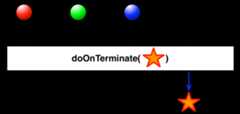
This differs from
doAfterTerminatein that this happensbefore theonSuccessoronErrornotification.- Scheduler:
doOnTerminatedoes not operate by default on a particularScheduler.
- Parameters:
onTerminate- the action to invoke when the consumer callsonSuccessoronError- Returns:
- the new Single instance
- Since:
- 2.2.7 - experimental
- See Also:
- ReactiveX operators documentation: Do,
doOnTerminate(Action)
doOnSuccess
@CheckReturnValue@NonNull@SchedulerSupport(value="none")public final Single<T> doOnSuccess(Consumer<? superT> onSuccess)
Calls the shared consumer with the success value sent via onSuccess for each SingleObserver that subscribes to the current Single.
- Scheduler:
doOnSuccessdoes not operate by default on a particularScheduler.
- Parameters:
onSuccess- the consumer called with the success value of onSuccess- Returns:
- the new Single instance
- Since:
- 2.0
doOnEvent
@CheckReturnValue@NonNull@SchedulerSupport(value="none")public final Single<T> doOnEvent(BiConsumer<? superT,? superThrowable> onEvent)
Calls the shared consumer with the error sent via onError or the value via onSuccess for each SingleObserver that subscribes to the current Single.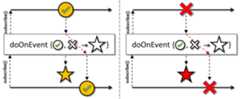
- Scheduler:
doOnEventdoes not operate by default on a particularScheduler.
- Parameters:
onEvent- the consumer called with the success value of onEvent- Returns:
- the new Single instance
- Since:
- 2.0
doOnError
@CheckReturnValue@NonNull@SchedulerSupport(value="none")public final Single<T> doOnError(Consumer<? superThrowable> onError)
Calls the shared consumer with the error sent via onError for each SingleObserver that subscribes to the current Single.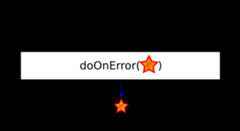
- Scheduler:
doOnErrordoes not operate by default on a particularScheduler.
- Parameters:
onError- the consumer called with the success value of onError- Returns:
- the new Single instance
- Since:
- 2.0
doOnDispose
@CheckReturnValue@NonNull@SchedulerSupport(value="none")public final Single<T> doOnDispose(Action onDispose)
Calls the sharedActionif a SingleObserver subscribed to the current Single disposes the common Disposable it received via onSubscribe.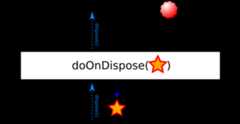
- Scheduler:
doOnDisposedoes not operate by default on a particularScheduler.
- Parameters:
onDispose- the action called when the subscription is disposed- Returns:
- the new Single instance
- Throws:
NullPointerException- if onDispose is null- Since:
- 2.0
filter
@CheckReturnValue@NonNull@SchedulerSupport(value="none")public final Maybe<T> filter(Predicate<? superT> predicate)
Filters the success item of the Single via a predicate function and emitting it if the predicate returns true, completing otherwise.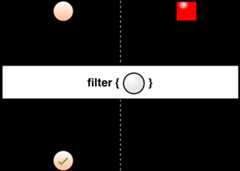
- Scheduler:
filterdoes not operate by default on a particularScheduler.
- Parameters:
predicate- a function that evaluates the item emitted by the source Maybe, returningtrueif it passes the filter- Returns:
- a Maybe that emit the item emitted by the source Maybe that the filter evaluates as
true - See Also:
- ReactiveX operators documentation: Filter
flatMap
@CheckReturnValue@NonNull@SchedulerSupport(value="none")public final <R> Single<R> flatMap(Function<? superT,? extendsSingleSource<? extends R>> mapper)
Returns a Single that is based on applying a specified function to the item emitted by the source Single, where that function returns a SingleSource.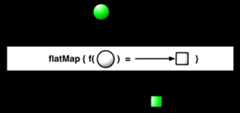
- Scheduler:
flatMapdoes not operate by default on a particularScheduler.
- Type Parameters:
R- the result value type- Parameters:
mapper- a function that, when applied to the item emitted by the source Single, returns a SingleSource- Returns:
- the Single returned from
mapperwhen applied to the item emitted by the source Single - See Also:
- ReactiveX operators documentation: FlatMap
flatMapMaybe
@CheckReturnValue@NonNull@SchedulerSupport(value="none")public final <R> Maybe<R> flatMapMaybe(Function<? superT,? extendsMaybeSource<? extends R>> mapper)
Returns a Maybe that is based on applying a specified function to the item emitted by the source Single, where that function returns a MaybeSource.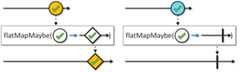
- Scheduler:
flatMapMaybedoes not operate by default on a particularScheduler.
- Type Parameters:
R- the result value type- Parameters:
mapper- a function that, when applied to the item emitted by the source Single, returns a MaybeSource- Returns:
- the Maybe returned from
mapperwhen applied to the item emitted by the source Single - See Also:
- ReactiveX operators documentation: FlatMap
flatMapPublisher
@BackpressureSupport(value=FULL)@CheckReturnValue@NonNull@SchedulerSupport(value="none")public final <R> Flowable<R> flatMapPublisher(Function<? superT,? extendsPublisher<? extends R>> mapper)
Returns a Flowable that emits items based on applying a specified function to the item emitted by the source Single, where that function returns a Publisher.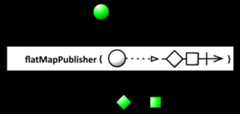
- Backpressure:
- The returned
Flowablehonors the backpressure of the downstream consumer and thePublisherreturned by the mapper function is expected to honor it as well. - Scheduler:
flatMapPublisherdoes not operate by default on a particularScheduler.
- Type Parameters:
R- the result value type- Parameters:
mapper- a function that, when applied to the item emitted by the source Single, returns a Flowable- Returns:
- the Flowable returned from
funcwhen applied to the item emitted by the source Single - See Also:
- ReactiveX operators documentation: FlatMap
flattenAsFlowable
@BackpressureSupport(value=FULL)@CheckReturnValue@NonNull@SchedulerSupport(value="none")public final <U> Flowable<U> flattenAsFlowable(Function<? superT,? extendsIterable<? extends U>> mapper)
Maps the success value of the upstreamSingleinto anIterableand emits its items as aFlowablesequence.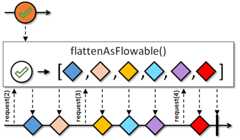
- Backpressure:
- The operator honors backpressure from downstream.
- Scheduler:
flattenAsFlowabledoes not operate by default on a particularScheduler.
- Type Parameters:
U- the type of item emitted by the resulting Iterable- Parameters:
mapper- a function that returns an Iterable sequence of values for when given an item emitted by the source Single- Returns:
- the new Flowable instance
- See Also:
- ReactiveX operators documentation: FlatMap
flattenAsObservable
@CheckReturnValue@NonNull@SchedulerSupport(value="none")public final <U> Observable<U> flattenAsObservable(Function<? superT,? extendsIterable<? extends U>> mapper)
Maps the success value of the upstreamSingleinto anIterableand emits its items as anObservablesequence.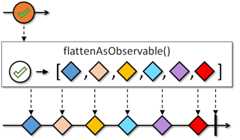
- Scheduler:
flattenAsObservabledoes not operate by default on a particularScheduler.
- Type Parameters:
U- the type of item emitted by the resulting Iterable- Parameters:
mapper- a function that returns an Iterable sequence of values for when given an item emitted by the source Single- Returns:
- the new Observable instance
- See Also:
- ReactiveX operators documentation: FlatMap
flatMapObservable
@CheckReturnValue@NonNull@SchedulerSupport(value="none")public final <R> Observable<R> flatMapObservable(Function<? superT,? extendsObservableSource<? extends R>> mapper)
Returns an Observable that is based on applying a specified function to the item emitted by the source Single, where that function returns an ObservableSource.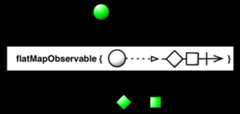
- Scheduler:
flatMapObservabledoes not operate by default on a particularScheduler.
- Type Parameters:
R- the result value type- Parameters:
mapper- a function that, when applied to the item emitted by the source Single, returns an ObservableSource- Returns:
- the Observable returned from
funcwhen applied to the item emitted by the source Single - See Also:
- ReactiveX operators documentation: FlatMap
flatMapCompletable
@CheckReturnValue@NonNull@SchedulerSupport(value="none")public final Completable flatMapCompletable(Function<? superT,? extendsCompletableSource> mapper)
Returns aCompletablethat completes based on applying a specified function to the item emitted by the sourceSingle, where that function returns aCompletable.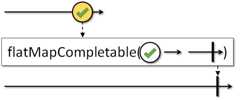
- Scheduler:
flatMapCompletabledoes not operate by default on a particularScheduler.
- Parameters:
mapper- a function that, when applied to the item emitted by the source Single, returns a Completable- Returns:
- the Completable returned from
funcwhen applied to the item emitted by the source Single - Since:
- 2.0
- See Also:
- ReactiveX operators documentation: FlatMap
blockingGet
@CheckReturnValue@SchedulerSupport(value="none")public final T blockingGet()
Waits in a blocking fashion until the current Single signals a success value (which is returned) or an exception (which is propagated).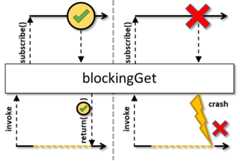
- Scheduler:
blockingGetdoes not operate by default on a particularScheduler.- Error handling:
- If the source signals an error, the operator wraps a checked
ExceptionintoRuntimeExceptionand throws that. Otherwise,RuntimeExceptions andErrors are rethrown as they are.
- Returns:
- the success value
lift
@CheckReturnValue@NonNull@SchedulerSupport(value="none")public final <R> Single<R> lift(SingleOperator<? extends R,? superT> lift)
This method requires advanced knowledge about building operators, please consider other standard composition methods first; Returns aSinglewhich, when subscribed to, invokes theapply(SingleObserver)method of the providedSingleOperatorfor each individual downstreamSingleand allows the insertion of a custom operator by accessing the downstream'sSingleObserverduring this subscription phase and providing a newSingleObserver, containing the custom operator's intended business logic, that will be used in the subscription process going further upstream.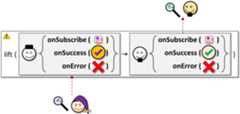
Generally, such a new
SingleObserverwill wrap the downstream'sSingleObserverand forwards theonSuccessandonErrorevents from the upstream directly or according to the emission pattern the custom operator's business logic requires. In addition, such operator can intercept the flow control calls ofdisposeandisDisposedthat would have traveled upstream and perform additional actions depending on the same business logic requirements.Example:
// Step 1: Create the consumer type that will be returned by the SingleOperator.apply(): public final class CustomSingleObserver<T> implements SingleObserver<T>, Disposable { // The downstream's SingleObserver that will receive the onXXX events final SingleObserver<? super String> downstream; // The connection to the upstream source that will call this class' onXXX methods Disposable upstream; // The constructor takes the downstream subscriber and usually any other parameters public CustomSingleObserver(SingleObserver<? super String> downstream) { this.downstream = downstream; } // In the subscription phase, the upstream sends a Disposable to this class // and subsequently this class has to send a Disposable to the downstream. // Note that relaying the upstream's Disposable directly is not allowed in RxJava @Override public void onSubscribe(Disposable d) { if (upstream != null) { d.dispose(); } else { upstream = d; downstream.onSubscribe(this); } } // The upstream calls this with the next item and the implementation's // responsibility is to emit an item to the downstream based on the intended // business logic, or if it can't do so for the particular item, // request more from the upstream @Override public void onSuccess(T item) { String str = item.toString(); if (str.length() < 2) { downstream.onSuccess(str); } else { // Single is usually expected to produce one of the onXXX events downstream.onError(new NoSuchElementException()); } } // Some operators may handle the upstream's error while others // could just forward it to the downstream. @Override public void onError(Throwable throwable) { downstream.onError(throwable); } // Some operators may use their own resources which should be cleaned up if // the downstream disposes the flow before it completed. Operators without // resources can simply forward the dispose to the upstream. // In some cases, a disposed flag may be set by this method so that other parts // of this class may detect the dispose and stop sending events // to the downstream. @Override public void dispose() { upstream.dispose(); } // Some operators may simply forward the call to the upstream while others // can return the disposed flag set in dispose(). @Override public boolean isDisposed() { return upstream.isDisposed(); } } // Step 2: Create a class that implements the SingleOperator interface and // returns the custom consumer type from above in its apply() method. // Such class may define additional parameters to be submitted to // the custom consumer type. final class CustomSingleOperator<T> implements SingleOperator<String> { @Override public SingleObserver<? super String> apply(SingleObserver<? super T> upstream) { return new CustomSingleObserver<T>(upstream); } } // Step 3: Apply the custom operator via lift() in a flow by creating an instance of it // or reusing an existing one. Single.just(5) .lift(new CustomSingleOperator<Integer>()) .test() .assertResult("5"); Single.just(15) .lift(new CustomSingleOperator<Integer>()) .test() .assertFailure(NoSuchElementException.class);Creating custom operators can be complicated and it is recommended one consults theRxJava wiki: Writing operators page about the tools, requirements, rules, considerations and pitfalls of implementing them.
Note that implementing custom operators via this
lift()method adds slightly more overhead by requiring an additional allocation and indirection per assembled flows. Instead, extending the abstractSingleclass and creating aSingleTransformerwith it is recommended.Note also that it is not possible to stop the subscription phase in
lift()as theapply()method requires a non-nullSingleObserverinstance to be returned, which is then unconditionally subscribed to the upstreamSingle. For example, if the operator decided there is no reason to subscribe to the upstream source because of some optimization possibility or a failure to prepare the operator, it still has to return aSingleObserverthat should immediately dispose the upstream'sDisposablein itsonSubscribemethod. Again, using aSingleTransformerand extending theSingleis a better option assubscribeActual(io.reactivex.SingleObserver<? super T>)can decide to not subscribe to its upstream after all.- Scheduler:
liftdoes not operate by default on a particularScheduler, however, theSingleOperatormay use aSchedulerto support its own asynchronous behavior.
- Type Parameters:
R- the output value type- Parameters:
lift- theSingleOperatorthat receives the downstream'sSingleObserverand should return aSingleObserverwith custom behavior to be used as the consumer for the currentSingle.- Returns:
- the new Single instance
- See Also:
- RxJava wiki: Writing operators,
compose(SingleTransformer)
map
@CheckReturnValue@NonNull@SchedulerSupport(value="none")public final <R> Single<R> map(Function<? superT,? extends R> mapper)
Returns a Single that applies a specified function to the item emitted by the source Single and emits the result of this function application.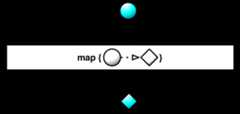
- Scheduler:
mapdoes not operate by default on a particularScheduler.
- Type Parameters:
R- the result value type- Parameters:
mapper- a function to apply to the item emitted by the Single- Returns:
- a Single that emits the item from the source Single, transformed by the specified function
- See Also:
- ReactiveX operators documentation: Map
materialize
@CheckReturnValue@SchedulerSupport(value="none")public final Single<Notification<T>> materialize()
Maps the signal types of this Single into aNotificationof the same kind and emits it as a single success value to downstream.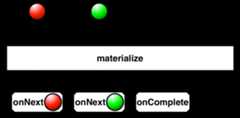
- Scheduler:
materializedoes not operate by default on a particularScheduler.
- Returns:
- the new Single instance
- Since:
- 2.2.4 - experimental
- See Also:
dematerialize(Function)
contains
@CheckReturnValue@SchedulerSupport(value="none")public final Single<Boolean> contains(Object value)
Signals true if the current Single signals a success value that is Object-equals with the value provided.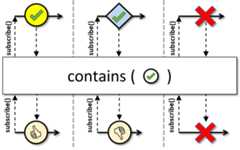
- Scheduler:
containsdoes not operate by default on a particularScheduler.
- Parameters:
value- the value to compare against the success value of this Single- Returns:
- the new Single instance
- Since:
- 2.0
contains
@CheckReturnValue@NonNull@SchedulerSupport(value="none")public final Single<Boolean> contains(Object value,BiPredicate<Object,Object> comparer)
Signals true if the current Single signals a success value that is equal with the value provided by calling a bi-predicate.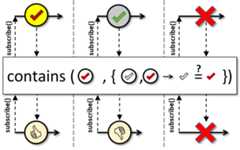
- Scheduler:
containsdoes not operate by default on a particularScheduler.
- Parameters:
value- the value to compare against the success value of this Singlecomparer- the function that receives the success value of this Single, the value provided and should return true if they are considered equal- Returns:
- the new Single instance
- Since:
- 2.0
mergeWith
@BackpressureSupport(value=FULL)@CheckReturnValue@SchedulerSupport(value="none")public final Flowable<T> mergeWith(SingleSource<? extendsT> other)
Flattens this and another Single into a single Flowable, without any transformation.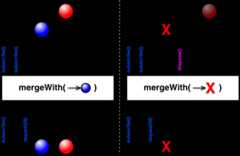
You can combine items emitted by multiple Singles so that they appear as a single Flowable, by using the
mergeWithmethod.- Backpressure:
- The returned
Flowablehonors the backpressure of the downstream consumer. - Scheduler:
mergeWithdoes not operate by default on a particularScheduler.
- Parameters:
other- a SingleSource to be merged- Returns:
- that emits all of the items emitted by the source Singles
- See Also:
- ReactiveX operators documentation: Merge
observeOn
@CheckReturnValue@NonNull@SchedulerSupport(value="custom")public final Single<T> observeOn(Scheduler scheduler)
Modifies a Single to emit its item (or notify of its error) on a specifiedScheduler, asynchronously.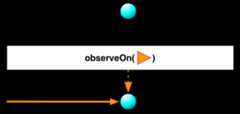
- Scheduler:
- you specify which
Schedulerthis operator will use.
- Parameters:
scheduler- theSchedulerto notify subscribers on- Returns:
- the source Single modified so that its subscribers are notified on the specified
Scheduler - Throws:
NullPointerException- if scheduler is null- See Also:
- ReactiveX operators documentation: ObserveOn,RxJava Threading Examples,
subscribeOn(io.reactivex.Scheduler)
onErrorReturn
@CheckReturnValue@NonNull@SchedulerSupport(value="none")public final Single<T> onErrorReturn(Function<Throwable,? extendsT> resumeFunction)
Instructs a Single to emit an item (returned by a specified function) rather than invokingonErrorif it encounters an error.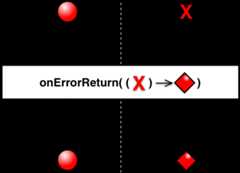
By default, when a Single encounters an error that prevents it from emitting the expected item to its subscriber, the Single invokes its subscriber's
SingleObserver.onError(java.lang.Throwable)method, and then quits without invoking any more of its subscriber's methods. TheonErrorReturnmethod changes this behavior. If you pass a function (resumeFunction) to a Single'sonErrorReturnmethod, if the original Single encounters an error, instead of invoking its subscriber'sSingleObserver.onError(java.lang.Throwable)method, it will instead emit the return value ofresumeFunction.You can use this to prevent errors from propagating or to supply fallback data should errors be encountered.
- Scheduler:
onErrorReturndoes not operate by default on a particularScheduler.
- Parameters:
resumeFunction- a function that returns an item that the new Single will emit if the source Single encounters an error- Returns:
- the original Single with appropriately modified behavior
- See Also:
- ReactiveX operators documentation: Catch
onErrorReturnItem
@CheckReturnValue@NonNull@SchedulerSupport(value="none")public final Single<T> onErrorReturnItem(T value)
Signals the specified value as success in case the current Single signals an error.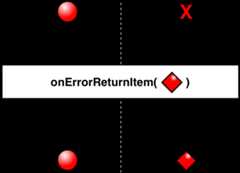
- Scheduler:
onErrorReturnItemdoes not operate by default on a particularScheduler.
- Parameters:
value- the value to signal if the current Single fails- Returns:
- the new Single instance
- Since:
- 2.0
onErrorResumeNext
@CheckReturnValue@NonNull@SchedulerSupport(value="none")public final Single<T> onErrorResumeNext(Single<? extendsT> resumeSingleInCaseOfError)
Instructs a Single to pass control to another Single rather than invokingSingleObserver.onError(Throwable)if it encounters an error.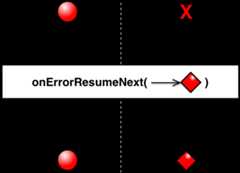
By default, when a Single encounters an error that prevents it from emitting the expected item to its
SingleObserver, the Single invokes its SingleObserver'sonErrormethod, and then quits without invoking any more of its SingleObserver's methods. TheonErrorResumeNextmethod changes this behavior. If you pass another Single (resumeSingleInCaseOfError) to a Single'sonErrorResumeNextmethod, if the original Single encounters an error, instead of invoking its SingleObserver'sonErrormethod, it will instead relinquish control toresumeSingleInCaseOfErrorwhich will invoke the SingleObserver'sonSuccessmethod if it is able to do so. In such a case, because no Single necessarily invokesonError, the SingleObserver may never know that an error happened.You can use this to prevent errors from propagating or to supply fallback data should errors be encountered.
- Scheduler:
onErrorResumeNextdoes not operate by default on a particularScheduler.
- Parameters:
resumeSingleInCaseOfError- a Single that will take control if source Single encounters an error.- Returns:
- the original Single, with appropriately modified behavior.
- See Also:
- ReactiveX operators documentation: Catch
onErrorResumeNext
@CheckReturnValue@NonNull@SchedulerSupport(value="none")public final Single<T> onErrorResumeNext(Function<? superThrowable,? extendsSingleSource<? extendsT>> resumeFunctionInCaseOfError)
Instructs a Single to pass control to another Single rather than invokingSingleObserver.onError(Throwable)if it encounters an error.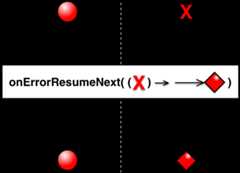
By default, when a Single encounters an error that prevents it from emitting the expected item to its
SingleObserver, the Single invokes its SingleObserver'sonErrormethod, and then quits without invoking any more of its SingleObserver's methods. TheonErrorResumeNextmethod changes this behavior. If you pass a function that will return another Single (resumeFunctionInCaseOfError) to a Single'sonErrorResumeNextmethod, if the original Single encounters an error, instead of invoking its SingleObserver'sonErrormethod, it will instead relinquish control toresumeSingleInCaseOfErrorwhich will invoke the SingleObserver'sonSuccessmethod if it is able to do so. In such a case, because no Single necessarily invokesonError, the SingleObserver may never know that an error happened.You can use this to prevent errors from propagating or to supply fallback data should errors be encountered.
- Scheduler:
onErrorResumeNextdoes not operate by default on a particularScheduler.
- Parameters:
resumeFunctionInCaseOfError- a function that returns a Single that will take control if source Single encounters an error.- Returns:
- the original Single, with appropriately modified behavior.
- Since:
- .20
- See Also:
- ReactiveX operators documentation: Catch
onTerminateDetach
@CheckReturnValue@SchedulerSupport(value="none")public final Single<T> onTerminateDetach()
Nulls out references to the upstream producer and downstream SingleObserver if the sequence is terminated or downstream calls dispose().
- Scheduler:
onTerminateDetachdoes not operate by default on a particularScheduler.
History: 2.1.5 - experimental
- Returns:
- a Single which nulls out references to the upstream producer and downstream SingleObserver if the sequence is terminated or downstream calls dispose()
- Since:
- 2.2
repeat
@BackpressureSupport(value=FULL)@CheckReturnValue@SchedulerSupport(value="none")public final Flowable<T> repeat()
Repeatedly re-subscribes to the current Single and emits each success value.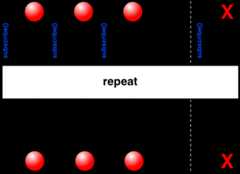
- Backpressure:
- The returned
Flowablehonors the backpressure of the downstream consumer. - Scheduler:
repeatdoes not operate by default on a particularScheduler.
- Returns:
- the new Flowable instance
- Since:
- 2.0
repeat
@BackpressureSupport(value=FULL)@CheckReturnValue@SchedulerSupport(value="none")public final Flowable<T> repeat(long times)
Re-subscribes to the current Single at most the given number of times and emits each success value.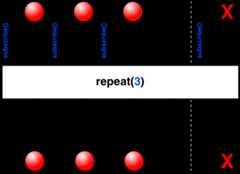
- Backpressure:
- The returned
Flowablehonors the backpressure of the downstream consumer. - Scheduler:
repeatdoes not operate by default on a particularScheduler.
- Parameters:
times- the number of times to re-subscribe to the current Single- Returns:
- the new Flowable instance
- Since:
- 2.0
repeatWhen
@BackpressureSupport(value=FULL)@CheckReturnValue@SchedulerSupport(value="none")public final Flowable<T> repeatWhen(Function<? superFlowable<Object>,? extendsPublisher<?>> handler)
Re-subscribes to the current Single if the Publisher returned by the handler function signals a value in response to a value signalled through the Flowable the handle receives.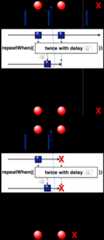
- Backpressure:
- The returned
Flowablehonors the backpressure of the downstream consumer. ThePublisherreturned by the handler function is expected to honor backpressure as well. - Scheduler:
repeatWhendoes not operate by default on a particularScheduler.
- Parameters:
handler- the function that is called with a Flowable that signals a value when the Single signalled a success value and returns a Publisher that has to signal a value to trigger a resubscription to the current Single, otherwise the terminal signal of the Publisher will be the terminal signal of the sequence as well.- Returns:
- the new Flowable instance
- Since:
- 2.0
repeatUntil
@BackpressureSupport(value=FULL)@CheckReturnValue@SchedulerSupport(value="none")public final Flowable<T> repeatUntil(BooleanSupplier stop)
Re-subscribes to the current Single until the given BooleanSupplier returns true.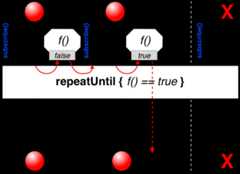
- Backpressure:
- The returned
Flowablehonors the backpressure of the downstream consumer. - Scheduler:
repeatUntildoes not operate by default on a particularScheduler.
- Parameters:
stop- the BooleanSupplier called after the current Single succeeds and if returns false, the Single is re-subscribed; otherwise the sequence completes.- Returns:
- the new Flowable instance
- Since:
- 2.0
retry
@CheckReturnValue@SchedulerSupport(value="none")public final Single<T> retry()
Repeatedly re-subscribes to the current Single indefinitely if it fails with an onError.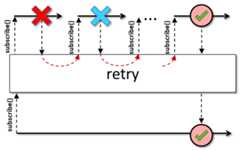
- Scheduler:
retrydoes not operate by default on a particularScheduler.
- Returns:
- the new Single instance
- Since:
- 2.0
retry
@CheckReturnValue@SchedulerSupport(value="none")public final Single<T> retry(long times)
Repeatedly re-subscribe at most the specified times to the current Single if it fails with an onError.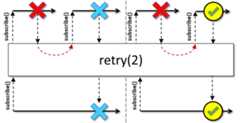
- Scheduler:
retrydoes not operate by default on a particularScheduler.
- Parameters:
times- the number of times to resubscribe if the current Single fails- Returns:
- the new Single instance
- Since:
- 2.0
retry
@CheckReturnValue@SchedulerSupport(value="none")public final Single<T> retry(BiPredicate<? superInteger,? superThrowable> predicate)
Re-subscribe to the current Single if the given predicate returns true when the Single fails with an onError.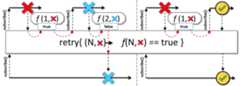
- Scheduler:
retrydoes not operate by default on a particularScheduler.
- Parameters:
predicate- the predicate called with the resubscription count and the failure Throwable and should return true if a resubscription should happen- Returns:
- the new Single instance
- Since:
- 2.0
retry
@CheckReturnValue@SchedulerSupport(value="none")public final Single<T> retry(long times,Predicate<? superThrowable> predicate)
Repeatedly re-subscribe at most times or until the predicate returns false, whichever happens first if it fails with an onError.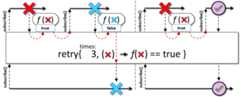
- Scheduler:
retrydoes not operate by default on a particularScheduler.
History: 2.1.8 - experimental
- Parameters:
times- the number of times to resubscribe if the current Single failspredicate- the predicate called with the failure Throwable and should return true if a resubscription should happen- Returns:
- the new Single instance
- Since:
- 2.2
retry
@CheckReturnValue@SchedulerSupport(value="none")public final Single<T> retry(Predicate<? superThrowable> predicate)
Re-subscribe to the current Single if the given predicate returns true when the Single fails with an onError.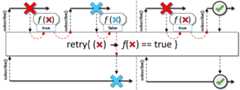
- Scheduler:
retrydoes not operate by default on a particularScheduler.
- Parameters:
predicate- the predicate called with the failure Throwable and should return true if a resubscription should happen- Returns:
- the new Single instance
- Since:
- 2.0
retryWhen
@CheckReturnValue@SchedulerSupport(value="none")public final Single<T> retryWhen(Function<? superFlowable<Throwable>,? extendsPublisher<?>> handler)
Re-subscribes to the current Single if and when the Publisher returned by the handler function signals a value.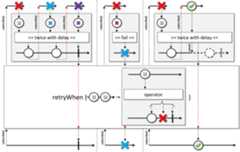
If the Publisher signals an onComplete, the resulting Single will signal a NoSuchElementException.
Note that the inner
Publisherreturned by the handler function should signal eitheronNext,onErrororonCompletein response to the receivedThrowableto indicate the operator should retry or terminate. If the upstream to the operator is asynchronous, signalling onNext followed by onComplete immediately may result in the sequence to be completed immediately. Similarly, if this innerPublishersignalsonErrororonCompletewhile the upstream is active, the sequence is terminated with the same signal immediately.The following example demonstrates how to retry an asynchronous source with a delay:
Single.timer(1, TimeUnit.SECONDS) .doOnSubscribe(s -> System.out.println("subscribing")) .map(v -> { throw new RuntimeException(); }) .retryWhen(errors -> { AtomicInteger counter = new AtomicInteger(); return errors .takeWhile(e -> counter.getAndIncrement() != 3) .flatMap(e -> { System.out.println("delay retry by " + counter.get() + " second(s)"); return Flowable.timer(counter.get(), TimeUnit.SECONDS); }); }) .blockingGet();- Scheduler:
retryWhendoes not operate by default on a particularScheduler.
- Parameters:
handler- the function that receives a Flowable of the error the Single emits and should return a Publisher that should signal a normal value (in response to the throwable the Flowable emits) to trigger a resubscription or signal an error to be the output of the resulting Single- Returns:
- the new Single instance
subscribe
@SchedulerSupport(value="none")public final Disposable subscribe()
Subscribes to a Single but ignore its emission or notification.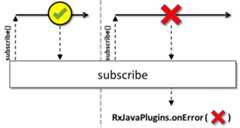
If the Single emits an error, it is wrapped into an
OnErrorNotImplementedExceptionand routed to the RxJavaPlugins.onError handler.- Scheduler:
subscribedoes not operate by default on a particularScheduler.
- Returns:
- a
Disposablereference can request theSinglestop work. - See Also:
- ReactiveX operators documentation: Subscribe
subscribe
@CheckReturnValue@NonNull@SchedulerSupport(value="none")public final Disposable subscribe(BiConsumer<? superT,? superThrowable> onCallback)
Subscribes to a Single and provides a composite callback to handle the item it emits or any error notification it issues.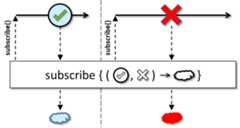
- Scheduler:
subscribedoes not operate by default on a particularScheduler.
- Parameters:
onCallback- the callback that receives either the success value or the failure Throwable (whichever is not null)- Returns:
- a
Disposablereference can request theSinglestop work. - Throws:
NullPointerException- ifonCallbackis null- See Also:
- ReactiveX operators documentation: Subscribe
subscribe
@CheckReturnValue@SchedulerSupport(value="none")public final Disposable subscribe(Consumer<? superT> onSuccess)
Subscribes to a Single and provides a callback to handle the item it emits.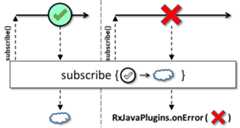
If the Single emits an error, it is wrapped into an
OnErrorNotImplementedExceptionand routed to the RxJavaPlugins.onError handler.- Scheduler:
subscribedoes not operate by default on a particularScheduler.
- Parameters:
onSuccess- theConsumer<T>you have designed to accept the emission from the Single- Returns:
- a
Disposablereference can request theSinglestop work. - Throws:
NullPointerException- ifonSuccessis null- See Also:
- ReactiveX operators documentation: Subscribe
subscribe
@CheckReturnValue@NonNull@SchedulerSupport(value="none")public final Disposable subscribe(Consumer<? superT> onSuccess,Consumer<? superThrowable> onError)
Subscribes to a Single and provides callbacks to handle the item it emits or any error notification it issues.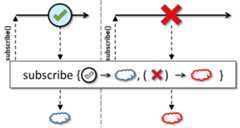
- Scheduler:
subscribedoes not operate by default on a particularScheduler.
- Parameters:
onSuccess- theConsumer<T>you have designed to accept the emission from the SingleonError- theConsumer<Throwable>you have designed to accept any error notification from the Single- Returns:
- a
Disposablereference can request theSinglestop work. - Throws:
NullPointerException- ifonSuccessis null, or ifonErroris null- See Also:
- ReactiveX operators documentation: Subscribe
subscribe
@SchedulerSupport(value="none")public final void subscribe(SingleObserver<? superT> observer)
Description copied from interface:SingleSourceSubscribes the given SingleObserver to this SingleSource instance.- Specified by:
subscribein interfaceSingleSource<T>- Parameters:
observer- the SingleObserver, not null
subscribeActual
protected abstract void subscribeActual(@NonNullSingleObserver<? superT> observer)
Implement this method in subclasses to handle the incomingSingleObservers.There is no need to call any of the plugin hooks on the current
Singleinstance or theSingleObserver; all hooks and basic safeguards have been applied bysubscribe(SingleObserver)before this method gets called.- Parameters:
observer- the SingleObserver to handle, not null
subscribeWith
@CheckReturnValue@SchedulerSupport(value="none")public final <E extendsSingleObserver<? superT>> E subscribeWith(E observer)
Subscribes a given SingleObserver (subclass) to this Single and returns the given SingleObserver as is.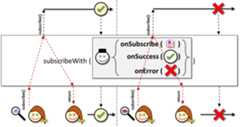
Usage example:
Single<Integer> source = Single.just(1); CompositeDisposable composite = new CompositeDisposable(); DisposableSingleObserver<Integer> ds = new DisposableSingleObserver<>() { // ... }; composite.add(source.subscribeWith(ds));- Scheduler:
subscribeWithdoes not operate by default on a particularScheduler.
- Type Parameters:
E- the type of the SingleObserver to use and return- Parameters:
observer- the SingleObserver (subclass) to use and return, not null- Returns:
- the input
observer - Throws:
NullPointerException- ifobserveris null- Since:
- 2.0
subscribeOn
@CheckReturnValue@NonNull@SchedulerSupport(value="custom")public final Single<T> subscribeOn(Scheduler scheduler)
Asynchronously subscribes subscribers to this Single on the specifiedScheduler.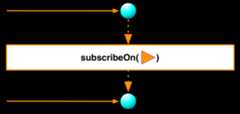
- Scheduler:
- You specify which
Schedulerthis operator will use.
- Parameters:
scheduler- theSchedulerto perform subscription actions on- Returns:
- the source Single modified so that its subscriptions happen on the specified
Scheduler - See Also:
- ReactiveX operators documentation: SubscribeOn,RxJava Threading Examples,
observeOn(io.reactivex.Scheduler)
takeUntil
@CheckReturnValue@NonNull@SchedulerSupport(value="none")public final Single<T> takeUntil(CompletableSource other)
Returns a Single that emits the item emitted by the source Single until a Completable terminates. Upon termination ofother, this will emit aCancellationExceptionrather than go toSingleObserver.onSuccess(Object).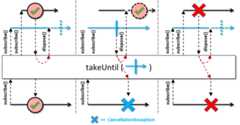
- Scheduler:
takeUntildoes not operate by default on a particularScheduler.
- Parameters:
other- the Completable whose termination will causetakeUntilto emit the item from the source Single- Returns:
- a Single that emits the item emitted by the source Single until such time as
otherterminates. - See Also:
- ReactiveX operators documentation: TakeUntil
takeUntil
@BackpressureSupport(value=FULL)@CheckReturnValue@NonNull@SchedulerSupport(value="none")public final <E> Single<T> takeUntil(Publisher<E> other)
Returns a Single that emits the item emitted by the source Single until a Publisher emits an item. Upon emission of an item fromother, this will emit aCancellationExceptionrather than go toSingleObserver.onSuccess(Object).
- Backpressure:
- The
otherpublisher is consumed in an unbounded fashion but will be cancelled after the first item it produced. - Scheduler:
takeUntildoes not operate by default on a particularScheduler.
- Type Parameters:
E- the type of items emitted byother- Parameters:
other- the Publisher whose first emitted item will causetakeUntilto emit the item from the source Single- Returns:
- a Single that emits the item emitted by the source Single until such time as
otheremits its first item - See Also:
- ReactiveX operators documentation: TakeUntil
takeUntil
@CheckReturnValue@NonNull@SchedulerSupport(value="none")public final <E> Single<T> takeUntil(SingleSource<? extends E> other)
Returns a Single that emits the item emitted by the source Single until a second Single emits an item. Upon emission of an item fromother, this will emit aCancellationExceptionrather than go toSingleObserver.onSuccess(Object).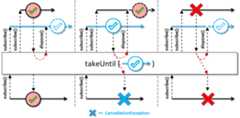
- Scheduler:
takeUntildoes not operate by default on a particularScheduler.
- Type Parameters:
E- the type of item emitted byother- Parameters:
other- the Single whose emitted item will causetakeUntilto emit the item from the source Single- Returns:
- a Single that emits the item emitted by the source Single until such time as
otheremits its item - See Also:
- ReactiveX operators documentation: TakeUntil
timeout
@CheckReturnValue@SchedulerSupport(value="io.reactivex:computation")public final Single<T> timeout(long timeout,TimeUnit unit)
Signals a TimeoutException if the current Single doesn't signal a success value within the specified timeout window.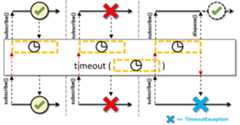
- Scheduler:
timeoutsignals the TimeoutException on thecomputationScheduler.
- Parameters:
timeout- the timeout amountunit- the time unit- Returns:
- the new Single instance
- Since:
- 2.0
timeout
@CheckReturnValue@SchedulerSupport(value="custom")public final Single<T> timeout(long timeout,TimeUnit unit,Scheduler scheduler)
Signals a TimeoutException if the current Single doesn't signal a success value within the specified timeout window.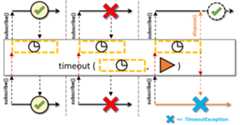
- Scheduler:
timeoutsignals the TimeoutException on theScheduleryou specify.
- Parameters:
timeout- the timeout amountunit- the time unitscheduler- the target scheduler where the timeout is awaited and the TimeoutException signalled- Returns:
- the new Single instance
- Since:
- 2.0
timeout
@CheckReturnValue@NonNull@SchedulerSupport(value="custom")public final Single<T> timeout(long timeout,TimeUnit unit,Scheduler scheduler,SingleSource<? extendsT> other)
Runs the current Single and if it doesn't signal within the specified timeout window, it is disposed and the other SingleSource subscribed to.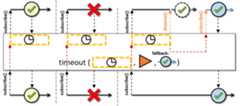
- Scheduler:
timeoutsubscribes to the other SingleSource on theScheduleryou specify.
- Parameters:
timeout- the timeout amountunit- the time unitscheduler- the scheduler where the timeout is awaited and the subscription to other happensother- the other SingleSource that gets subscribed to if the current Single times out- Returns:
- the new Single instance
- Since:
- 2.0
timeout
@CheckReturnValue@NonNull@SchedulerSupport(value="io.reactivex:computation")public final Single<T> timeout(long timeout,TimeUnit unit,SingleSource<? extendsT> other)
Runs the current Single and if it doesn't signal within the specified timeout window, it is disposed and the other SingleSource subscribed to.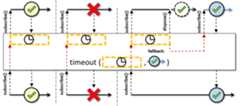
- Scheduler:
timeoutsubscribes to the other SingleSource on thecomputationScheduler.
- Parameters:
timeout- the timeout amountunit- the time unitother- the other SingleSource that gets subscribed to if the current Single times out- Returns:
- the new Single instance
- Throws:
NullPointerException- if other is null, or if unit is null, or if scheduler is null- Since:
- 2.0
to
@CheckReturnValue@SchedulerSupport(value="none")public final <R> R to(Function<? superSingle<T>,R> convert)
Calls the specified converter function with the current Single instance during assembly time and returns its result.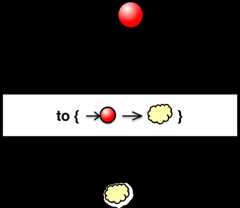
- Scheduler:
todoes not operate by default on a particularScheduler.
- Type Parameters:
R- the result type- Parameters:
convert- the function that is called with the current Single instance during assembly time that should return some value to be the result- Returns:
- the value returned by the convert function
toCompletable
@CheckReturnValue@SchedulerSupport(value="none")@Deprecatedpublic final Completable toCompletable()
Deprecated. seeignoreElement()instead, will be removed in 3.0Returns aCompletablethat discards result of theSingleand callsonCompletewhen this sourceSinglecallsonSuccess. Error terminal event is propagated.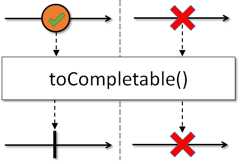
- Scheduler:
toCompletabledoes not operate by default on a particularScheduler.
- Returns:
- a
Completablethat callsonCompleteon it's subscriber when the sourceSinglecallsonSuccess. - Since:
- 2.0
ignoreElement
@CheckReturnValue@SchedulerSupport(value="none")public final Completable ignoreElement()
Returns aCompletablethat ignores the success value of thisSingleand callsonCompleteinstead on the returnedCompletable.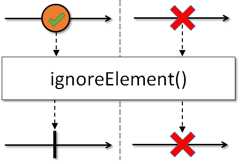
- Scheduler:
ignoreElementdoes not operate by default on a particularScheduler.
- Returns:
- a
Completablethat callsonCompleteon it's observer when the sourceSinglecallsonSuccess. - Since:
- 2.1.13
toFlowable
@BackpressureSupport(value=FULL)@CheckReturnValue@SchedulerSupport(value="none")public final Flowable<T> toFlowable()
Converts this Single into aFlowable.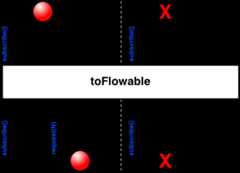
- Backpressure:
- The returned
Flowablehonors the backpressure of the downstream consumer. - Scheduler:
toFlowabledoes not operate by default on a particularScheduler.
- Returns:
- a
Flowablethat emits a single item T or an error.
toFuture
@CheckReturnValue@SchedulerSupport(value="none")public final Future<T> toFuture()
Returns aFuturerepresenting the single value emitted by thisSingle.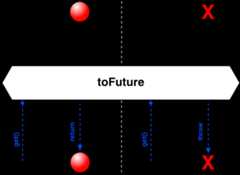
- Scheduler:
toFuturedoes not operate by default on a particularScheduler.
- Returns:
- a
Futurethat expects a single item to be emitted by thisSingle - See Also:
- ReactiveX documentation: To
toMaybe
@CheckReturnValue@SchedulerSupport(value="none")public final Maybe<T> toMaybe()
Converts this Single into aMaybe.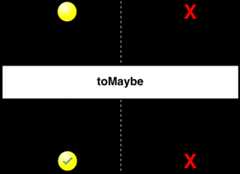
- Scheduler:
toMaybedoes not operate by default on a particularScheduler.
- Returns:
- a
Maybethat emits a single item T or an error.
toObservable
@CheckReturnValue@SchedulerSupport(value="none")public final Observable<T> toObservable()
Converts this Single into anObservable.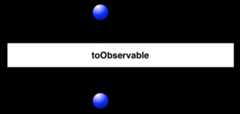
- Scheduler:
toObservabledoes not operate by default on a particularScheduler.
- Returns:
- an
Observablethat emits a single item T or an error.
unsubscribeOn
@CheckReturnValue@NonNull@SchedulerSupport(value="custom")public final Single<T> unsubscribeOn(Scheduler scheduler)
Returns a Single which makes sure when a SingleObserver disposes the Disposable, that call is propagated up on the specified scheduler.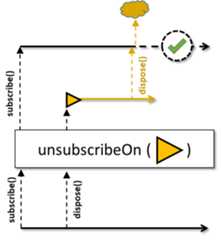
- Scheduler:
unsubscribeOncalls dispose() of the upstream on theScheduleryou specify.
History: 2.0.9 - experimental
- Parameters:
scheduler- the target scheduler where to execute the disposal- Returns:
- the new Single instance
- Throws:
NullPointerException- if scheduler is null- Since:
- 2.2
zipWith
@CheckReturnValue@SchedulerSupport(value="none")public final <U,R> Single<R> zipWith(SingleSource<U> other,BiFunction<? superT,? super U,? extends R> zipper)
Returns a Single that emits the result of applying a specified function to the pair of items emitted by the source Single and another specified Single.- Scheduler:
zipWithdoes not operate by default on a particularScheduler.
- Type Parameters:
U- the type of items emitted by theotherSingleR- the type of items emitted by the resulting Single- Parameters:
other- the other SingleSourcezipper- a function that combines the pairs of items from the two SingleSources to generate the items to be emitted by the resulting Single- Returns:
- a Single that pairs up values from the source Single and the
otherSingleSource and emits the results ofzipFunctionapplied to these pairs - See Also:
- ReactiveX operators documentation: Zip
test
@CheckReturnValue@SchedulerSupport(value="none")public final TestObserver<T> test()
Creates a TestObserver and subscribes it to this Single.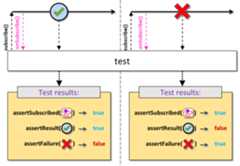
- Scheduler:
testdoes not operate by default on a particularScheduler.
- Returns:
- the new TestObserver instance
- Since:
- 2.0
test
@CheckReturnValue@SchedulerSupport(value="none")public final TestObserver<T> test(boolean cancelled)
Creates a TestObserver optionally in cancelled state, then subscribes it to this Single.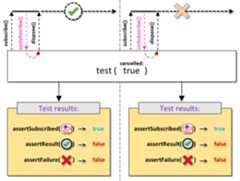
- Scheduler:
testdoes not operate by default on a particularScheduler.
- Parameters:
cancelled- if true, the TestObserver will be cancelled before subscribing to this Single.- Returns:
- the new TestObserver instance
- Since:
- 2.0