GERMANS
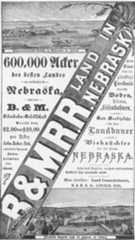
Burlington and Missouri Railroad lands advertisement in German
View largerImmigrants from the German-speaking areasof Europe (the various German states wereunited politically only after 1871) compriseone of the most significant elements of thepopulation of both the United States and Canada.Germans began to arrive in North Americaas early as the late seventeenth century,but the overwhelming majority came between1840 and 1890, "pushed" out of mainly northwesternGermany because of the disruption oftraditional ways of life by the advent of factorymodes of production, and "pulled" toNorth America (especially the American Midwestand the Great Plains during this period)by both real and perceived opportunities foreconomic betterment, due in large part to theprospects presented by landownership.
Immigrants from the German lands accountedfor at least six million of those whoentered the United States between 1830 andWorld War II, or about one in five. Duringmost of this period Germans outnumberedany other single immigrant ethnic group, andtheir share of the total foreign-born in thecountry was never less than one-quarter. Theinfluence of such a large immigration onthe ancestral makeup of the United States isclearly reflected in late-twentieth-century censusdata. In 1980, for example, just over 26percent of those sampled in the long formreported German ancestry, the largest of anysingle ancestral group. The number of Germanswho immigrated to Canada is muchsmaller, and they mainly arrived between 1870and 1935, with an interruption during WorldWar I when Germans were barred from entryinto the country. Returns from the 1996 censusreveal that about 10 percent of the Canadianpopulation claims German ethnic origin,but the numbers are much higher in thePrairie Provinces of Saskatchewan, Alberta,and Manitoba (29, 23, and 19 percent, respectively).In these provinces most "German" immigrants,however, were in fact German Russianswho emigrated primarily from southernareas of the Ukraine.
One of the distinguishing characteristicsof the German population in North America(especially in comparison to other immigrantgroups) has been its relative degree of culturaldiversity, reflected especially in the number ofChristian denominations to which Germansbelonged. In part this reflects patterns that haddeveloped over centuries in Germany, whosepopulation came to include nearly every varietyof Christianity–from Catholics, Lutherans,and Reformed groups to more radical Anabaptistpietistic movements such as Amish,Mennonites, Schwenkfelders, and the Moravianchurch. It is not surprising, then, thatnearly all of these denominations were representedamong the German immigrant populationin North America. The occupational profileof German immigrants was diverse, butlike those of other western and northernEuropean immigrants, it was dominated byfarmers. This is largely because the processof immigration tended to be highly selective,drawing from specific socioeconomic strata.Those Germans who immigrated to NorthAmerica during the nineteenth century, as revealedin recent detailed studies of Germantransatlantic migrations, mainly were smalltimefarmers, landless sharecroppers, and servants(maids and farmhands), all of whomhad been negatively affected by the socialand economic disruptions that accompaniedindustrialization. While many came overin small family groups, a good number wereyoung, single men and women travelingalone. A common theme underlying Germanimmigration to North America was chain migration,the process by which generations ofimmigrants moved between two locales over aperiod of decades, creating transatlantic kinshipand place-specific linkages, which oftenresulted in the transplantation of whole communitiesoverseas.
German immigrants participated in the settlementand expansion of the agriculturalfrontier in the American Great Plains from thesecond half of the nineteenth century on, buttheir numerical presence in this frontier wasnot nearly as large as in the midwestern onethat had come before it. Their presence in theregion during the early phases of frontier expansionimmediately after the Civil War waslimited largely to the prairies of eastern DakotaTerritory, Nebraska, and Kansas, as wellas parts of central Texas. With the exception ofVolga Germans (who came from a physicalenvironment similar to the Plains), the semiaridsteppe grasslands in the western GreatPlains were much less attractive to most Germanimmigrant farmers, whether migratingfrom the Midwest or Germany.
At the regional level, Germans, like otherpopulation groups, were attracted to the lureof free or cheap land in the Plains, largely as aresult of the Homestead Act of 1862. At thelocal level, however, settlement patterns reflectedthe influence of such processes as chainmigration and boosterism on the part of railroadagents and land speculators. These processestended to direct migrants and immigrantsto specific locales and resulted inliterally hundreds of German ethnic "islands,"particularly in the eastern Great Plains. Once acommunity nucleus had been established bythe first generation of frontier settlers (oftencentered around an ethnic church), subsequentgenerations of migrants and immigrants,attracted to a place inhabited by thosespeaking a similar language or dialect, practicinga specific faith, or even hailing fromthe same region or village in Germany, filledin surrounding areas until an ethnic community–perhaps several townships or evena county in size–had been established. By1910 German-born immigrants comprised anaverage of about 9 percent of the total populationin the Great Plains states, with NorthDakota registering the highest number (18 percent)and Oklahoma and Texas the fewest(5 percent).
The settlement of German immigrants inthe Hill Country of central Texas differed significantlyfrom that in the Midwest and elsewherein the Great Plains proper. There, immigrantswere participants in a short-livedbut nevertheless highly influential plannedsettlement venture founded in 1842 in Hessen-Nassau by members of the nobility as a privatejoint-stock company. Among the goals of thisso-calledAdelsverein (union of nobles) werethe alleviation of poverty and overpopulationamong German peasants on the nobles' landsand the creation of new markets for goods bytransplanting Germans to south Texas. Thecompany obtained from the Republic of Mexicoa two-million-acre grant situated in theSouthern Plains of West Texas, and between1844 and 1846 shipped about 10,000 Germansfrom many areas of central and northern Germanyto Galveston through the port of Bremerhaven.Unfortunately, the company wentbankrupt in 1846 before most had even arrivedin the proposed area of settlement.Many became stranded along the way and settledin present-day Mason, Gillespie, Kendall,and Comal Counties at the edge of the SouthernPlains, where most became successfulfarmers. Despite this setback, individuals andfamilies continued to migrate to the GermanHill Country on their own throughout the1850s and 1860s. By 1857 it was estimated that35,000 to 40,000 German-born immigrantslived in Texas; in 1850 they comprised between60 and 80 percent of the total population inthe four counties mentioned above.
In Canada, the Canadian Homestead Lawof 1872 (which offered 160 acres of land foronly $10) succeeded in attracting thousandsof German immigrant farmers to the PrairieProvinces of Alberta, Saskatchewan, andManitoba. Overwhelmingly, these Germanicimmigrants were German Mennonites fromeastern Europe and southern Russia. In 1874alone, 7,000 German Mennonites establishedseveral villages near Winnipeg along the RedRiver. But starting in the late 1880s thousandsof ethnic Germans who belonged to traditionalreligions such as Lutheranism and Catholicismbegan to immigrate to the Prairiesfrom parts of eastern and central Europe andRussia, where they had been colonists in theearly and middle decades of the nineteenthcentury. A smaller number came directly fromGermany or migrated from Ontario or theUnited States. By 1911, 14 percent of Saskatchewan'spopulation was German-born. Interruptedby World War I, immigration fromGermany resumed after the war, and between1919 and 1935 more than 90,000 Germanspeakingpersons arrived in Canada. Fifty percentagain came from eastern Europe and Russia,half came directly from Germany, andseven of every ten were farmers. German settlementprocesses in the Canadian PrairieProvinces tended to mirror those in the AmericanGreat Plains, with chain migration workingto direct immigrants to specific small ethniccommunities populated by those withsimilar religious and linguistic backgrounds,as well as similar geographic origins in Europe.
See also ARCHITECTURE:German Architecture.
Timothy G. AndersonOhio University
Conzen, Kathleen Neils. "Germans." InHarvard Encyclopedia of American Ethnic Groups, edited by StephanThernstrom. Cambridge: Harvard University Press, 1980:405–25.
Jordan, Terry G.German Seed in Texas Soil: Immigrant Farmers in Nineteenth-Century Texas. Austin: Universityof Texas Press, 1966.
McLaughlin, K. M.The Germans in Canada. Ottawa: Canadian Historical Association,1985.
XML:egp.ea.013.xml