

The Development of Algebra - 2
Thefirstpart of this brief history of algebra focussed on the importantpractical origins of the problems that led to the procedures wehave for solving equations, and the ways in which the problems werevisualised as manipulation of geometrical shapes.
This second part shows how the visual images slowly give way toliteral representations, abbreviations, and finally, in the 17thcentury, to a more developed algebraic symbolism close to what weuse in schools today [see: Note 1].
1. Mediaeval Algebra
The expansion of the Arab Empire into Asia Minor (ModernTurkey) at the end of the 11th century led to a series of Crusadesto recapture the Holy Land. The major period of these military andpolitical disturbances lasted until the end of the 14th century. In1340 the 'Black Death' spread into Western Europe killing some 40%of the population by about 1370. In spite of these upheavals,exchange of ideas and translations of Arab scholarship were broughtto Europe. After 1450 the printing press enabled many people toread the Latin translations of Arab and Greek science.
Mediaeval Algebra in Western Europe was first learnt from theworks of al-Khowarizmi, Abu Kamil and Fibonacci. The algebraconsisted of simple linear and quadratic equations and a few cubicequations, together with the methods for solving them; rules foroperating with positive and negative numbers, finding squares,cubes and their roots; the rule of False Position (seeHistory of Algebra Part 1 ) and the Rule of Three (simpleproportion). These methods were applied to business and legalproblems. There was some justification of the solution usingdiagrams, but mostly it was a matter of 'memorising the rules' andapplying them to standard problems.
Leonardo Fibonacci(1170 - 1250)

Well known for his collection of mathematical techniques [see:Note 2] and the promotion of the Hindu numeral system in theLiber Abaci of 1202, healso wroteFlos , a bookwhere he shows that the root of the cubic equation $10x + 2x^2 +x^3 = 20$ can neither be a rational number, nor the square root ofa rational number [see: Note 3].
In hisBook of Squares1225 he turned much of Euclid's geometrical work into arithmetic,developing new ideas from Arab science, and other techniques usedby the 'Abacus Masters' who taught commercial arithmetic [see: Note4]. He organised the rules as a series of logical propositions andsupported his arguments using proportional triangles, squares andrectangles, which as we have seen, are perfectly general.
Proposition1 shows how the sum of the odd numbers always makes aperfect square. In our notation, the substance of Leonardo'sargument is:$$(1+3+5+7)+9=(1+3+5+7+9)$$
Proposition 2states "Any square number exceeds the square before it by the sumof the roots." Leonardo's first example is simple:
$$5^2 - 4^2 = 25 - 16 \mbox{,which is } 9 \mbox {, the sum of } 5 \mbox { and } 4\mbox {, whichare the roots of }25 \mbox{ and } 16.$$
Proposition 10finds the sum of a sequence of square numbers: $$6(1^2 + 2^2 + 3^2+.... + n^2) = n(n + 1)( 2n + 1)$$
Proposition 19shows how to find numbers $A$, $B$, and $C$ such that: $$B^2 - B =A^2 \mbox { and } B^2 + B = C^2$$
These and many other numerical relationships helpedmathematicians of the 15th and 16th centuries to develop techniquesfor solving quadratic and cubic equations.
Jordanus de Nemore (1225 -1260)
The mediaeval student's attitude towards solving equations wasquite different to ours. Today we arrange the algebra to isolatethe unknown and we make $x$ the 'subject' of the equation. InMediaeval times, the student worked with the known numbers in orderto find the 'root'. Jordanus' book,De Numeris Datis (Concerning givennumbers) was written about 1250 and is considered to be the firstadvanced algebra written in Western Europe since Diophantos . Itoffers a generalised treatment of quadratic, simultaneous andproportional equations. For solving quadratics, the procedureearlier described by Abu Kamil (c850 - c930) as 'completing thesquare' was simplified,Part1 (Section 7 Case 5) , and for a problem like 'A square and 10of its roots equal 39' you make a square, and attach to two of itssides rectangles whose length is half the number of roots, andproceed to fill in the empty space with another square.
Image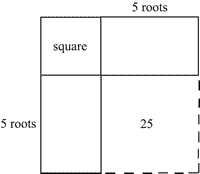
Image
In the diagram, since the rectangles are $5$ roots long thedotted square must be $25$ roots. But the total of square and rootsare given as $39$, so the side of the unknown square must be $3$,and the whole square $64$.
The 'Datis ' shows how, by analysis ofbasic geometrical properties and using letters of the alphabet torepresent numerical relationships, it is possible to establishgeneralised knowledge. Jordanus then illustrates each case withnumerical examples.
For example, inBook IVProposition 6, he shows that "If the ratio of two numbersand the sum of their squares is known, then each of the numbers isknown." [see: Note 6].
In modern symbols, he proceeds like this:$$\mbox{Given, }x : y= a \mbox { and } x^2 + y^2 = b$$
Let $d$ be the square of $x$, and $c$ the square of $y$,and let $d + c$be known , so wehave:
$$x : y = a, ~~~~~~~x^2 = d, ~~~~~~~y^2 = c, ~~\mbox {and so }~~d + c = b $$
Now the ratio of $d$ to $c$ is the square of the ratio of $x$to $y$, so $$\frac{d}{c}=\frac{x^2}{y^2}=a^2~~~~~~~~\frac{d}{c}y^2=b-y^2 ~~~~~~~~\left(\frac{d}{c}+1\right)y^2=b~~~~~~~~ \mbox {and so}y=\sqrt{\frac{b}{\left(a^2+1\right)}}$$
$$ \text{For example, if}\frac{x}{y}=2 \mbox { and } x^2+y^2=500 \mbox { then}y=\sqrt{\frac{500}{\left(4+1\right)}} = 10\mbox {, and }x=20~~~~~~~~~~~~~~~$$
The work of Jordanus was a significant change in the wayequations were tackled. Much more emphasis was given to the numberrelationships that were based on proportional reasoning. It was theunderstanding of these relationships that was so important toFrancois Viete later in the sixteenth century.
2. Early Renaissance Algebra
Nicolas Chuquet (1445 -1488)
Nicolas Chuquet was described as an'algoriste' and his manuscript onLe Triparty en la Science des Nombres(1484) was known only to a few of his contemporaries. 'Triparty'means three parts, and the first section was on Numbers and theiroperations; the second on Surds $\left(3+\sqrt{5}\right)$ and Rootsof Surds $\sqrt{\left(3+\sqrt{5}\right)}$; and the third onAlgebra, where he invented special symbols for the unknown, squaresand cubes up to the fourth power, and a system of indices whichincluded $x^0 = 1$. He also used the first letters of operationslikep for plus andm for minus. His algebrawas developed as a series of general methods and in this worknegative numbers appear as coefficients, exponents and solutions toproblems. His rules for solving arithmetic problems also used zeroand negative numbers. Unfortunately his work was little known, andnot published until 1880, but his ideas reappear in the early 17thcentury.
Luca Pacioli (1445 - 1517)
Pacioli was a contemporary of Chuquet, and famous for theSumma de Arithmetica, geometria,proportioni et proportionibus (1494) and theDivina Proportione (1509) Pacioli'sworks were important popular collections of current practicalmathematics and were more useful for passing on known techniquesand problems than for any original contributions. Pacioli is alsofamous for publishing the first description of double entrybook-keeping where negative numbers had an obvious practicalsignificance as debts or losses, and numerous works on accountingsoon appeared in other languages, obviously copied from Pacioli[see: Note 7].
3. Late Renaissance and Early Modern Algebra

Girolamo Cardano (1501- 1576)
Cardano earned his living as a doctor and by castinghoroscopes; he wrote on probability and published other books buthis importance for us rests on hisArtis Magnae sive de Regulis AlgebraicisLiber Unus (1545) "Of the Great Art, or the First Book onthe Rules of Algebra" the 'Ars Magna' as it is often called [see:Note 8].
While the methods for solving quadratic problems were wellknown as a collection of geometrically based proportional relationsand arithmetical algorithms, a unified and general approach wasstill not commonly available.
The big unsolved problem of the time was finding solutions tocubic equations. By this time mathematicians had identified about13 different cases of cubic equations which included variouscombinations of cubes, squares and numbers [see: Note 9]. TheArs Magna contains theproportional methods and rules that had been developed bymathematicians before him, his own work was also a significantcontribution, and he acknowledged the discoveries of hiscontemporaries.
Existing methods for solving cubic equations relied on findingsubstitutions to reduce them to quadratics; many of these trickscould only be applied to special cases. For example this is thefirst problem in Chapter XXV:
Whenthe cube is equal to the first power and a constant, divide thecoefficient of x into two parts that the sum of each multiplied bythe square root of the other is half the constant of the equation.The roots of these two parts added together make the value of$x$.
Example: $x^3 = 10x + 24$
Solution: "Ten divides into two parts, $9$ and $1$, either ofwhich multiplied by the square root of the other makes $9$ and $3$,the sum of which is $12$, one half of $24$. ThereforeR $9$ plusR $1$ which are $3$ and $1$ addedtogether, produce $4$, the value of x."[see: Note 10]
Throughout the book, everyrule was written in Latin; the only notations used werepfor plus andmfor minus and an elaborate capitalRfor radix, to indicate squareroots.
Image  | $~~~~~$ | Image  |
This symbol was invented by Regiomontanus (1436 - 1476) | This symbol was not commonly used until about 1630 |
Discovering Imaginary Numbers
In Chapter XXXVII Cardano discusses the use of negativenumbers in calculations, and in Rule II appears hisfirst use of negative squareroots.
The problem is to 'divide $10$ into two parts whose product is$40$'
His method is exactly the same as the 'Babylonian Algorithm'shown inPart 1 (Teachers' notes 5) and if we think of the problem as: $x(10 - x) = 40$, we have a quadratic equation $x^2 + 40 = 10x$(squares and numbers equal roots) with $10$ as the coefficient of$x$ which we divide in half,andproceed with the algorithm .
Cardano gives two solutions
$5$p :R :m $15$ and $5$m :R :m $15~~$. [see: Note 11]
The product of these two results is, in fact $40$, and hedemonstrates how to solve four other problems that give negativesquare roots. He was clearly mystified by these 'imaginary' squareroots of negative numbers, and this is still a problem for many whomeet them for the first time.
4. Introducing the 17th Century

Francois Viete (1540-1603)
In his two major works,InArtem Analyticem Isagoge (Introduction to the Analytic Art,1591) andDe PotestatumResolutione (On the Numerical Resolution of Powers 1600)Viete made probably the most important contributions to thedevelopment of algebra at this time.
Viete used a consistent symbolic notation with vowels A, E, I,O, U and Y for unknown quantities, and given terms by the lettersB, G, D and other consonants.
Addition and Subtraction used the symbols + and -. ForMultiplication he used the word 'in' and for Division used thefraction bar. So $$\frac{\mbox {B in C}}{\mbox {AQ}} \mbox { meant} \frac{\mbox {BC}}{A^2}$$
Powers were N (fornumerus - a pure number), Q(quadratus - a square) C(cubus - a cube) furtherpowers were expressed by combinations of these symbols, so QQ was afourth power, CQ, a fifth power and so on.
For Roots he used the symbol$L$ (forLatus - a side) and sometimes the$R$symbol . So $L9$ meant the square rootof $9$, and $LC 27$ meant the cube root of $27$.
All his equations were homogeneous - that means the dimensionsof all the terms in the equation had to be the same.
In the equation $~~~~AQ + AB = Z Q, ~~~~~AQ$ and $ZQ$represent squares, and AB a rectangle.
Some of these notational ideas were already being used; forexample,Johannes Scheubel(1494 - 1570) writing in 1551 used special combinations of symbolsfor powers of the unknown:

The English mathematician,Robert Recorde used the same notationin his book [see: Note 12] on algebra in 1557 but describes thepowers of numbers in this way:

Using his literal notation,Viete exposed thestructural aspects of polynomial equations and gave solutionmethods for whole classes of equations.
Viete's solution of quadratic equations used the threeproportional triangles in a semi-circle shown inPart1 (Section 6. Greek Geometry)

The equation: $ A$quadratus $+ AB = Z $quadratus or $ (A^2 + AB = Z^2) $, inViete's symbols is $AQ + AB = Z Q$, which can be written as$A(A+B)=ZZ$ and rearranged as equal proportions becomes: $$\frac{A}{Z}=\frac{Z}{(A+B)}$$
In the diagram there are three lines of increasing magnitude,$FC, FD$ and $FB$.
$FC$ is $A$, $~~~~~FD$ is $Z~~$and $FB$ is $A+B$
For three magnitudes in proportion, the well-known ruleis:
'the product of the extremes isequal to the square of the mean'.
The lines $A$ and $(A+B)$ are theextremes and $Z$ is themean .
For the equation $A^2 + 10A = 144, ~~~~~Z = 12 ~~~$ and $~~~A: 12 = 12 : (A+10)$ so we have to find a number $A$, so that theratios are equal. The three numbers are $8, 12$ and $18$.
The Fundamental Theorem of Algebra

Thomas Harriot (c1560- 1621) andAlbert Girard(1595-1632)
By this time, many mathematicians were working on similarproblems and developing their own notations. The most important ofthese were Thomas Harriot, an English mathematician and explorer,and Albert Girard, a Dutch Army Engineer. Harriot's work remainsmainly in manuscript form, even today. HisArtis Analyticae Praxis (The Practiceof the Analytical Art) only appeared in 1661 well after his death,but his papers show that he had developed a sophisticated notation,almost like we use today, using $aa$ for $a^2, aaa$ for $a^3$ etc.and through this realised that multiplying brackets like $(b - a)(c- a)(d - a)$ led to a clear relationship between the roots andcoefficients of an equation.
The first explicit statement of the idea that every polynomialequation of degree $n$ has $n$ roots appeared in 1629 in Girard'sL'Invention Nouvelle enL'Algebre (A New Discovery in Algebra). Here, Girard stateshis basic theorem,
"Everyalgebraic equation .... admits of as many solutions as thedenomination of the highest quantity indicates ..."
Girard gave examples, but did not show how he derived histheorem, and did not clearly account for 'imaginary' roots. Thesearch for a general proof occupied mathematicians for many yearsto come.

Rene Descartes (1596 -1650)
Even though many improvements in notation had begun to exposethe structure of algebraic equations, and begun to transform therepresentation of the problems from geometric images to writtenexpressions, mathematicians still used geometry as a way ofdemonstrating the 'truth' and generality of the algebra.
In 1637 he published hisDiscours de la Methode'... a work on'how to undertake investigation to make ideas clear, and to seekfor truth in the sciences'. As an example of this method heincludedLa Geometriewhich states on the first page that,
"Anyproblem in geometry can easily be reduced to such terms that aknowledge of the length of certain straight lines is sufficient forits construction."
Descartes demonstrates how this may be done:

The equation is $z^2 \varpropto az-bb$. Construct $LM$ and$LN$ so that $LM =b$ and $LN = \frac{a}{2}$
The unknown $z$, is $OM$. In triangle$NLM$, $$ NM^2=\left(\frac{a}{2} \right)^2 + bb ~~\mbox { and }~~NM =\sqrt{\left(\frac{a}{2} \right)^2 + bb}~~~ \mbox{. So }z=\frac{a}{2}+\sqrt{\left(\frac{a}{2} \right)^2 + bb}.$$
However, Descartes still appealed to a theorem from EuclidBook II Proposition 6 to justify his solution to the reader.

The rectangle contained by $OM$ and $PM$, plus the square on$NP$, is equal in area to the square on $NM$. ($N$ bisects $OP$.)The area of the green rectangle is the same as the areas of the redrectangles.
$$ OM.PM + NP^2 = NM^2 $$
Here is Descartes' original description of the problem:

5. Notation and Representation[see: Note 13]
By the middle of the 17th Century the representation ofelementary algebraic problems and relations looked much as it istoday. The major factors influencing change were the printing pressthat provided wider communication of ideas, and the slowappreciation of the similarity in the structure of the algorithmsbrought about by the changes in notation. Most of this happened inthe period from 1500 to 1650; by then the standard notation hadbecome generally accepted.
There were no clear stages in this process. Some historiansproposed a 'literal' stage where all the problems are written,sometimes in very complicated language; a 'syncopated' stage with amixture of words and symbols; and a final 'symbolic' stage wherethe mathematics consists only of symbols. But this is not the case,even today when you look at a text, words are still there. Anotheraspect wasthe technicallanguage . Translating from Greek and Arabic into Latin, andthen into the common language of a country, new words were inventedto describe new ideas, and were then taken over by others. Forexample, the German for 'thing' or the unknown, was 'Die Coss', thetitle of a book byMichaelStifel (1487 - 1567). So, in England, algebra became knownas theCossic Art .Borrowing from the French, the pentagon was known as acinqangle and so on. There are manymore examples among the writings of English mathematicians of the16th and 17th centuries.
Representation of the objects, relationships, operations, andthe structure of processes together with the evolution of theprinting press, were the most important aspects which aided thedevelopment of mathematics during this period.
The signs forAdditionandSubtraction firstappear in print in 1526, and theEquals sign appears in 1557. The crossX forMultiplication islater, about 1628; the Colon (: ) forDivision in 1633 and the Obelus($\div$) in 1659. The signs forinequality , > and < are firstused in 1631.
Square and otherroots start as the capitalR (as in the picture above)in about 1465 and eventually our usual sign $\sqrt{}$ by 1630;Powers were first expressedby whole number indices in 1484 and had become widely accepted by1637, andnegative indicesalso appear in 1484, butfractional indices not until1676.
The symbols for theunknown and forconstants are greatly varied. All kindsof signs and combinations of signs were initially used. Jordanusused letters to replace numbers as a sign of generality, Vieta wasthe first to use vowels (A, E, I, O, U) for the unknown andconsonants (A, B, C, ...) for known quantities, and Descartesintroduced the convention of letters at the end of the alphabet (x,y, z) for unknown and at the beginning (a, b, c) for knownquantities which is what we use today.
N.B.Teachers' notes related to the history of algebra discussedhere can be found by clicking on the 'Notes' tab at the top of thisarticle .
Notes
- It is important to note that there were many people throughoutthis period from the 11th to the 17th century who made significantcontributions to the story of the development of algebra, and havenot been mentioned here. Further information can be found byconsulting the references.
- We are very lucky that copies of Fibonacci's books havesurvived. TheLiber Abaci(1202 ),PracticaGeometriae (1220),Flos and theBook of Squares both produced in 1225tell us a great deal about mathematics in the early Mediaevalperiod.
- Fibonnaci's approximate result is correct to nine decimalplaces. This equation was solved by Omar Khayyam (1048 - 1122)using the intersection of a circle with a hyperbola.
- The Abacus Schools were training courses for merchants incommercially useful arithmetic, but they also included 'puzzleproblems'. Fibonacci has been mistakenly seen as the father of theAbacus Schools, but they existed well before his time.
- TheArithmetica ofDiophantos (c200 - c284) had been translated and developed by theArabs and was available in Latin at this time.
- I have taken this example from the translation by BarnabasHughes, pages 167-168.
- It is interesting to contrast the social circumstances and thequality of the work of Chuquet and Pacioli. Chuquet had access tomany mathematical works, and made the most of his opportunities indeveloping original ideas. However he was relatively isolated,hardly went outside his home city of Lyon, and his manuscript workwas not printed at the time. Pacioli on the other hand was borninto a commercial milleu in Italy, was known to two famous artists,Piero della Francesca and Leone Battista Alberti, was a tutor tothe sons of powerful people in Venice and Rome, and had his booksprinted. This is not to denigrate Pacioli, but only to point outthat different circumstances and the printing press played a largepart in their fortunes.
- Most recent histories of mathematics give versions of the storyof the solution of equations in 15th and 16th century Italy.Chapter 4 of John Derbyshire'sUnknown Quantity gives a good accountof the convolutions surrounding Cardan's work.
- We know that a cubic equation has three roots that are real orimaginary according to whether the graph cuts the x-axis in threeplaces, touches the axis at a minimum, or cuts it only once.Clearly, these concepts were not available to Cardano.
- The substitution 'trick' comes from the works of Fibonacci andJordanus: in our notation, if $x^3=ax+N$, let $a=f+g $ and let $ f\sqrt{g}+g\sqrt{f}=\frac{N}{2}$ then $x=\sqrt{f}+\sqrt{g}$
- $5+\sqrt{-15}$ and $5-\sqrt{-15}$
- Robert RecordeThe Whetstoneof Witte 1557. Another interesting aspect of the evolutionof mathematical understanding is the development of a universaltechnical language. In England, many words were taken over fromFrench (moitie meaninghalf) and German (zenzike meaning square). This is where thestrange z symbol comes from.
- For websites with more detailed information on the developmentof notation see the list of References.
References
a) General sources covering themathematics of the Middle Ages and Renaissance:
Boyer, C. B. (1968)AHistory of Mathematics . London. John Wiley. A popular bookwith many reprints. Chapters XV and XVI cover the Middle Ages andthe Renaissance.
Cajori, F. A. (2007)AHistory of Mathematical Notations 2 Vols. . This is theprincipal source book for information in this area. Originallypublished in 1928/9 by Open Court, there is a new paperback editionavailable from Amazon at £ 17 for each volume. A bargainfor your college library.
Derbyshire, J. (2008)TheUnknown Quantity . London. Atlantic Books Now in paperbackat £9.99 this is a popular story of the problem offinding the 'thing' of ancient algebra up to the 20th Century. TheIntroduction and Part 1 up to page 94 1591cover the ideas in bothparts of this NRICH account. There are useful sections givingreasonable straightforward explanations of the mathematicsinvolved.
Katz, Victor, J. (1999) (Second Edition, Corrected)A History of Mathematics :An Introduction Harlow,England. Addison-Wesley The best and most comprehensive andup-to-date general history of mathematics available. Chapter 9'Algebra in the Renaissance' (pages 342 - 384) covers most of thematerial in this article.
Kline, M. (1972) Mathematical Thought from Ancient to ModernTimes. Oxford. O.U.P. Before Katz, this was the best available andhas been reprinted a number of times. Chapters 11 to 13 on theRenaissance and its mathematics are still very useful.
b) More specialised sourcesavailable in translation:
Girolamo Cardano (1545)TheGreat Art, or the Rules of Algebra. (Translated by R.Witmer) 1968. M.I.T. Press.
Nicolas Chuquet, RenaissanceMathematician (1985) Translated by Graham Flegg, Cynthia Hayand Barbara Moss ofLe Tripartyen la Science des Nombres . Lancaster Reidel PublishingCompany.
Rene Descartes (1637)LaGeometrie (Translated by D.E. Smith and Marcia Latham) 1954.This Dover edition of the Geometry is still available. The Englishtranslation is on one page, and a facsimile of the original Frenchon the facing page. The French is not too difficult, and thenotation for a quadratic equation virtually the same astoday.
Leonardo FibonacciThe Bookof Squares (Translated by L.E. Sigler ) 1987) London.Academic Press.
Jordanus de NemoreDeNumeris Datis (Translated by Barnabas Hughes) 1981University of California Press.
Recorde, Robert (1557)TheWhetstone of Witte From the original English Text.
Johannes Scheubel (1551)Algebrae Compendiosa From the OriginalLatin Text Francois
Viete (1591)The AnalyticArt (Translated by R. Witmer) 1983 Kent State UniversityPress
Weblinks
The 'MACTUTOR ' is themost comprehensive easily navigable website for the History ofMathematics.
Here you can find the biographies of the mathematiciansmentioned in this article, including some detail of the relevantmathematics involved.
The earliest use of various mathematical symbols can be foundat:
NRICH Links
Mathematical symbols:
Girard stated the Fundamental Theorem of Algebra, but theproof for all kinds of polynomials was difficult to achieve.
Proof: A Brief HistoricalSurvey:
The search for general solutions to polynomial equations ledto the development of Galois Theory.
Introduction to GaloisTheory:
Here is an Algebra Problem from 1525.
Rudolff's Problem:
Diophantos' mathematics was translated by the Arabs in the10th century. Many of his problems appeared in the work ofFibonacci and Jordanus
Diophantine N-tuples:
The first diagram in this article represents some ideas thatare also found in Fibbonacci'sBook of Squares
Picturing PythagoreanTriples:
This is a modern treatment of the 'Imaginary' numbersdiscovered by Cardano
What are Complex Numbers?