

matplotlib.tri¶Unstructured triangular grid functions.
matplotlib.tri.Triangulation(x,y,triangles=None,mask=None)¶An unstructured triangular grid consisting of npoints points andntri triangles. The triangles can either be specified by the useror automatically generated using a Delaunay triangulation.
| Parameters: | x, y : array_like of shape (npoints)
triangles : integer array_like of shape (ntri, 3), optional
mask : boolean array_like of shape (ntri), optional
|
|---|
Notes
For a Triangulation to be valid it must not have duplicate points,triangles formed from colinear points, or overlapping triangles.
Attributes
edges | |
neighbors | |
| is_delaunay | (bool) Whether the Triangulation is a calculated Delaunay triangulation (wheretriangles was not specified) or not. |
calculate_plane_coefficients(z)¶Calculate plane equation coefficients for all unmasked triangles fromthe point (x,y) coordinates and specified z-array of shape (npoints).Returned array has shape (npoints,3) and allows z-value at (x,y)position in triangle tri to be calculated usingz = array[tri,0]*x + array[tri,1]*y + array[tri,2].
edges¶Return integer array of shape (nedges,2) containing all edges ofnon-masked triangles.
Each edge is the start point index and end point index. Eachedge (start,end and end,start) appears only once.
get_from_args_and_kwargs(*args,**kwargs)¶Return a Triangulation object from the args and kwargs, andthe remaining args and kwargs with the consumed values removed.
There are two alternatives: either the first argument is aTriangulation object, in which case it is returned, or the argsand kwargs are sufficient to create a new Triangulation toreturn. In the latter case, see Triangulation.__init__ forthe possible args and kwargs.
get_masked_triangles()¶Return an array of triangles that are not masked.
get_trifinder()¶Return the defaultmatplotlib.tri.TriFinder of thistriangulation, creating it if necessary. This allows the sameTriFinder object to be easily shared.
neighbors¶Return integer array of shape (ntri,3) containing neighbortriangles.
For each triangle, the indices of the three triangles thatshare the same edges, or -1 if there is no such neighboringtriangle. neighbors[i,j] is the triangle that is the neighborto the edge from point index triangles[i,j] to point indextriangles[i,(j+1)%3].
set_mask(mask)¶Set or clear the mask array. This is either None, or a booleanarray of shape (ntri).
matplotlib.tri.TriFinder(triangulation)¶Abstract base class for classes used to find the triangles of aTriangulation in which (x,y) points lie.
Rather than instantiate an object of a class derived from TriFinder, it isusually better to use the functionmatplotlib.tri.Triangulation.get_trifinder().
Derived classes implement __call__(x,y) where x,y are array_like pointcoordinates of the same shape.
matplotlib.tri.TrapezoidMapTriFinder(triangulation)¶Bases:matplotlib.tri.trifinder.TriFinder
TriFinder class implemented using the trapezoidmap algorithm from the book “Computational Geometry, Algorithms andApplications”, second edition, by M. de Berg, M. van Kreveld, M. Overmarsand O. Schwarzkopf.
The triangulation must be valid, i.e. it must not have duplicate points,triangles formed from colinear points, or overlapping triangles. Thealgorithm has some tolerance to triangles formed from colinear points, butthis should not be relied upon.
__call__(x,y)¶Return an array containing the indices of the triangles in which thespecified x,y points lie, or -1 for points that do not lie within atriangle.
x,y are array_like x and y coordinates of the same shape and anynumber of dimensions.
Returns integer array with the same shape andx andy.
matplotlib.tri.TriInterpolator(triangulation,z,trifinder=None)¶Abstract base class for classes used to perform interpolation ontriangular grids.
Derived classes implement the following methods:
__call__(x,y),where x, y are array_like point coordinates of the same shape, andthat returns a masked array of the same shape containing theinterpolated z-values.gradient(x,y),where x, y are array_like point coordinates of the sameshape, and that returns a list of 2 masked arrays of the same shapecontaining the 2 derivatives of the interpolator (derivatives ofinterpolated z values with respect to x and y).
matplotlib.tri.LinearTriInterpolator(triangulation,z,trifinder=None)¶Bases:matplotlib.tri.triinterpolate.TriInterpolator
A LinearTriInterpolator performs linear interpolation on a triangular grid.
Each triangle is represented by a plane so that an interpolated value atpoint (x,y) lies on the plane of the triangle containing (x,y).Interpolated values are therefore continuous across the triangulation, buttheir first derivatives are discontinuous at edges between triangles.
| Parameters: | triangulation :
z : array_like of shape (npoints,)
trifinder :
|
|---|
Methods
__call__ (x, y) | ( Returns interpolated values at x,y points) |
gradient (x, y) | (Returns interpolated derivatives at x,y points) |
__call__(x,y)¶Returns a masked array containing interpolated values at the specifiedx,y points.
| Parameters: | x, y : array-like
|
|---|---|
| Returns: | z : np.ma.array
|
gradient(x,y)¶Returns a list of 2 masked arrays containing interpolated derivativesat the specified x,y points.
| Parameters: | x, y : array-like
|
|---|---|
| Returns: | dzdx, dzdy : np.ma.array
|
matplotlib.tri.CubicTriInterpolator(triangulation,z,kind='min_E',trifinder=None,dz=None)¶Bases:matplotlib.tri.triinterpolate.TriInterpolator
A CubicTriInterpolator performs cubic interpolation on triangular grids.
In one-dimension - on a segment - a cubic interpolating function isdefined by the values of the function and its derivative at both ends.This is almost the same in 2-d inside a triangle, except that the valuesof the function and its 2 derivatives have to be defined at each trianglenode.
The CubicTriInterpolator takes the value of the function at each node -provided by the user - and internally computes the value of thederivatives, resulting in a smooth interpolation.(As a special feature, the user can also impose the value of thederivatives at each node, but this is not supposed to be the commonusage.)
| Parameters: | triangulation :
z : array_like of shape (npoints,)
kind : {‘min_E’, ‘geom’, ‘user’}, optional
trifinder :
dz : tuple of array_likes (dzdx, dzdy), optional
|
|---|
Notes
This note is a bit technical and details the way aCubicTriInterpolator computes a cubicinterpolation.
The interpolation is based on a Clough-Tocher subdivision scheme ofthetriangulation mesh (to make it clearer, each triangle of thegrid will be divided in 3 child-triangles, and on each child trianglethe interpolated function is a cubic polynomial of the 2 coordinates).This technique originates from FEM (Finite Element Method) analysis;the element used is a reduced Hsieh-Clough-Tocher (HCT)element. Its shape functions are described in[R1].The assembled function is guaranteed to be C1-smooth, i.e. it iscontinuous and its first derivatives are also continuous (thisis easy to show inside the triangles but is also true when crossing theedges).
In the default case (kind =’min_E’), the interpolant minimizes acurvature energy on the functional space generated by the HCT elementshape functions - with imposed values but arbitrary derivatives at eachnode. The minimized functional is the integral of the so-called totalcurvature (implementation based on an algorithm from[R2] - PCG sparsesolver):
If the casekind =’geom’ is chosen by the user, a simple geometricapproximation is used (weighted average of the triangle normalvectors), which could improve speed on very large grids.
References
| [R1] | (1,2) Michel Bernadou, Kamal Hassan, “Basis functions for generalHsieh-Clough-Tocher triangles, complete or reduced.”,International Journal for Numerical Methods in Engineering,17(5):784 - 789. 2.01. |
| [R2] | (1,2) C.T. Kelley, “Iterative Methods for Optimization”. |
Methods
__call__ (x, y) | ( Returns interpolated values at x,y points) |
gradient (x, y) | (Returns interpolated derivatives at x,y points) |
__call__(x,y)¶Returns a masked array containing interpolated values at the specifiedx,y points.
| Parameters: | x, y : array-like
|
|---|---|
| Returns: | z : np.ma.array
|
gradient(x,y)¶Returns a list of 2 masked arrays containing interpolated derivativesat the specified x,y points.
| Parameters: | x, y : array-like
|
|---|---|
| Returns: | dzdx, dzdy : np.ma.array
|
Examples
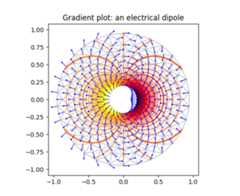
An example of effective application is shown below (plot of thedirection of the vector field derivated from a known potential field):
matplotlib.tri.TriRefiner(triangulation)¶Abstract base class for classes implementing mesh refinement.
A TriRefiner encapsulates a Triangulation object and provides tools formesh refinement and interpolation.
Derived classes must implements:
refine_triangulation(return_tri_index=False,**kwargs), wherethe optional keyword argumentskwargs are defined in eachTriRefiner concrete implementation, and which returns :
- a refined triangulation
- optionally (depending onreturn_tri_index), for eachpoint of the refined triangulation: the index ofthe initial triangulation triangle to which it belongs.
refine_field(z,triinterpolator=None,**kwargs), where:
- z array of field values (to refine) defined at the basetriangulation nodes
- triinterpolator is a
TriInterpolator(optional)- the other optional keyword argumentskwargs are defined ineach TriRefiner concrete implementation
and which returns (as a tuple) a refined triangular mesh and theinterpolated values of the field at the refined triangulation nodes.
matplotlib.tri.UniformTriRefiner(triangulation)¶Bases:matplotlib.tri.trirefine.TriRefiner
Uniform mesh refinement by recursive subdivisions.
| Parameters: | triangulation :
|
|---|
refine_field(z,triinterpolator=None,subdiv=3)¶Refines a field defined on the encapsulated triangulation.
Returnsrefi_tri (refined triangulation),refi_z (interpolatedvalues of the field at the node of the refined triangulation).
| Parameters: | z : 1d-array-like of length
triinterpolator :
subdiv : integer, optional
|
|---|---|
| Returns: | refi_tri :
refi_z : 1d array of length:refi_tri node count.
|
Examples
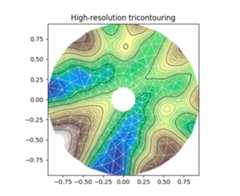
The main application of this method is to plot high-qualityiso-contours on a coarse triangular grid (e.g., triangulation builtfrom relatively sparse test data):
refine_triangulation(return_tri_index=False,subdiv=3)¶Computes an uniformly refined triangulationrefi_triangulation ofthe encapsulatedtriangulation.
This function refines the encapsulated triangulation by splitting eachfather triangle into 4 child sub-triangles built on the edges midsidenodes, recursively (level of recursionsubdiv).In the end, each triangle is hence divided into4**subdivchild triangles.The default value forsubdiv is 3 resulting in 64 refinedsubtriangles for each triangle of the initial triangulation.
| Parameters: | return_tri_index : boolean, optional
subdiv : integer, optional
|
|---|---|
| Returns: | refi_triangulation :
found_index : array-like of integers
|
matplotlib.tri.TriAnalyzer(triangulation)¶Define basic tools for triangular mesh analysis and improvement.
A TriAnalizer encapsulates aTriangulationobject and provides basic tools for mesh analysis and mesh improvement.
| Parameters: | triangulation :
|
|---|
Attributes
scale_factors |
circle_ratios(rescale=True)¶Returns a measure of the triangulation triangles flatness.
The ratio of the incircle radius over the circumcircle radius is awidely used indicator of a triangle flatness.It is always<=0.5 and==0.5 only for equilateraltriangles. Circle ratios below 0.01 denote very flat triangles.
To avoid unduly low values due to a difference of scale between the 2axis, the triangular mesh can first be rescaled to fit inside a unitsquare withscale_factors (Only ifrescale is True, which isits default value).
| Parameters: | rescale : boolean, optional
|
|---|---|
| Returns: | circle_ratios : masked array
|
get_flat_tri_mask(min_circle_ratio=0.01,rescale=True)¶Eliminates excessively flat border triangles from the triangulation.
Returns a masknew_mask which allows to clean the encapsulatedtriangulation from its border-located flat triangles(according to theircircle_ratios()).This mask is meant to be subsequently applied to the triangulationusingmatplotlib.tri.Triangulation.set_mask() .new_mask is an extension of the initial triangulation maskin the sense that an initially masked triangle will remain masked.
Thenew_mask array is computed recursively ; at each step flattriangles are removed only if they share a side with the currentmesh border. Thus no new holes in the triangulated domain will becreated.
| Parameters: | min_circle_ratio : float, optional
rescale : boolean, optional
|
|---|---|
| Returns: | new_mask : array-like of booleans
|
Notes
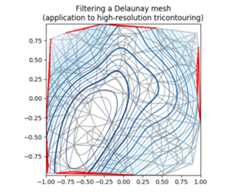
The rationale behind this function is that a Delaunaytriangulation - of an unstructured set of points - sometimes containsalmost flat triangles at its border, leading to artifacts in plots(especially for high-resolution contouring).Masked with computednew_mask, the encapsulatedtriangulation would contain no more unmasked border triangleswith a circle ratio belowmin_circle_ratio, thus improving themesh quality for subsequent plots or interpolation.
Examples
Please refer to the following illustrating example:
scale_factors¶Factors to rescale the triangulation into a unit square.
Returnsk, tuple of 2 scale factors.
| Returns: | k : tuple of 2 floats (kx, ky)
|
|---|


 and the second those of
 .
.


