
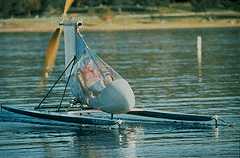
On 27 October 1991, Mark Drela pedalled the human-powered hydrofoil,Decavitator, to aworld-record speed of 18.5 knots (9.53 meters/second) over a 100 meter race course on the Charles River in Boston, Massachusetts.
In the spring of 1993 the Decavitatorteam was awarded the DuPont prize for the fastest human-powered water craft. This prize was to be awarded to the first team to break 20 knots over a 100 meter course, or to the team with the fastest speed on record as of 31 December 1992.
A Little Background Information...
The trek to the world record flight began in 1988 as Daedalus team members Marc Schafer and Bryan Sullivan returned from Greece. At that time they decided to build a human-powered vehicle (HPV) that an armchair athlete could operate. Marc initiated a student-run project (under MIT's Undergraduate Research Opportunities Program - UROP) with funding from the MIT SeaGrant program. When the $25 000 DuPont Prize was announced in 1989, the goals of the project changed and speed became the primary objective. For the rest of the story, see thehistory page.
Where did the name "Decavitator" come from? Traditional boats often encounter problems at high speeds when their propellors cavitate. This boat uses an air propellor, and thus never suffers from cavitation. Also, if you stand too close to the propellor you could lose your head.
What's In This Page...
This page contains links to ahistory of the project, a summary ofwho was involved, a short time line of the project (including a summary of theversions the boat went through), and the projectsponsors.
In addition, you will find thespecifications for the boat as well as a page that describes some of themethods andmaterials used to manufacture the boat. See the3-view drawing of the boat if you are confused about its layout.
You can skim through thehistory text and view the videos and still images in historical context, or go right to the list ofvideo segments orstill images to get a visual outline of what happened. Unfortunately, there aren't many sounds unique to this project, so we don't have much of an audio history.
If you're interested in still more human-powered hydrofoil stuff, stop by theInternational Human Powered Vehicle Association for information about all kinds of human-powered vehicles.
Index to all the Decavitator documentation
