Uh oh!
There was an error while loading.Please reload this page.
- Notifications
You must be signed in to change notification settings - Fork3.1k
DevOps Roadmap for 2025. with learning resources
License
milanm/DevOps-Roadmap
Folders and files
| Name | Name | Last commit message | Last commit date | |
|---|---|---|---|---|
Repository files navigation
This is a step-by-step guide on how to become a DevOps engineer, with links to relevant learning resources.
If you want to learn more about DevOps, be sure to subscribe tomy newsletter.
If you find this repository helpful, consider supporting me on Patreon:

The purpose of this roadmap is to give you an idea about the landscape. The road map will guide you if you are confused about what to learn next, rather than encouraging you to pick what is hype and trendy. You should grow some understanding of why one tool would be better suited for some cases than the other and remember that hype and trendy do not always mean best suited for the job.
If you like or are using this project to learn or start your solution, please give it a star. Thanks!
Here is the complete DevOps roadmap.

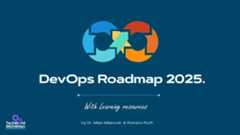
DownloadPDF version.
- Learning resources for DevOps Engineers (mostly free)
- 1. GIT
- 2. Learn one programming language
- 3. Learn Linux & Scripting
- 4. Learn Networking & Security
- 5. Learn Server Management
- 6. Learn Containers
- 7. Learn Container Orchestration
- 8. Learn Infrastructure as a code (X as Code)
- 9. Learn CI/CD
- 10. Learn Monitoring & Observability
- 11. Learn one Cloud provider
- 12. Learn Software Engineering Practices
- Bonus: Learn DevSecOps Fundamentals
- Additional resources
All your resources (files) will be held in a GIT repository. Those files areapplication code but alsoinfrastructure as a code.
Git is a free tool used for source code management. Git is used to tracking changes in the source code, enabling multiple developers to work together on non-linear development.
The two most popular Git platforms areGitLab andGitHub.
Here you need to learn Git commands, like git clone, branch, merge, and how to collaborate on a project with pull requests.
Resources:
- Pro Git BookFREE
- Learn Git by AtlassianFREE
- Learn Git BranchingFREE
- Learn Git & GitHub on CodeAcademyFREE
- Git Command ExplorerFREE
- Git ImmersionFREE
- A Visual Git ReferenceFREE
- Git & GitHub TutorialFREE
- Advanced Git TutorialFREE
As an engineer, it is recommended to know at least one programming language that you can use to writeautomation scripts.
Some popular programming languages for DevOps-es arePython, Go, and JavaScript.
Python is a multi-paradigm language. Being an interpreted language, code is executed as soon as it is written, and the syntax allows for writing code in different ways.Python is frequently recommended as the first language new coders should learn, because of its focus on readability, consistency, and ease of use.
Here you need to learn basic concepts of programming languages, such as syntax, if/else, loops, data structures, etc.
Resources:
- Python:
- #"auto">
- The Modern JavaScript TutorialFREE
- JavaScript Crash Course For BeginnersFREE
- Eloquent JavaScript, 3rd edition, Marjin HaverbekeFREE book
- Go by ExampleFREE
- Learn Go with TestsFREE
An Operating system serves as a bridge between a computer's user and its hardware. Its function is to offer a setting in which a user can conveniently and effectively run programs.
As most servers useLinux OS, you need to make yourself comfortable with Linux and its CLI.
Learn basic commands, such as: ls, cd, mkdir, rm, cp, mv, touch, cat, printenv, grep, find, chmod, chmod, ps, kill, top, df, du, tar, gzip, ssh, scp, wget, curl, etc.
One easy-to-start distribution isUbuntu.
In addition, you need to knowscripting to automate tasks for development and operations.
Here you can learn OS-specific languages, such asBash or Powershell, or independent, like Python or Go.
Resources:
- Operating System - OverviewFREE
- Shell Scripting TutorialFREE
- Powershell Tutorial for Beginners: Learn Powershell ScriptingFREE
- Bash Reference ManualFREE
- Ultimate Guide: Getting Started With UbuntuFREE
- FreeBSD HandbookFREE
- Linux command handbookFREE
- Linux commands for Cloud and Devops engineersFREE
Anetwork protocol is an established set of rules that determine how data is transmitted between different devices in the same network. Essentially, it allows connected devices to communicate with each other, regardless of any differences in their internal processes, structure, or design.
Here you will need to know how a network works, how to configurefirewalls, understand howDNS works,OSI model, IP addresses, ports, etc.
Resources:
- OSI Model ExplainedFREE
- Computer Networking: A Top-Down ApproachbookVideo Contentvideo
- TCP/IP and Networking Fundamentals for IT ProsPluralsight course
- DevSecOps : Master Securing CI/CD | DevOps PipelineUdemy course
- Hands-On Security in DevOps: Ensure continuous security, deployment, and delivery with DevSecOps Book
- Securing DevOps: Security in the Cloud Book
- Professor Messers Network+ courseFREE
- How DNS works
- How DNSSEC works
- How HTTPS works
Server management includes all the infrastructure monitoring and maintenance required for servers to operate reliably and at optimal performance levels. The primary goals of aneffective server management strategy are to:
- Minimize server slowdowns and downtime while maximizing reliability.
- Build secure server environments.
- Scale servers and related operations to meet the needs of the organization over time.
Here you will need to know what isforward and reverse proxies,caching servers, and how to operateWeb Servers, such as Nginx, Apache, or IIS.
Resources:
- What is a reverse proxy?FREE
- What is a CDN edge server??FREE
- Cache ServerFREE
- Reverse Proxy vs. Forward Proxy: The DifferencesFREE
- What is load balancing?FREE
- What is a Firewall?FREE
- The NGINX HandbookFREE
- Learn Apache ServerFREE
- Learn IISFREE
Acontainer is a standard unit of software that packages up code and all its dependencies, so the application runs quickly and reliably from one computing environment to another.
Docker is by far the most popular container technology today. A Docker container image is a lightweight, standalone, executable package of software that includes everything needed to run an application: code, runtime, system tools, system libraries, and settings.
Here you need to know how to run containers, Docker Networking, Volumes, Dockerfiles, and run multiple containers with Docker-Compose.
Docker Compose is important as pre-requisite for Kubernetes. It is a tool for defining and running multi-container Docker applications. With Compose, you use a YAML file to configure your application’s services. Then, with a single command, you create and start all the services from your configuration.
Resources:
- What are Containers?FREE
- Learning Containers From The Bottom UpFREE
- Docker Crash Course for Absolute Beginners by TechWorld with NanaFREE
- Docker Tutorial for Beginners by TechWorld with NanaFREE
- Ultimate Docker Compose Tutorial by TechWorld with NanaFREE
- Docker Mastery: with Kubernetes + Swarm from a Docker CaptainUdemy course
- What is Service Mesh?FREE
- DevOps with KubernetesFREE
- OCI Specification
Container orchestrationautomates the deployment, management, scaling, and networking of containers.
Container orchestration can be used in any environment where you use containers. It can help you to deploy the same application across different environments without needing to redesign it. And microservices in containers make it easier to orchestrate services, including storage, networking, and security.
Here you need to learn howKubernetes works, and how to administer the Kubernetes cluster and deploy applications on it.
You need to know basic components of Kubernetes, such as: Master Node, Worker Node, Pod, ReplicaSet, Deployment, Service, Ingress, ConfigMap, Secret, PersistentVolume, PersistentVolumeClaim, StatefulSet, DaemonSet, Job and CronJob.
Also, you need to know how to work with kubectl and Helm tools.
Resources:
- Kubernetes Crash Course for Absolute Beginners by TechWorld with NanaFREE
- Primer: How Kubernetes Came to Be, What It Is, and Why You Should CareArticle
- Certified Kubernetes Administrator (CKA) with Practice TestsUdemy course
- Learn Kubernetes - Beginners to Advanced by KodeKloudCourse
- Understand when to use Cluster Services, Ingresses or API GatewaysFREE
- Understand which Problems Service Mesh solve (Use an Abstraction smi-spec.ioFREE
- Learn how to automate TLS andDNSFREE
- Kubernetes Up and RunningBook
- Kubernetes Learning Path - 50 days from zero to hero from MicrosoftFREE
- Below Kubernetes: Demystifying container runtimesFREE
Sometimes referred to asIaC, it refers to the techniques and tools used to define infrastructure, typically in a markup language like YAML or JSON. Infrastructure as code allows Engineers to automate environment setup and teardown. Accelerates and de-risks deployment by provisioning gold copy environments on demand.
Terraform is the most popular infrastructure provisioning tool, but there are others such as Ansible, Chef, Puppet, and Vagrant.
Here you need to know how to doinfrastructure provisioning andconfiguration management.
Resources:
- GUIs, CLI, APIs: Learn Basic Terms of Infrastructure-as-CodeFREE
- Terraform:
- Puppet:
- Puppet overviewFREE
- Puppet CoursesFREE and PAID
- Chef:
- Learn ChefFREE
- Ansible:
- Getting Started With AnsibleFREE
- Learning Ansible Basics
- Get started with Red Hat AnsibleFREE and PAID
- Mastering AnsibleUdemy Course</sup
- Istio:
- What is Istio?FREE
Continuous Integration / Continuous Deployment (CI/CD) is a method to frequently deliver apps to customers by introducingautomation into the stages of app development. CI/CD is a solution to the problems integrating new code can cause for development and operations teams.
CI/CD introduces continuous automation andcontinuous monitoring throughout the lifecycle of apps, from integration and testing phases to delivery and deployment. These connected practices are often referred to as a "CI/CD pipeline" and are supported by development and operations teams.
There aredifferent stages of a CI/CD pipeline, such as:build, test and deploy, but there could be much more activities included:
- Checking code from version control and building it
- Having staged gates for different kinds of approvals
- Managing environment variables
- Restarting services
- Executing tests
- And more...
Here you need to learn how to set up CI/CD server, integrate code and trigger pipelines automatically, store and read secrets, and build and package management tools.
Somepopular CI/CD tools are: Jenkins, TeamCity, CircleCI, Bamboo, GitLab, and Azure DevOps.
Resources:
- Continuous IntegrationFREE
- CI/CD Pipeline: A Gentle IntroductionFREE
- Jenkins:
- Azure DevOps:
- GitHub Actions:
- GitLab:
Monitoring entails overseeing the entire development process from planning, development, integration and testing, deployment, and operations. It involves a complete andreal-time view of the status of applications, services, and infrastructure in the production environment.
This is especially important when our software is inproduction, and we need to track all kinds of issues in our infrastructure and application.
The two most popular tools arePrometheus andGrafana, but also Cloud-based tools such as AWS CloudWatch, Azure Monitor, and Google Cloud Monitoring.
Here you need to know how to set up monitoring and visualize data, crating and setting up alerting, and creating automatization during alerting.
Resources:
- What Is Observability? Comprehensive Beginners GuideFREE
- The Hows, Whys and Whats of Monitoring MicroservicesFREE
- DevOps MonitoringFREE
- Applying Basic vs. Advanced Monitoring TechniquesFREE
- Learn PrometheusFREE
- Learn GrafanaFREE
- Beautiful Dashboards with Grafana and PrometheusFREE
- Elastic StackFREE
- AWS Tutorial - Amazon CloudWatch TutorialFREE
- Datadog 101 CourseFREE
- Splunk FundamentalsFREE
Cloud providers provide a layer of APIs to abstract infrastructure and provision it based on security and billing boundaries. The cloud runs on servers in data centers, but the abstractions cleverly give the appearance of interacting with a single "platform" or large application. The ability to quickly provision, configure and secure resources with cloud providers has been key to both the tremendous success, and complexity, of modern DevOps.
The most popular cloud providers in the market areAWS andAzure, as well asGoogle Cloud.
Here you need to know how to manage users and administration, networks, virtual servers, etc.
Resources:
- Serverless 101 - Serverless LandFREE
- Azure:
- AWS:
- Google Cloud:
As a DevOps engineer, you will probably work in a team with other developers in an Agile world, such asScrum. So, it is very important to know different parts ofSDLC, as well as the tools which are used there.
In addition, it would be good to know howautomation testing is working, as you will need to set up it in CI/CD way.
Here you need to know what isScrum, all phases ofSDLC, howautomation testing works, etc.
Resources:
- What is Scrum?FREE
- Ways To Learn About ScrumFREE
- Software Development Life Cycle (SDLC) Phases & ModelsFREE
- The Beginner's Guide to Agile in Jira: Course descriptionFREE
- Learn SAFeFREE
- Learn Automation TestingFREE
- GitLab - Beginner's Guide to DevOpsFREE
- Common SDLC ModelsFREE
Security must be integrated throughout the DevOps lifecycle rather than added as an afterthought.
Here you will need to learn how to integrate security into the DevOps pipeline, and how to automate security testing (SAST and DAST).
Also, you need to know how to manage secrets and credentials, and how to set up security policies.
Resources:
- OWASP DevSecOps GuidelineFREE
- Supply Chain Levels for Software Artifacts (SLSA)FREE
- HashiCorp Vault DocumentationFREE
- Trivy DocumentationFREE
- Falco Runtime SecurityFREE
- DevSecOps: A leader's guideFREE
- Container Security book
- Work Tracking:**Asana,Monday,Jira,Trello,Azure Boards.
- Source code control:Git,Github,GitLab,BitBucket,Azure DevOps.
- CI/CD:Jenkins,Team City,Github Actions,Travis CI,Bamboo,Circle CI,Azure Pipelines,Octopus Deploy,Harness,CloudBees CodeShip.
- Source Code Analysis:SonarQube,Veracode.
- Artifact management:Artifactory,Docker Container Register,npm,Yarn,NuGet.
- Configuration Management:Terraform,Ansible,Puppet,Chef.
- Container orchestration:Docker,Kubernetes,Red Hat OpenShift.
- Monitoring:Prometheus,Grafana,Splunk,Dynatrace,Kibana.

The DevOps Handbook: How to Create World-Class Agility, Reliability, and Security in Technology Organizations, Gene Kim, Patrick Debois, John Willis, Jez Humble
The book introduces product development, quality assurance, IT operations, and information security. It is a great read for those who are new to DevOps or who want to learn more about how the various components of DevOps work together.
Accelerate: The Science of Lean Software and DevOps: Building and Scaling High Performing Technology Organizations, Nicole Forsgren, Jez Humble, Gene Kim
This book presents both the findings and the science behind measuring software delivery performance. For promoting DevOps to senior management, it's a fantastic tool.
Continuous Delivery: Reliable Software Releases through Build, Test, and Deployment Automation, Jez Humble, David Farley
It introduces automated architecture management and data migration. Many of the deployment pipeline concepts that have since become standard were established in this book. Config as Code, build and deployment automation, and efficient testing techniques are covered in some technical detail. Its mostly technical book.
Team Topologies: Organizing Business and Technology Teams for Fast Flow, Matthew Skelton, Manuel Pais
The book talks about how to organize teams in a way that enables fast flow of value to customers. It provides a set of four fundamental team topologies: Stream-Aligned Teams, Enabling Teams, Complicated-Subsystem Teams, and Platform Teams, which can be combined and adapted to suit different organizational contexts.
Effective DevOps: Building a Culture of Collaboration, Affinity, and Tooling at Scale, Jennifer Davis, Ryn Daniels
The book provides effective ways to improve team coordination. It shows how to break down information silos, monitor relationships, and repair misunderstandings that arise between and within teams in your organization.
The Phoenix Project: A Novel about IT, DevOps, and Helping Your Business Win, Gene Kim, Kevin Behr, George Spafford
It is a classic novel about effectiveness and communications. IT work is like manufacturing plant work, and a system must be established to streamline the workflow. One of the best books out there.
Site Reliability Engineering, Betsy Beyer, Chris Jones, Jennifer Petoff, Niall Richard Murphy
This book explains the whole life cycle of Google’s development, deployment, and monitoring, and how to manage the world’s biggest software systems (also known as SRE). Anyone who considers themselves to be more on the "Ops" end of the DevOps side or who wants to know how to strengthen the bonds between various Dev and Ops teams should read SRE.
Fundamentals of DevOps and Software Delivery, by Yevgeniy Brikman
This book provides a a comprehensive, hands-on guide to deploying and managing software in production, written for practitioners. This is a hands-on guide that includes dozens of step-by-step examples that will have you running real systems: e.g., you’ll deploy Kubernetes clusters in AWS, manage infrastructure with OpenTofu, set up CI/CD pipelines with GitHub Actions, etc.

We can even present this roadmap as a burger :).

If you think the roadmap can be improved, please open a PR with any updates and submit any issues. Also, I will continue to improve this, so you might want to star this repository to revisit.
- Open a pull request with improvements
- Discuss ideas in issues
- Spread the word

- Dr. Milan Milanović - CTO at3MD.
- Romano Roth - Chief of DevOps atZühlke.
About
DevOps Roadmap for 2025. with learning resources
Topics
Resources
License
Uh oh!
There was an error while loading.Please reload this page.
Stars
Watchers
Forks
Sponsor this project
Uh oh!
There was an error while loading.Please reload this page.


Uh oh!
There was an error while loading.Please reload this page.