Uh oh!
There was an error while loading.Please reload this page.
- Notifications
You must be signed in to change notification settings - Fork111
📐 Javascript Geometric Algebra Generator for Javascript, c++, c#, rust, python. (with operator overloading and algebraic literals) -
License
enkimute/ganja.js
Folders and files
| Name | Name | Last commit message | Last commit date | |
|---|---|---|---|---|
Repository files navigation
GeometricAlgebra -NotJustAlgebra

Ganja.js is a Geometric Algebra code generator for javascript. It generatesClifford algebras and sub-algebras of any signature and implements operatoroverloading and algebraic constants.
cite as

@misc{ganja.js,doi ={10.5281/ZENODO.3635774},url ={https://zenodo.org/record/3635774},author ={De Keninck, Steven},title ={ganja.js},howpublished ={Zenodo. https://doi.org/10.5281/ZENODO.3635774},year ={2020}}
(Mathematically, an algebra generated by ganja.js is a graded exterior (Grassmann) algebra(or one of its subalgebras) with a non-metric outer product, extended (Clifford) with geometric and contraction inner products, a Poincare duality operator and the maininvolutions and morphisms.)
(Technically, ganja.js is a code generator producing classes that reificate algebraic literalsand expressions by using reflection, a built-in tokenizer and a simple AST translator torewrite functions containing algebraic constructs to their procedural counterparts.)
(Practically, ganja.js enables real math syntax inside javascript, with element, vector and matrixoperations overreals,complex numbers,dual numbers,hyperbolic numbers,vectors,spacetime events,quaternions,dual quaternions,biquaternions orany other Clifford Algebra.)
(Seriously, look at theexamples,run some quick numbers using theGAlculatoror playthe wedge game first.)
Visitbivector.net for our forum and chat - the perfectplace for questions and support.
ganja.js now has a nodejs based templated source generator that allows the creation of arbitrary algebrasforC++,C#,python andrust. The generated code provides in a flat multivector format and operator overloading.Check the 'codegen' folder for the source, several algebras are available in pregenerated versions.
- C++ pre-generated sources
- C# pre-generated sources
- rust pre-generated sources
- python pre-generated sources
1. Reasons to use ganja
2. Using ganja for the first time
3. Getting free ganja samples
4. Ganja for experienced users
5. Ganja ingredients and syntax
6. Ganja starterkit : PGA2D P(R*2,0,1)
7. Ganja starterkit : PGA3D P(R*3,0,1)
Ganja.js makes doing Geometric Algebra in your browser easy and fun. Itsinline syntax and graphing makes math in the browser feel like .. math.
- Operator overloading
- Algebraic constants
- Supports any metric (positive,negative,zero) and dimensionality (also +10)
- smallish (20kb on the wire)
- matrix-free inverses up to 5D.
- geometric, inner (left contraction), outer (wedge) and regressive (vee) product
- conjugate, Reverse, Involute, Dual (Poincare), Negative
- 4 API's (inline, asciimath, object oriented, functional)
- Easy graph function for 1D and 2D functions, Projective 2D, 3D and conformal 2D and 3D elements. (SVG/webGL/OPNS)
- Supports vectors and matrices in all its algebras.
- There's agame that teaches you how to use ganja.js !
Install ganja.js using npm :
npm install ganja.jsAnd require it in your script :
varAlgebra=require('ganja.js');
Or in the browser, just include the ganja.js script. (ganja.js has no dependencies)
<SCRIPTSRC="https://unpkg.com/ganja.js"></SCRIPT>
To create an Algebra, call theAlgebra function specifying the metricsignature (number of positive,negative and zero dimensions). The result isan ES6 class implementing the requested clifford algebra.
functionAlgebra(p,q,r,func);// p = number of positive dimensions.// q = optional number of negative dimensions.// r = optional number of zero dimensions.// func = optional function. (shorthand .. it is passed to .inline and executed)
An extended syntax is also available that allows you to further tweak the created Algebra.
functionAlgebra(options,func);// options = object containing subset of// {// p, integer number of positive dimensions.// q, integer number of negative dimensions.// r, integer number of zero dimensions.// metric, [a,b,..] array with metric per generating dimensions. (e.g. [0,1,1] for PGA2D)// basis, ["1","e1","e2"] basis that overrules the standard cannonical basis.// Cayley, [["1","e1"],["e1","-1"]] Cayley table to overrule standard GA tables.// baseType, float32Array (default), float64Array, .. baseType to be used for the Elements.// mix Set to true to enable interoperable sub-algebras. (defaults to false).// }// returns : algebra class if no func supplied, function result if func supplied.
Here are some examples :
// BasicvarHyper=Algebra(1);// Hyperbolic numbers.varComplex=Algebra(0,1);// Complex numbers.varDual=Algebra(0,0,1);// Dual numbers.varH=Algebra(0,2);// Quaternions.// CliffordvarCl2=Algebra(2);// Clifford algebra for 2D vector space.varCl3=Algebra(3);// Clifford algebra for 3D vector space.vartimeSpace=Algebra(1,3);// Clifford algebra for timespace vectors.// SubAlgebrasvarComplex=Algebra({p:3,basis:['1','e123']});// Complex Numbers as subalgebra of Cl3varH=Algebra({p:3,basis:['1','e12','e13','e23']});// Quaternions as even subalgebra of Cl3// GeometricvarPGA2D=Algebra(2,0,1);// Projective Euclidean 2D plane. (dual)varPGA3D=Algebra(3,0,1);// Projective Euclidean 3D space. (dual)varCGA2D=Algebra(3,1);// conformal 2D space.varCGA3D=Algebra(4,1);// Conformal 3D space.// High-Dimensional GAvarDCGA3D=Algebra(6,2);// Double Conformal 3D Space.varTCGA3D=Algebra(9,3);// Triple Conformal 3D Space.varDCGSTA=Algebra(4,8);// Double Conformal Geometric Space Time Algebra.varQCGA=Algebra(9,6);// Quadric Conformal Geometric Algebra.
You can now use these classes to generate algebraic elements. Those elements will have all of theexpected properties. (Length, blade access, Dot, Wedge, Mul, Dual, Inverse, etc ...)
And while not advised you could use them in a 'classic' programming style syntax like the example below.
varComplex=Algebra(0,1);// Complex numbers.vara=newComplex([3,2]);// 3+2ivarb=newComplex([1,4]);// 1+4ireturna.Mul(b);// returns [-5, 14]
This however, is not very pretty. It's not that much fun either. Luckily,ganja.js provides an alternate way to write algebraic functions, literalsand expressions.
Your Algebra class exposes this interface through theinline function. It accepts a javascript function, and translates it touse the Algebra of your choice. Using theinline function, the above example iswritten :
Algebra(0,1).inline(()=>(3+2e1)*(1+4e1))();// return [-5,14]
Note that if you are immediately executing the function, you can add it as a last parameterto your Algebra constructor call.
Algebra(0,1,()=>(3+2e1)*(1+4e1));// return [-5,14]
The inline syntax is powerful and flexible. It offers full operatoroverloading, overloads scientific e-notation to allow you to directlyspecify basis blades and allows using arrays or lambda expressions withoutthe need for calling brackets in algebraic expressions.
Algebra(2,0,1,()=>{// Direct specification of basis blades using e-notation.varxy_bivector=1e12,pseudoscalar=1e012;// Operator overloading .. * = geometric product, ^ = wedge, & = vee, << = dot, >>> = sandwich ...varxy_bivector_from_product=1e1*1e2;// Directly specified point.varsome_point=1e12+0.4e01+0.5e02;// Function that returns point.varfunction_that_returns_point=()=>some_point+0.5e01;// Join of point and function .. notice no calling brackets ..varjoin_between_point_and_function=some_point&function_that_returns_point;// Same line as above.. but as function.. (so will update if the point changes)varfunction_that_returns_join=()=>some_point&function_that_returns_point;// Binary operations on arrays also work as expected.vareven=[1,2,3,4,5]*2;// Even if those contain multivectors or other arrays :varfunky=[1,1e01+0.5e02,[3,4]]*3+[1,2,3];// All elements and functions can be rendered directly. (again, no calling brackets).varcanvas=this.graph([some_point,function_that_returns_point,function_that_returns_join]);});
Under the hood, ganja.js will translate these functions.
// the pretty mathematical expression (!=dual, ^=wedge)a=()=>!(!a^!b)*(c*1e23)// gets translated to ..b=()=>this.Mul(this.Dual((this.Wedge(this.Dual(a),this.Dual(b)))),(this.Mul(c,this.Coeff(6,1))))
In the example above, functionsa andb do the same thing, but it should be clear thata-b=headeache.Because I'm out of aspirin, I'll leave the proof of that to the reader.
See thecoffeeshop for moreexamples of how to use the inline syntax.
Your Algebra also exposes a staticgraph function that allows you toeasily graph 1D or 2D functions as well as 2D and 3D PGA and CGA elements.
- canvas output is available for 1D and 2D functions.
- SVG output is available for 2D PGA, 3D PGA and 2D CGA.
- webGL output is available for 3D PGA and 3D CGA.
- webGL2 implicit OPNS rendering is available for all other spaces.
canvas=Algebra(0).graph(x=>Math.sin(x*5));// Graph a 1D function in Rcanvas=Algebra(0).graph((x,y)=>x+y);// Graph a 2D function in Rsvg=Algebra(2,0,1,()=>this.graph([1e12,1e1,1e2]));// Graph the origin and x and y-axis in 2D PGAsvg=Algebra(3,0,1,()=>this.graph([1e123,1e23,1e13,1e12],{camera:1+.5e01-.5e02}));// and in 3D PGAcanvas=Algebra(4,1,()=>this.graph([.5e4-.5e5],{conformal:true,gl:true});// The origin in 3D CGA
Again, many more examples can be found atthe coffeeshop.
To display the basis blade names, metric, Cayley table and more, use thestaticdescribe function.
Algebra(0,1).describe();
sample output :
Basis1,e1Metric-1Cayley 1, e1 e1, -1Matrix Form: A,-B B, APlease visitthe coffeeshopand play around with the examples. They are interactive and you can easilychange the code online. No need to download or install anything !
complex mandelbrot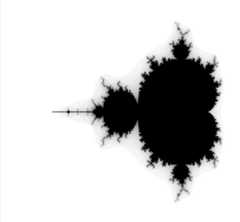 | complex least squares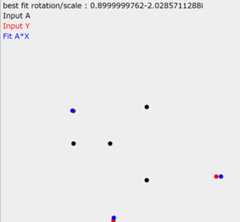 |
dual differentiation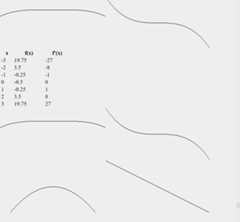 | dual backpropagation |
quaternion hue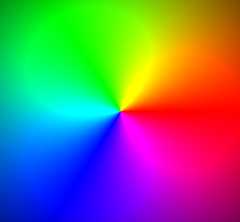 | quaternion mandelbrot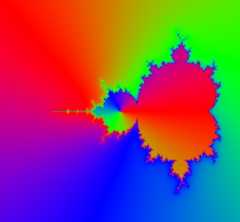 |
timespace lorentz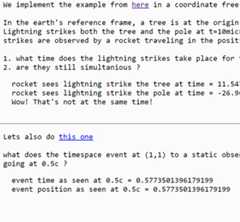 | pga2d points and lines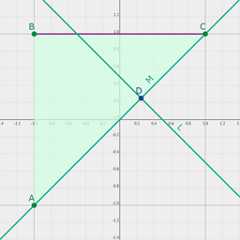 |
pga2d distances and angles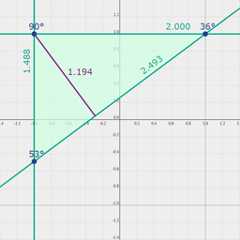 | pga2d project and reject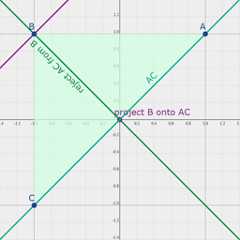 |
pga2d rotors and translators | pga2d isometries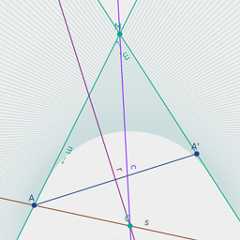 |
pga2d inverse kinematics | pga2d separating axis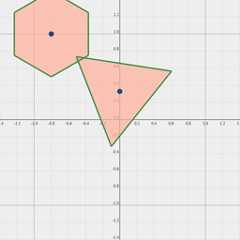 |
pga2d pose estimation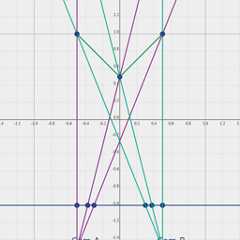 | pga2d euler line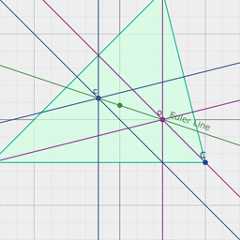 |
pga2d desargues theorem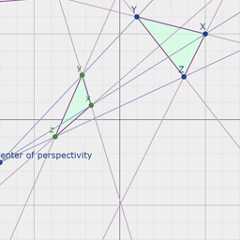 | pga2d differentiation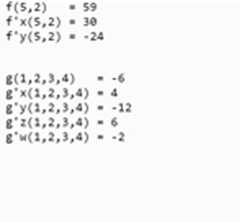 |
pga2d physics moon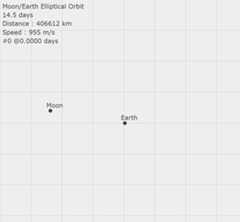 | pga2d origami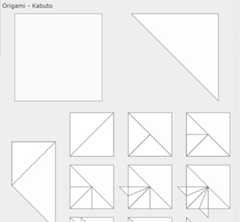 |
pga2d poncelet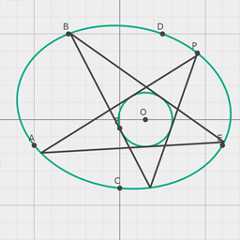 | pga3d points and lines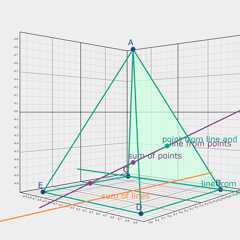 |
pga3d distances and angles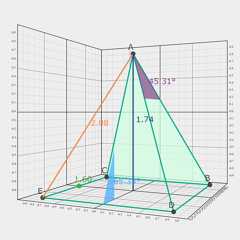 | pga3d rotors and translators |
pga3d icosahedron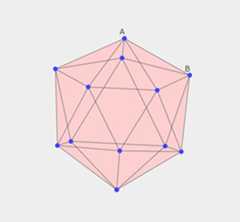 | pga3d sampling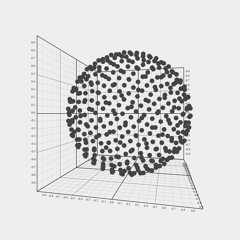 |
pga3d slicing | pga3d differentiation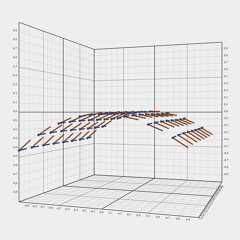 |
pga3d skinning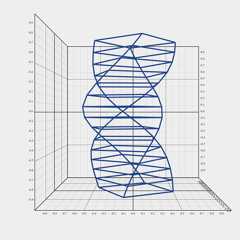 | pga3d physics planets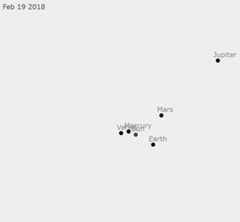 |
pga3d origami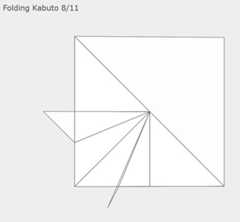 | pga3d physics symmetric top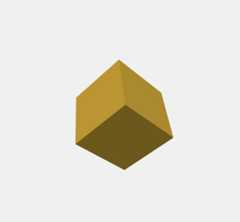 |
pga3d physics free top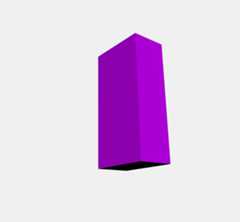 | pga3d objects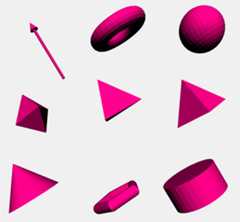 |
cga2d points and circles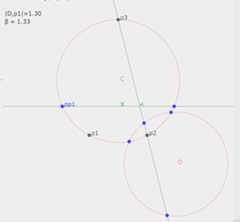 | cga2d project and reject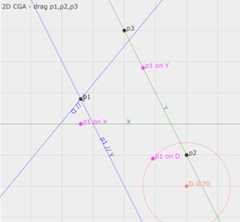 |
cga2d rotors and translators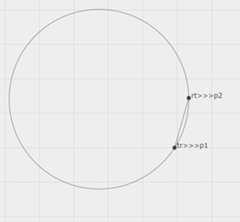 | cga2d euler line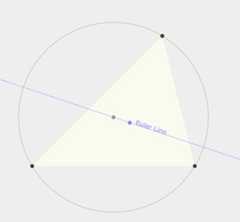 |
cga3d points circles lines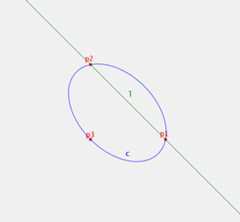 | cga3d points spheres planes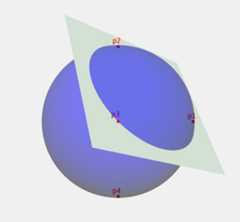 |
cga3d dual spheres planes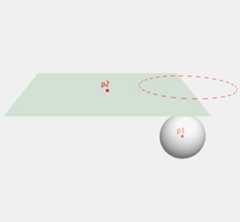 | cga3d intersections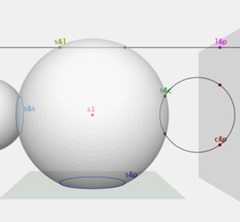 |
cga3d project reject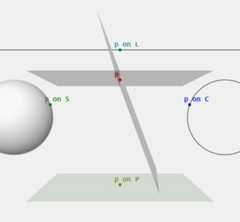 | cga3d opns visualizer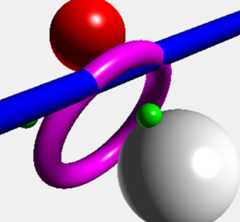 |
cga3d opns line circle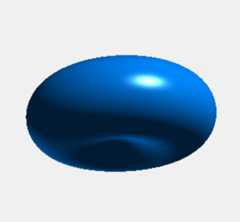 | cga3d json |
mga3d points and lines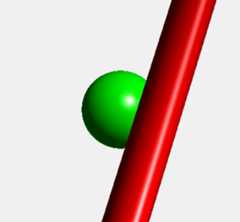 | ccga3d points quadrics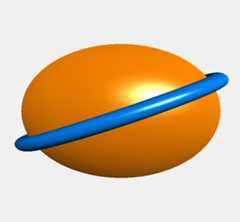 |
qcga3d points and more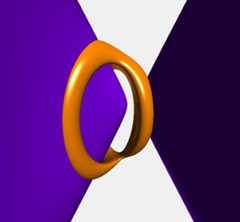 | game wedge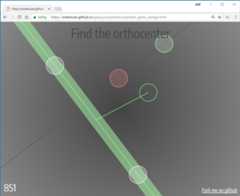 |
ganja.js is also the engine behind the GAlculator - try itonline or get it on theplay store

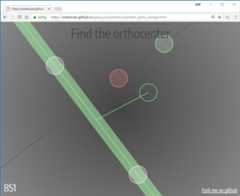
Or - get some hands on experience with euclidian plane PGA by playing thewedge game.
Ganja.js allows you to further customise the algebra class itgenerates, allowing you to generate subalgebras (who's elements useless storage), or algebra's where you decide on the order and nameof the basis blades. (the name should always be exyz butyou can pick e.g. e20 instead of the default e02and expect ganja.js to make appropriate sign changes)
The advanced options are available by passing in an options object asthe first parameter to theAlgebra call.
// The complex numbers as the even subalgebra of R2C=Algebra({p:2,basis:['1','e12']});// The Quaternions as the even subalgebra of R3varH=Algebra({p:3,basis:['1','e12','e13','e23']});
When not specified, ganja.js will generate basis names that aregrouped by rank and numerically sorted. By default, a single zerodimension will get generator name e0. Zero dimensions comefirst.
| signature | default basis names |
|---|---|
| 2,0,0 and 1,1,0 | 1,e1,e2,e12 |
| 1,0,1 | 1,e0,e1,e01 |
| 3,0,0 and 2,1,0 | 1,e1,e2,e3,e12,e13,e23,e123 |
| 2,0,1 | 1,e0,e1,e2,e01,e02,e12,e012 |
| 4,0,0 and 3,1,0 | 1,e1,e2,e3,e4,e12,e13,e14,e23,e24,e34,e123,e124,e134,e234,e1234 |
| 3,0,1 | 1,e0,e1,e2,e3,e01,e02,e03,e12,e13,e23,e012,e013,e023,e123,e0123 |
note the scalar part of a multivector"mv" can be addressed with"mv.s", other basisblades follow the expected pattern. e.g."mv.e12" or"mv.e012".
By default, your algebra elements will inherit from Float32Array.You can change the underlying datatype used by ganja.js to any of thetyped array basis types :
varR3_32=Algebra(3);varR3_64=Algebra({p:3,baseType:Float64Array});
Or take things a bit further and simply specify a Cayley table to your liking. The example below showsautomatic numerical differentiation and calculates the value, 1st, 2nd and 3rd derivative of any polynomial.
varbasis=['1','e1','e2','e3'];varCayley=[['1','e1','e2','e3'],['e1','e2','e3','0'],['e2','e3','0','0'],['e3','0','0','0']];Algebra({basis,Cayley},()=>{varf=(x)=>0.25*x*x*x*x-0.5;for(vari=-5;i<5;i++)console.log(i,f(i+1e1));});
outputs : x [f(x),f'(x),f''(x)/2!,f'''(x)/3!]
-5 [155.75, -125, 37.5, -5]-4 [ 63.5, -64, 24, -4]-3 [ 19.75, -27, 13.5, -3]-2 [ 3.5, -8, 6, -2]-1 [ -0.25, -1, 1.5, -1]0 [ -0.5, 0, 0, 0]1 [ -0.25, 1, 1.5, 1]2 [ 3.5, 8, 6, 2]3 [ 19.75, 27, 13.5, 3]4 [ 63.5, 64, 24, 4]For storage and performance reasons it can be interesting to combine elements of various sub-algebras ofa given Algebra. Ganja.js supports this by setting options.mix to true when you create your algebra.
// Create R2 - Clifford algebra of 2D vectors - indicate you want mix mode.varR2=Algebra({p:2,q:0,r:0,mix:true});// Create the complex numbers as the even subalgebra of R2.varC=Algebra({p:2,q:0,r:0,basis:['1','e12'],mix:true});// Elements of R2 have four components.// Create the complex number 1+4ivara=newR2([1,0,0,4])// Elements of C have two components.// Create the complex number 3+2ivarb=newC([3,2]);// They inter-operate ..a.Mul(b);// returns an element of R2 : [-5,0,0,14]b.Mul(a);// returns an element of C : [-5,14]
With themix mode enabled, all operations generated by ganja.js will use basis name accessinstead of array indexing. (and all operations are protected to substitute missing blades with 0).
The Inline syntax can still be used, keep in mind that in most cases you would want that to bethe inline function of the 'parent' algebra. (In the example above, use R2.Inline and not C.Inlineas the latter will reduce all your operations to the field of C).
Here's a list of the supported operators in all syntax flavors :
Please note that operator precedence is as always in javaScript, exceptfor Wedge, Vee, Dot and Sandwich which have higher precedence than * and /,resulting in less brackets in many common GA expressions.
| Precedence | Inline JS | AsciiMath | Object Oriented | Functional |
|---|---|---|---|---|
| 5 | x.Involute | tilde(x) | x.Involute | A.Involute(x) |
| 5 | x.Reverse | ddot(x) | x.Reverse | A.Reverse(x) |
| 5 | ~x | hat(x) | x.Conjugate | A.Conjugate(x) |
| 5 | !x | bar(x) | x.Dual | A.Dual(x) |
| 4 rtl | x**-1 | x^-1 | x.Inverse | A.Inverse(x) |
| 4 rtl | x**y | x^y | x.Pow(y) | A.Pow(x,y) |
| 3 | x^y | x^^y | x.Wedge(y) | A.Wedge(x,y) |
| 3 | x<<y | x*y | x.Dot(y) | A.Dot(x,y) |
| 3 | x&y | bar(bar(x)^^bar(y)) | x.Vee(y) | A.Vee(x,y) |
| 3 | x>>>y | x ** y ** hat(x) | x.Mul(y).Mul(x.Conjugate) | A.sw(x,y) |
| 2 | x*y | x**y | x.Mul(y) | A.Mul(x,y) |
| 2 | x/y | x/y | x.Div(y) | A.Div(x,y) |
| 1 | x-y | x-y | x.Sub(y) | A.Sub(x,y) |
| 1 | x+y | x+y | x.Add(y) | A.Add(x,y) |
| 1e1 | 1e_1 | new A([0,1]) | A.Vector(1) | |
| 2e2 | 2e_2 | new A([0,0,2,0]) | A.Vector(0,2) | |
| 2e12 | 2e_12 | new A([0,0,0,2]) | A.Bivector(2) |
The Duality operator implements Poincare duality, a definition and implementation that workseven if the pseudoscalar of the subspace in consideration is degenerate. It is defined for anyk-vectorx of an n-dimensional subspace as the n-k vectory containing all the basisvectors that are not inx. For non-degenerate metrics, you can still use multiplicationwith the pseudoscalar if so desired (although it will be less efficient)
The dot product implemented is the left contraction - without any extensions or modifications.The geometric meaning is usually formulated as the dot product betweenx andy gives the orthogonalcomplement iny of the projection ofx ontoy.
The vee product is available as an optimized shorthand for the dual of the wedge of the duals.
a&b = !(!a^!b)I've chosen the& symbol as it can be interpreted as 'join' or 'meet' depending on the geometricmeaning given to vectors. (planes/lines or points)
Want to get started quickly with 2D Projective Geometric Algebra ? Theboiler plate below gets you going with a bunch of usefull identities.(and the coffeeshop has plenty of examples).
We start off with a clifford algebra with signature (2,0,1). We thenupgrade it to a geometric algebra by extending it with geometricoperators. (this is where we decide our bivectors will be points,effectively making this P(R*2,0,1).
Simply include the ganja.js script and put the block below in aSCRIPT tagto get started ..
// Create a Clifford Algebra with 2 positive and one zero generator.Algebra(2,0,1,()=>{// Output algebra info to the console.this.describe();// The default basis is s,e0,e1,e2,e01,e02,e12,e012// The metric for vectors is 0, 1, 1 - Vectors will represent lines.// The metric for bivectors is 0, 0, -1 - Bivectors will represent points.// The pseudoscalar is degenerate, so use the built-in duality operator instead.// The bivectors consist of two motor elements and one rotation element -// exactly what is needed to represent translations and rotations in the plane.// In dual projectivized space, the origin is represented by the e12 bivector.varorigin=1e12,EX=-1e02,EY=1e01;// Points and lines can be specified directly. (note : -e02 = e20)varpoint=(x,y)=>origin+x*EX+y*EY;varline=(a,b,c)=>a*1e1+b*1e2+c*1e0;// Or through join and meet operations. (dual so wedge is meet and vee is join.)varjoin=(p1,p2)=>p1&p2;varmeet=(l1,l2)=>l1^l2;// Distances and anglesvardist_points=(P1,P2)=>(P1.Normalized&P2.Normalized).Length;vardist_point_line=(P,l)=>((P.Normalized)^(l.Normalized)).e012;varangle_lines=(l1,l2)=>(l1.Normalized<<l2.Normalized).s;// Points and lines can be projected and rejected.varproject=(P,l)=>P<<l*l;varparallel=(P,l)=>P<<l*P;varortho=(P,l)=>P<<l;// translations and rotations.varrotor=(a,P)=>Math.cos(a*0.5)+Math.sin(a*0.5)*P;vartranslator=(x,y)=>1+0.5*(x*1e02-y*1e01);// To demonstrate graphing, we create some points and lines.// Users can drag points in the graph, lambda expressions can be// used to create dynamic updating items.varA=point(-1,-1),B=point(1,-1),C=point(-1,1),l=line(-1,1,0.5);// Ganja.js can directly graph 2D PGA elements. Pass in an array of// items to render. (numbers are colors, strings are labels, PGA points// and lines are rendered automatically and arrays can be used for line// segments and polygons). The graph function returns a HTML SVG element.document.body.appendChild(this.graph([// use numbers to set the current color.0x444444,// strings label the items they follow, first string is a title."title",// render points (user can drag these)A,B,C,"Label for point",// render linesl,"Label for line",// line segments()=>[A,B],"Label for segment",// polygons0xffeeee,()=>[A,B,C],0xff7777,"Label for polygon"],{grid:true,animate:false}));// When using the animation mode, all lambda's will be evaluated every frame.// Use Date.now() or similar. (many examples in the coffeeshop.)});

This example implements the table on page 15 ofGunn's Geometric Algebra for Computer Graphics.We apply the same strategy from above and start from a Clifford Algebra in R3,0,1.
// Create a Clifford Algebra with 3 positive and one zero generator.Algebra(3,0,1,()=>{// Output algebra info to the console.this.describe();// The default basis is 1,e0,e1,e2,e3,e01,e02,e03,e12,e13,e23,e012,e013,e023,e123,e0123// The metric for vectors is 0, 1, 1, 1 - Vectors will represent planes.// The metric for bivectors is 0, 0, 0, -1, -1, -1 - Bivectors will represent lines.// The metric for trivectors is 0, 0, 0, -1 - Trivectors will represent points.// The pseudoscalar is degenerate, so use the built-in duality operator instead.// The bivectors consist of three motor elements and three rotation element -// exactly what is needed to represent translations and rotations in euclidean space.// In dual projectivized space, the origin is represented by the e12 bivector.varorigin=1e123,EX=-1e023,EY=1e013,EZ=-1e012;// Points and planes can be specified directly.varpoint=(x,y,z)=>origin+x*EX+y*EY+z*EZ,plane=(a,b,c,d)=>a*1e1+b*1e2+c*1e3+d*1e0;// Table from "Geometric Algebra for Computer Graphics" p.15varLineFromPoints=(P,Q)=>P&Q,LineFromPlanes=(a,b)=>a^b,PointFromPlanes=(a,b,c)=>a^b^c,PlaneFromPoints=(P,Q,R)=>P&Q&R,DistPointToPlane=(a,P)=>a&P,DistPoints=(P,Q)=>(P&Q).Length,AnglePlanes=(a,b)=>Math.acos((a<<b).Length),LineThroughPointPerpPlane=(P,a)=>P<<a,OrthProjPointToPlane=(P,a)=>P<<a*a,PlaneThroughPointParPlane=(P,a)=>P<<a*P,IntersectLinePlane=(PI,a)=>PI^a,PlaneThroughPointPerpLine=(PI,P)=>P<<PI,OrthProjPointToLine=(PI,P)=>P<<PI*PI,LineThroughPointParLine=(PI,P)=>P<<PI*P,LineThroughPointPerpLine=(PI,P)=>(P<<PI*P)&P,DistLines=(PI,EP)=>PI&EP,AngleLines=(PI,EP)=>Math.acos((PI<<EP).Length),ReflectionInPlane=(a,X)=>a*X*a,Rotor=(PI,alpha)=>Math.cos(alpha/2)+Math.sin(alpha/2)*PI,RotationAroundLine=(X,PI,alpha)=>Rotor(PI,alpha)*X*~Rotor(PI,alpha),Translator=(x,y,z)=>1+0.5*(x*EX+y*EY+z*EZ);// To demonstrate graphing, we create some points and lines.// Users can drag points in the graph, lambda expressions can be// used to create dynamic updating items.varA=point(-1,-1,0),B=point(1,-1,0),C=point(-1,1,0);// Ganja.js can directly graph 3D PGA elements. Pass in an array of// items to render. (numbers are colors, strings are labels, PGA points// and lines are rendered automatically and arrays can be used for line// segments and polygons). The graph function returns a HTML SVG element.document.body.appendChild(this.graph([// use numbers to set the current color.0x444444,// strings label the items they follow, first string is a title."title",// render points (user can drag these)A,B,C,"Label for point",// render lines()=>(B&C&A)<<(B&C)<<-A,"Label for line",// line segments()=>[A,B],"Label for segment",// polygons0xffeeee,()=>[A,B,C],0xff7777,"Label for polygon"],{grid:false,animate:false}));// When using the animation mode, all lambda's will be evaluated every frame.// Use Date.now() or similar. (many examples in the coffeeshop.)});
About
📐 Javascript Geometric Algebra Generator for Javascript, c++, c#, rust, python. (with operator overloading and algebraic literals) -
Topics
Resources
License
Contributing
Uh oh!
There was an error while loading.Please reload this page.
Stars
Watchers
Forks
Sponsor this project
Uh oh!
There was an error while loading.Please reload this page.
Packages0
Uh oh!
There was an error while loading.Please reload this page.
Contributors12
Uh oh!
There was an error while loading.Please reload this page.