- Notifications
You must be signed in to change notification settings - Fork29
C++ implementation of a fast and memory efficient hash map and hash set specialized for strings
License
Tessil/array-hash
Folders and files
| Name | Name | Last commit message | Last commit date | |
|---|---|---|---|---|
Repository files navigation

Cache conscious hash map and hash set for strings based on the "Cache-conscious collision resolution in string hash tables." (Askitis Nikolas and Justin Zobel, 2005) paper. You can find some details regarding the structurehere.
Thanks to its cache friendliness, the structure provides fast lookups while keeping a low memory usage. The main drawback is the rehash process which is a bit slow and need some spare memory to copy the strings from the old hash table to the new hash table (it can’t usestd::move as the other hash tables usingstd::string as key).
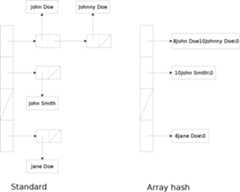
Four classes are provided:tsl::array_map,tsl::array_set,tsl::array_pg_map andtsl::array_pg_set. The first two are faster and use a power of two growth policy, the last two use a prime growth policy instead and are able to cope better with a poor hash function. Use the prime version if there is a chance of repeating patterns in the lower bits of your hash (e.g. you are storing pointers with an identity hash function). SeeGrowthPolicy for details.
Abenchmark oftsl::array_map against other hash maps can be foundhere. This page also gives some advices on which hash table structure you should try for your use case (useful if you are a bit lost with the multiple hash tables implementations in thetsl namespace). You can also find another benchmark on thetsl::hat-trie page.
- Header-only library, just add theinclude directory to your include path and you are ready to go. If you use CMake, you can also use the
tsl::array_hashexported target from theCMakeLists.txt. - Low memory usage with good performances, see thebenchmark for some numbers.
- Support for move-only and non-default constructible values.
- Strings with null characters inside them are supported (you can thus store binary data as key).
- If the hash is known before a lookup, it is possible to pass it as parameter to speed-up the lookup (see
precalculated_hashparameter inAPI). - Support for efficient serialization and deserialization (seeexample and the
serialize/deserializemethods in theAPI for details). - By default the maximum allowed size for a key is set to 65 535. This can be raised through the
KeySizeTtemplate parameter (seeAPI for details). - By default the maximum size of the map is limited to 4 294 967 296 elements. This can be raised through the
IndexSizeTtemplate parameter (seeAPI for details).
tsl::array_map tries to have an interface similar tostd::unordered_map, but some differences exist:
- Iterator invalidation doesn't behave in the same way, any operation modifying the hash table invalidate them (seeAPI for details).
- References and pointers to keys or values in the map are invalidated in the same way as iterators to these keys-values.
- Erase operations have an amortized runtime complexity of O(1) for
tsl::array_map. An erase operation will delete the key immediately but for the value part of the map, the deletion may be delayed. The destructor of the value is only called when the ratio between the size of the map and the size of the map + the number of deleted values still stored is low enough. The methodshrink_to_fitmay be called to force the deletion. - The key and the value are stored separately and not in a
std::pair<const Key, T>. Methods likeinsertoremplacetake the key and the value separately instead of astd::pair. The insert method looks likestd::pair<iterator, bool> insert(const CharT* key, const T& value)instead ofstd::pair<iterator, bool> insert(const std::pair<const Key, T>& value)(seeAPI for details). - For iterators,
operator*()andoperator->()return a reference and a pointer to the valueTinstead ofstd::pair<const Key, T>. For an access to the key string, thekey()(which returns aconst CharT*) orkey_sv()(which returns astd::basic_string_view<CharT>) method of the iterator must be called. - No support for some bucket related methods (like
bucket_size,bucket, ...).
These differences also apply betweenstd::unordered_set andtsl::array_set.
Thread-safety and exception guarantees are similar to the STL containers.
The default hash function used by the structure depends on the presence ofstd::string_view. If it is available,std::hash<std::string_view> is used, otherwise a simpleFNV-1a hash function is used to avoid any dependency.
If you can't use C++17 or later, we recommend to replace the hash function with something likeCityHash, MurmurHash,FarmHash, ... for better performances. On the tests we did, CityHash64 offers a ~40% improvement on reads compared to FNV-1a.
#include<city.h>structstr_hash { std::size_toperator()(constchar* key, std::size_t key_size)const {returnCityHash64(key, key_size); }};tsl::array_map<char,int, str_hash> map;
Thestd::hash<std::string> can't be used efficiently as the structure doesn't store anystd::string object. Any time a hash would be needed, a temporarystd::string would have to be created.
The library supports multiple growth policies through theGrowthPolicy template parameter. Three policies are provided by the library but you can easily implement your own if needed.
- tsl::ah::power_of_two_growth_policy. Default policy used by
tsl::array_map/set. This policy keeps the size of the bucket array of the hash table to a power of two. This constraint allows the policy to avoid the usage of the slow modulo operation to map a hash to a bucket, instead ofhash % 2n, it useshash & (2n - 1)(seefast modulo). Fast but this may cause a lot of collisions with a poor hash function as the modulo with a power of two only masks the most significant bits in the end. - tsl::ah::prime_growth_policy. Default policy used by
tsl::array_pg_map/set. The policy keeps the size of the bucket array of the hash table to a prime number. When mapping a hash to a bucket, using a prime number as modulo will result in a better distribution of the hash across the buckets even with a poor hash function. To allow the compiler to optimize the modulo operation, the policy use a lookup table with constant primes modulos (seeAPI for details). Slower thantsl::ah::power_of_two_growth_policybut more secure. - tsl::ah::mod_growth_policy. The policy grows the map by a customizable growth factor passed in parameter. It then just use the modulo operator to map a hash to a bucket. Slower but more flexible.
To implement your own policy, you have to implement the following interface.
structcustom_policy {// Called on hash table construction and rehash, min_bucket_count_in_out is the minimum buckets// that the hash table needs. The policy can change it to a higher number of buckets if needed// and the hash table will use this value as bucket count. If 0 bucket is asked, then the value// must stay at 0.explicitcustom_policy(std::size_t& min_bucket_count_in_out);// Return the bucket [0, bucket_count()) to which the hash belongs.// If bucket_count() is 0, it must always return 0. std::size_tbucket_for_hash(std::size_t hash)constnoexcept;// Return the number of buckets that should be used on next growth std::size_tnext_bucket_count()const;// Maximum number of buckets supported by the policy std::size_tmax_bucket_count()const;// Reset the growth policy as if the policy was created with a bucket count of 0.// After a clear, the policy must always return 0 when bucket_for_hash() is called.voidclear()noexcept;}
To use the library, just add theinclude directory to your include path. It is aheader-only library.
If you use CMake, you can also use thetsl::array_hash exported target from theCMakeLists.txt withtarget_link_libraries.
# Example where the array-hash project is stored in a third-party directoryadd_subdirectory(third-party/array-hash)target_link_libraries(your_targetPRIVATE tsl::array_hash)
If the project has been installed throughmake install, you can also usefind_package(tsl-array-hash REQUIRED) instead ofadd_subdirectory.
The code should work with any C++11 standard-compliant compiler and has been tested with GCC 4.8.4, Clang 3.5.0 and Visual Studio 2015.
To run the tests you will need the Boost Test library and CMake.
git clone https://github.com/Tessil/array-hash.gitcd array-hash/testsmkdir buildcd buildcmake ..cmake --build../tsl_array_hash_tests
The API can be foundhere. Ifstd::string_view is available, the API changes slightly and can be foundhere.
#include<iostream>#include<tsl/array_map.h>#include<tsl/array_set.h>intmain() {// Map of const char* to int tsl::array_map<char,int> map = {{"one",1}, {"two",2}}; map["three"] =3; map["four"] =4; map.insert("five",5); map.insert_ks("six_with_extra_chars_we_ignore",3,6); map.erase("two");// When template parameter StoreNullTerminator is true (default) and there is no// null character in the strings.for(auto it = map.begin(); it != map.end(); ++it) { std::cout <<"{" << it.key() <<"," << it.value() <<"}" << std::endl; }// If StoreNullTerminator is false for space efficiency or you are storing null characters,// you can access to the size of the key.for(auto it = map.begin(); it != map.end(); ++it) { (std::cout <<"{").write(it.key(), it.key_size()) <<"," << it.value() <<"}" << std::endl; }// Better, use key_sv() if you compiler provides access to std::string_view.for(auto it = map.begin(); it != map.end(); ++it) { std::cout <<"{" << it.key_sv() <<"," << it.value() <<"}" << std::endl; }// Or if you just want the values.for(int value: map) { std::cout <<"{" << value <<"}" << std::endl; }// Map of const char32_t* to int tsl::array_map<char32_t,int> map_char32 = {{U"one",1}, {U"two",2}}; map_char32[U"three"] =3;// Set of const char* tsl::array_set<char> set = {"one","two","three"}; set.insert({"four","five"});for(auto it = set.begin(); it != set.end(); ++it) { std::cout <<"{" << it.key() <<"}" << std::endl; }}
The library provides an efficient way to serialize and deserialize a map or a set so that it can be saved to a file or send through the network.To do so, it requires the user to provide a function object for both serialization and deserialization.
structserializer {// Must support the following types for U: std::uint64_t, float and T if a map is used.template<typename U>voidoperator()(const U& value);voidoperator()(const CharT* value, std::size_t value_size);};
structdeserializer {// Must support the following types for U: std::uint64_t, float and T if a map is used.template<typename U> Uoperator()();voidoperator()(CharT* value_out, std::size_t value_size);};
Note that the implementation leaves binary compatibility (endianness, float binary representation, size of int, ...) of the types it serializes/deserializes in the hands of the provided function objects if compatibility is required.
More details regarding theserialize anddeserialize methods can be found in theAPI.
#include<cassert>#include<cstdint>#include<fstream>#include<type_traits>#include<tsl/array_map.h>classserializer {public:serializer(constchar* file_name) { m_ostream.exceptions(m_ostream.badbit | m_ostream.failbit); m_ostream.open(file_name); }template<classT,typename std::enable_if<std::is_arithmetic<T>::value>::type* =nullptr>voidoperator()(const T& value) { m_ostream.write(reinterpret_cast<constchar*>(&value),sizeof(T)); }voidoperator()(constchar32_t* value, std::size_t value_size) { m_ostream.write(reinterpret_cast<constchar*>(value), value_size*sizeof(char32_t)); }private: std::ofstream m_ostream;};classdeserializer {public:deserializer(constchar* file_name) { m_istream.exceptions(m_istream.badbit | m_istream.failbit | m_istream.eofbit); m_istream.open(file_name); }template<classT,typename std::enable_if<std::is_arithmetic<T>::value>::type* =nullptr> Toperator()() { T value; m_istream.read(reinterpret_cast<char*>(&value),sizeof(T));return value; }voidoperator()(char32_t* value_out, std::size_t value_size) { m_istream.read(reinterpret_cast<char*>(value_out), value_size*sizeof(char32_t)); }private: std::ifstream m_istream;};intmain() {const tsl::array_map<char32_t, std::int64_t> map = {{U"one",1}, {U"two",2}, {U"three",3}, {U"four",4}};constchar* file_name ="array_map.data"; { serializerserial(file_name); map.serialize(serial); } { deserializerdserial(file_name);auto map_deserialized = tsl::array_map<char32_t, std::int64_t>::deserialize(dserial);assert(map == map_deserialized); } { deserializerdserial(file_name);/** * If the serialized and deserialized map are hash compatibles (see conditions in API), * setting the argument to true speed-up the deserialization process as we don't have * to recalculate the hash of each key. We also know how much space each bucket needs.*/constbool hash_compatible =true;auto map_deserialized = tsl::array_map<char32_t, std::int64_t>::deserialize(dserial, hash_compatible);assert(map == map_deserialized); }}
It's possible to use a serialization library to avoid some of the boilerplate if the types to serialize are more complex.
The following example uses Boost Serialization with the Boost zlib compression stream to reduce the size of the resulting serialized file.
#include<boost/archive/binary_iarchive.hpp>#include<boost/archive/binary_oarchive.hpp>#include<boost/iostreams/filter/zlib.hpp>#include<boost/iostreams/filtering_stream.hpp>#include<boost/serialization/split_free.hpp>#include<boost/serialization/utility.hpp>#include<cassert>#include<cstdint>#include<fstream>#include<tsl/array_map.h>template<typename Archive>structserializer { Archive& ar;template<typename T>voidoperator()(const T& val) { ar & val; }template<typename CharT>voidoperator()(const CharT* val, std::size_t val_size) { ar.save_binary(reinterpret_cast<constvoid*>(val), val_size*sizeof(CharT)); } };template<typename Archive>structdeserializer { Archive& ar;template<typename T> Toperator()() { T val; ar & val;return val; }template<typename CharT>voidoperator()(CharT* val_out, std::size_t val_size) { ar.load_binary(reinterpret_cast<void*>(val_out), val_size*sizeof(CharT)); } };namespaceboost {namespaceserialization {template<classArchive,classCharT,classT>voidserialize(Archive & ar, tsl::array_map<CharT, T>& map,constunsignedint version) {split_free(ar, map, version); }template<classArchive,classCharT,classT>voidsave(Archive & ar,const tsl::array_map<CharT, T>& map,constunsignedint version) { serializer<Archive> serial{ar}; map.serialize(serial);}template<classArchive,classCharT,classT>voidload(Archive & ar, tsl::array_map<CharT, T>& map,constunsignedint version) { deserializer<Archive> deserial{ar}; map = tsl::array_map<CharT, T>::deserialize(deserial);}}}intmain() {const tsl::array_map<char32_t, std::int64_t> map = {{U"one",1}, {U"two",2}, {U"three",3}, {U"four",4}};constchar* file_name ="array_map.data"; { std::ofstream ofs; ofs.exceptions(ofs.badbit | ofs.failbit); ofs.open(file_name, std::ios::binary); boost::iostreams::filtering_ostream fo; fo.push(boost::iostreams::zlib_compressor()); fo.push(ofs); boost::archive::binary_oarchiveoa(fo); oa << map; } { std::ifstream ifs; ifs.exceptions(ifs.badbit | ifs.failbit | ifs.eofbit); ifs.open(file_name, std::ios::binary); boost::iostreams::filtering_istream fi; fi.push(boost::iostreams::zlib_decompressor()); fi.push(ifs); boost::archive::binary_iarchiveia(fi); tsl::array_map<char32_t, std::int64_t> map_deserialized; ia >> map_deserialized;assert(map == map_deserialized); }}
The code is licensed under the MIT license, see theLICENSE file for details.
About
C++ implementation of a fast and memory efficient hash map and hash set specialized for strings
Topics
Resources
License
Uh oh!
There was an error while loading.Please reload this page.
Stars
Watchers
Forks
Packages0
Uh oh!
There was an error while loading.Please reload this page.