- Notifications
You must be signed in to change notification settings - Fork124
Demo iOS application built to highlight MVP (Model View Presenter) and Clean Architecture concepts
License
FortechRomania/ios-mvp-clean-architecture
Folders and files
| Name | Name | Last commit message | Last commit date | |
|---|---|---|---|---|
Repository files navigation
Library is an iOS application built to highlightMVP (Model View Presenter) andClean Architecture concepts
- Xcode 10.2.1
- Swift 5
View- delegates user interaction events to thePresenterand displays data passed by thePresenter- All
UIViewController,UIView,UITableViewCellsubclasses belong to theViewlayer - Usually the view is passive / dumb - it shouldn't contain any complex logic and that's why most of the times we don't need write Unit Tests for it
- All
Presenter- contains the presentation logic and tells theViewwhat to present- Usually we have one
Presenterper scene (view controller) - It doesn't reference the concrete type of the
View, but rather it references theViewprotocol that is implemented usually by aUIViewControllersubclass - It should be a plain
Swiftclass and not reference anyiOSframework classes - this makes it easier to reuse it maybe in amacOSapplication - It should be covered by Unit Tests
- Usually we have one
Configurator- injects the dependency object graph into the scene (view controller)- You could very easily use a DI (dependency injection) library. Unfortunately DI libraries are not quite mature yet on
iOS/Swift - Usually it contains very simple logic and we don't need to write Unit Tests for it
- You could very easily use a DI (dependency injection) library. Unfortunately DI libraries are not quite mature yet on
Router- contains navigation / flow logic from one scene (view controller) to another- In some communities / blog posts it might be referred to as a
FlowController - Writing tests for it is quite difficult because it contains many references to
iOSframework classes so usually we try to keep it really simple and we don't write Unit Tests for it - It is usually referenced only by the
Presenterbut due to thefunc prepare(for segue: UIStoryboardSegue, sender: Any?)method we some times need to reference it in the view controller as well
- In some communities / blog posts it might be referred to as a
UseCase / Interactor- contains the application / business logic for a specific use case in your application- It is referenced by the
Presenter. ThePresentercan reference multipleUseCasessince it's common to have multiple use cases on the same screen - It manipulates
Entitiesand communicates withGatewaysto retrieve / persist the entities - The
Gatewayprotocols should be defined in theApplication Logiclayers and implemented by theGateways & Framework Logic - The separation described above ensures that the
Application Logicdepends on abstractions and not on actual frameworks / implementations - It should be covered by Unit Tests
- It is referenced by the
Entity- plainSwiftclasses / structs- Models objects used by your application such as
Order,Product,Shopping Cart, etc
- Models objects used by your application such as
Gateway- contains actual implementation of the protocols defined in theApplication Logiclayer- We can implement for instance a
LocalPersistenceGatewayprotocol usingCoreDataorRealm - We can implement for instance an
ApiGatewayprotocol usingURLSessionorAlamofire - We can implement for instance a
UserSettingsprotocol usingUserDefaults - It should be covered by Unit Tests
- We can implement for instance a
Persistence / API Entities- contains framework specific representations- For instance we could have a
CoreDataOrderthat is aNSManagedObjectsubclass - The
CoreDataOrderwould not be passed to theApplication Logiclayer but rather theGateways & Framework Logiclayer would have to "transform" it to anOrderentity defined in theApplication Logiclayer
- For instance we could have a
Framework specific APIs- contains implementations ofiOSspecific APIs such as sensors / bluetooth / camera
- The demo applications tries to expose a fairly complex set of features that justifies the usage of the concepts presented above
- The followingUnit Tests have been written:
BooksPresenterTest- highlights how you can test the presentation logicDeleteBookUseCaseTest- highlights how you can test the application / business logic and also how to test async code that uses completion handlers andNotificationCenterCacheBooksGatewayTest- highlights how you can test a cache policyCoreDataBooksGatewayTest- highlights how you can test aCoreDatagatewayApiClientTest- highlights how you can test the API / Networking layer of your application by substituting theURLSessionstack
- Code comments can be found in several classes highlighting different design decisions or referencing followup resources
- The project structure tries to mimic theScreaming Architecture concept that can be found in the references section
- High level UML diagram:
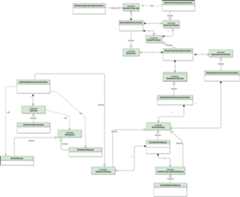

Giving that a large majority of mobile apps are a thin client on top of a set of APIs and that most of them contain little business logic (since most of the business logic is found in the APIs) some of theClean Architecture concepts can be debatable in the mobile world. Below you can find some:
- Creating a representation for each layer (API, CoreData) might seem like over-engineering. If your application relies heavily on an API that is under your control then it might make sense to model both the entity and the API representation using the same class. You shouldn't however allow the persistence representation (the
NSManagedObjectsubclass for instance) leak in the other layers (seeParseexample that got discontinued) - If you find that in most cases your
Use Cases / Interactorssimply delegate the actions to theGatewaythen maybe you don't need theUse Cases / Interactorsin the first place and you can use theGatewaydirectly in thePresenter - If you want to enforce the layer separation even more you can consider moving all the layers in their own projects / modules
- Some might consider that creating
display(xyz: String)methods on aCellViewprotocol is over-engineering and that passing a planeCellViewModelobject to theCellViewand have the view configure itself with the view model is more straightforward. If you want top keep the view as passive / dumb as possible then you should probably create the methods, but then again simply reading some strings from a view model and setting some labels is not really complex logic
The list above is definitely not complete, and if you identify other debatable decisions please create an issue and we can discuss about it and include it in the list above.
For the items listed above (and also for other items of your own) it is important that you useyour own judgement and make aninformed decision.
Keep in mind that you don't have to make all the design decisions up front and that you can refactor them in as you go.
Discuss about all the design decision with your team members and make sure you are all in agreement.
- iOS Architecture Patterns
- Architecture Wars - A New Hope
- VIPER to be or not to be?
- Effective Android Architecture - our note here is that you should be careful about coupling you application to Rx* or any other framework for that matter. Please readMake the Magic go away, by Uncle Bob and think twice before letting a framework take over your application.
- Improve your iOS Architecture with FlowControllers
- GUI Architectures, by Martin Fowler
- The Clean Architecture, by Uncle Bob
- Architecture: The Lost Years, by Uncle Bob
- Clean Architecture, By Uncle Bob
- Uncle Bob's clean architecture - An entity/model class for each layer?
Please feel free to open an issue for any questions or suggestions you have!
About
Demo iOS application built to highlight MVP (Model View Presenter) and Clean Architecture concepts
Topics
Resources
License
Uh oh!
There was an error while loading.Please reload this page.
Stars
Watchers
Forks
Releases
Packages0
Uh oh!
There was an error while loading.Please reload this page.
Contributors5
Uh oh!
There was an error while loading.Please reload this page.