1961 Generals’ Putsch of Algiers
TheApril 1961 Generals’ Putsch of Algiers (Putsch des généraux), was a failed military action to press French PresidentCharles de Gaulle to not abandon French Algeria, along with French people and pro-French Arabs living there. The putsch in French Algeria was conducted by four retired generals, led byMaurice Challe, the commander of the French Armed Forces in Algeria in 1958-60 and the author of the successful Challe Plan. The plan which in effect helped to defeat militant rebels across Algeria.
In 1960-61, French soldiers, and legionnaires in particular, who saw the successes of their military actions in 1958-60, couldn’t understand why Presidentde Gaulle was speaking about abandoning Algeria, an integral part of France since 1848. Moreover, it was the French Army after all who carried out a successful anti-government putsch inAlgiers in May 1958 to installde Gaulle as President, to save French Algeria…
Prelude to the 1961 Generals’ Putsch of Algiers
1940-46
–GeneralCharles de Gaulle
– a French officer
– in June 1940, he fled France for Great Britain
– there, he presented hisAppeal of 18 June 1940
– a response to the end of war between France and Germany
– Generalde Gaulle asked French soldiers to continue in fighting
– he asked them to join him in Britain
– the next day, a new speech by Generalde Gaulle
– he said that “all forms of authority had disappeared”
– he didn’t see the then French government as legal
– later in June 1940, he proclaimed himself as the only legal French leader
– in July 1940, he would establish the so called Free French Forces (FFL)
– a part of the British Army
– in fact,de Gaulle launched an armed action
– to overthrow the then French government
– to install himself as a French leader
– however, at the beginning, the plan wasn’t so successfull
– some 14,000 French soldiers were in Britain at the time
– only 1,300 would join him and his FFL of the British Army
– the rest asked to return to France to serve under the French flag
– in 1940-42, FFL would fight against France and French soldiers
– in 1944, Generalde Gaulle was recognized by the US as a French leader
– in November 1945, he became an official leader of France
– however, he kept his office only a few weeks
– in January 1946, Generalde Gaulle had to resign
– the result of then French political crisis

1946-54
–First Indochina War
– French Indochina refers to French colonial territories in Southeast Asia
– today’s Vietnam, Cambodia, Laos
– under the French rule since the 1880s
– in Indochina in 1946, the new conflict officially started
– between France and theViet Minh (League for the Independence of Vietnam)
– tens of thousands of French soldiers died
– between them, thousands of legionnires
– in 1954, the ceasefire in Indochina went into force
–the French had to leave Indochina
– many French officers and soldiers saw it as a treason
– they were persuaded that the war could have been won
– they saw then French politicians as traitors of France
1954-55
–Algerian War started
– in North Africa, local rebels intensified military actions
– these actions took part in Morocco, Tunisia, Algeria
– countries under French control for decades
– Algeria under the French rule since the 1830s
– the attacks were aimed at French forces presented there
– in Algeria, the main rebel force was the FLN
– FLN stands for National Liberation Front
– later in 1955, rebel operations escalated into the Algerian War
1956
–Independence of Tunisia + Morocco
– countries under the French control for decades
– thousands of French soldiers have died for
– then rebels were poorly equipped and less active than in Algeria
– seen as another betrayal, after the loss of Indochina
1958
–May 1958 Putsch of Algiers
– May 13, a coup took place inAlgiers
– led by four French generals
– GeneralSalan, GeneralMassu, GeneralJouhaud, GeneralGracieux
– a response to an “incompetent government support of military efforts”
– French politicians were once again seen as traitors of France
– the French Army and French settlers were afraid of “another Indochina”
– they didn’t want to see Algeria to be lost
– during the night of May 13, the Army seized power inAlgiers
– the armed putschists were led by GeneralJacques Massu
– the then head of the 10th Parachute Division (10e DP)
– they formed a provisional military government
– led by GeneralRaoul Salan
– then commander of the French Armed Forces in Algeria
– GeneralSalan gave a speech on radio
– he said the Army “took over responsibility for the destiny of French Algeria”
– the putsch’s goal was to bring Generalde Gaulle back to power
– the putschists wanted to install him as the President of France
–Operation Corse
– part of the May 1958 Putsch
– a military operation to size Corsica by the putschists
– an island south-east of France
– on May 24, it was seized by French paratroopers (coming from Algeria)
–Operation Resurrection
– part of the May 1958 Putsch
– a planned military operation to sizeParis, the capital of France
– planned by the May 1958 putschists
– French paratroopers would have been involved in
– the goal was to force the French government
– eventually, the French politicians agreed forde Gaulle‘s return to power
– May 29, Generalde Gaulle was appointed as Prime Minister
– the operation was cancelled
–French Algeria by de Gaulle
– in June 1958,de Gaulle visited Algeria
– he shouted “Long life French Algeria!” to the crowds
– the French soldiers and French settlers were happy
– they believed French Algeria was saved
–1958 French constitutional referendum
– held on September 28, 1958
– to adopt a new constitution for the French Fifth Republic
– French overseas departments were allowed to vote for their independence
–in Algeria, 96,6% of voters voted YES for French Algeria
– voted by both the French settlers and local muslim Arabs
–French President de Gaulle
– in December 1958,de Gaulle became the French President
– the Fifth Republic was established

1959
–French victory in Algeria
– in Algeria in 1958-59, many successful military operations
– FLN rebels were almost defeated
–in mid-1959, the French Army was the closest it would be to victory in Algeria
–De Gaulle’s Algerian self-determination
– on September 16, 1959,de Gaulle spoke about Algerian self-determination
– he said Algeria had the right to self-determination
– a shock to Algerians and to the French Army in Algeria
– they saw it as a great betrayal
– French settlers and local Arabs feared left-wing FLN militants to gain power
– French soldiers didn’t want to accept they were fighting and dying for nothing
1960
–General Massu’s criticism ofde Gaulle
– then commander of French forces in the capital of Algeria
– the ex-commander of the 10th Parachute Division
– the key figure of the May 1958 Putsch
– January 18, an interview with GeneralMassu was published
– by Germany newspaperSüddeutsche Zeitung
– in the interview, he stated thatde Gaulle‘s Algerian policy is bad
– according to him, the Army would be ready to provide weapons to civilians
– he also stated that the selection ofde Gaulle in 1958 was a bad choice
– GeneralMassu was immediately removed from office
–Week of barricades
– January 24, an insurrection in the Algerian capital started
– led by French militant civilian groups (supporting the Army)
– a response to the removal of GeneralMassu
– they demonstrated in support of French Algeria
– the demonstration was led byPierre Lagaillarde,Joseph Ortiz andGuy Forzy
–Lagaillarde andOrtiz were involved in the May 1958 Putsch
– they were the key non-military putschists back then
– several military units were sent to restore order inAlgiers
– between them, the1er REP
– however, French soldiers and legionnaires sympathized with demonstrators
– in Paris,de Gaulle asked the French Army to remain loyal to him
– he made a TV speech which included these words:
French President de Gaulle:
You French of Algeria, how can you listen to the liars and the conspirators who tell you that, if you grant free choice to the Algerians, France and de Gaulle want to abandon you, retreat from Algeria, and deliver you to the rebellion?
– the demonstrations ended on February 1
– the leaders of the insurrection were arrested

–Algerian Algeria
– September 4, a speech byde Gaulle
– he announced that Algerian Algeria was “on the way”
–Barricades Trial
– in early November, the Barricades Trial started
– the demonstrations’ leaders would be sentenced to 10 years in prison
– ironically, in May 1958, they helpedde Gaulle to gain the power
–Algerian republic
– November 4, a TV speech by Presidentde Gaulle
– he spoke about future “Algerian republic”
–Demonstrations in Algiers
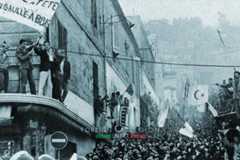
– during December 8-13, large demonstrations occured inAlgiers
– demonstrations in support of French Algeria
– aimed atDe Gaulle visiting Algeria at the time
– the demonstrations were led by French Algeria Front (FAF)
– a French party established in June 1960
– over one million members (40% of them were muslim Arabs)
– December 15, the FAF party was banned by the French government
– duringde Gaulle‘s visit, also pro-Algerian demonstrations
– for the first time in history, Algerian flags appeared
1961
–French referendum on Algerian self-determination
– January 8, the referendum was held
– ordered by French Presidentde Gaulle
– in Algeria, 70% of voters voted for YES
– only 59% of all Algerian voters voted in the referendum
–1er REP Officers’ Revolt
– January 8, 1er REP officers revolted
– a unique, extraordinary issue
– while being stationed on the Tunisia border
– four company commanders
– they refused to carry out a military operation
– their revolt was a response to the referendum
– the four officers were transferred out of the Legion
– also other officers would have to leave the regiment
–Preparations for a new Putsch
– in January inParis, a new putsch started to be preparred
– by several French high-ranking officers
– led by ColonelBroizat + ColonelArgoud
– between them, also a number of Legion officers
– including Lt Colde La Chapelle, the then commander of the1er REC
–Talks with the FLN rebels
– in March, French talks with the FLN rebels started
–Algerian independent state
– April 11, a conference withde Gaulle
– he said France had no problem with an independent Algeria
–Decision to make the Putsch
– April 12, the plotters decided to make the putsch
1961 Generals’ Putsch of Algiers
April 20, 1961 – Thursday
–GeneralMaurice Challe arrived secretly to Algeria
- a French officer, born in 1905
- between 1958-60, a Chief of the French forces in Algeria
- the author of the famous Challe Plan
- a series of successful operations aimed at FLN rebels
- in 1960-61, he was a NATO commander of Central Europe
- he resigned in February 1961
– he was accompanied byGeneralAndré Zeller
- a French officer, born in 1898
- between 1955-56 and 1958-59, a Chief of the French Army
– both generals were welcomed byMajorGeorges Robin
– then commander of theGCP-RG (Parachute Commando Group)
– GCP-RG was an elite, battalion-sized airborne unit
– MajorRobin spent almost 10 years in the Foreign Legion
- Georges Robin was a French officer, born in Algeria in 1921
- as a young Second Lieutenant, he preferred to serve in the Legion
- in 1946-48, he served with the3e REI in Indochina
- in 1948-49, he served in Morocco with the Mounted Company,4e REI
- back in Indochina in 1950-52, CaptainRobin served with the5e REI
- in 1955-56, he served with the1er REP in Algeria
- in 1957, he led an instruction company of the1er RE
- in 1960, MajorRobin took command of the GCP-RG
- in 1961, he became one of the plotters
– the plotters moved toAlgiers
– to the Poirson villa atLes Tagarins (a district ofAlgiers)
– then HQ of MajorRobin and his GCP-RG
– other French officers participating in the putsch arrived too
– GeneralGardy, ColonelBroizat, ColonelGodard or ColonelGardes
– between them,GeneralEdmond Jouhaud
- GeneralJouhaud was a French officer, born in Algeria in 1905
- a member of the French Air Army since 1926
- 1943-45, a member of the French resistance
- in 1954, the commander of Air Forces in Indochina
- in 1957-58, a deputy commander of all French forces in Algeria
- in 1958-60, the commander of the French Air Army
- in 1960, GeneralJouhaud resigned from the Army
- in 1961, he became one of the plotters
–GeneralChalle would becomethe head of the Putsch


April 21, 1961 – Friday
– 01.30 PM (13:30) – MajorHélie de Saint Marc visited GeneralChalle
– a provisional commander of the1er REP
- Caserne Pelissier (the barracks of French forces inAlgiers)
- Ouled Fayet radio station
- Hussei Dey Police Academy
- General Delegation (French Government’s HQ in Algeria)
- Charles de La Chapelle was a French officer, born in France in 1914
- a member of an old, French nobility family
- in 1934, he joined the Army as an volunteer
- in 1940, he left a military academy as an officer
- in 1941, Lieutenantde La Chapelle landed in Syria
- he took part in the Syria-Lebanon Campaign
- in Syria, he faced Free French Forces ofde Gaulle
- he refused to join them and returned to North Africa
- in November 1941, Lieutenantde La Chapelle joined the 1er REC
- with his unit, he took part in the 1943 Tunisia Campaign
- in 1944-45, Captainde La Chapelle fought in France and Germany
- in 1946-50, he served at a military cavalry academy
- in 1951-54, with a French cavalry unit in Indochina
- in 1954-59, Majorde La Chapelle served in Germany and in France
- in mid-1960, Lt Colde La Chapelle took command of the 1er REC
- Georges Masselot was a French officer, born in Tunisia in 1911
- as Lieutenant, he joined the Foreign Legion in 1936
- with his unit, he served in Syria and Lebanon
- in 1940, he took part in the Battle of France, with12e REI
- in 1942, he moved to Senegal with 4e DBLE (ex-4e REI)
- in 1943, CaptainMasselot fought in Tunisia with 1er REIM (ex-4e DBLE)
- in 1944-45, he participated in the Liberation of France with RMLE
- redesignated to 3e REI, he served with his unit in Indochina in 1946-48
- back in North Africa, he was with 4e REI in Morocco in 1949-51
- in 1951-53, he returned to Indochina to serve with 5e REI
- in 1953, he joined 3e BEP in Algeria to command the unit in 1954
- in 1954, he and his 3e BEP moved to Indochina to become a new 2e BEP
- redesignated to the 2e REP, MajorMasselot served with the unit until 1958
- in early 1960, Lt ColMasselot took command of the 18e RCP
- Paul Gardy was a French officer, born in France in 1901
- as Lieutenant, he joined the Foreign Legion in 1925
- he was assigned to the 4th Squadron, 1er REC based in Syria
- two times wounded in the famousBattle of Rachaya (Sept 1925)
- 1926-29, he served with the 1er REC in Syria, Morocco, Tunisia
- 1930-33, he served in North Africa with regular French units
- in 1933-38, CaptainGardy served once again with the 1er REC
- during WWII, he commanded French cavalry units
- Lieutenant ColonelGardy rejoined the Legion in 1951
- in 1951-55, he commanded the Legion’s HQ inSidi Bel Abbes
- 1958-60, GeneralGardy became the Chief of the Foreign Legion
- Raoul Salan was a French officer, born in France in 1899
- most likely, he has remainedthe most decorated French military person
- he fought in both World Wars
- in 1952-53, he commanded French Forces in Indochina
- under his command, the successful1952 Battle of Na San
- in 1956-58, he commanded French Forces in Algeria
- under his command, the successful Putsch of 13 May 1958
- in December 1958, he was replaced by GeneralChalle
- GeneralSalan retired in June 1960
- in October 1960, he publicly supported French Algeria
- the French government wanted to arrest him, he escaped
- since late October 1960, GeneralSalan lived inexile in Spain
- Georges de Boissieu was a French officer, born in France in 1911
- as Lieutenant, he was assigned to the Legion in 1936
- in 1936-41, he served with the 1er REI in Algeria
- in 1941-42, he was in Senegal with 4e DBLE (ex-4e REI)
- in 1943, Captainde Boissieu fought in Tunisia with 1er REIM (ex-4e DBLE)
- in 1943-54, he served outside the Legion
- in Indochina in 1954, Majorde Boissieu was assigned to the 5e REI
- in 1954-56, as Lt Colonel, he commanded the regiment
- Colonelde Boissieu took command of the Djidjelli sector in 1960
- his cousinAlain de Boissieu was the son-in-law of Generalde Gaulle
- a French officer, born in France in 1913
- as a young Lieutenant, he served in Syria and Lebanon with the6e REI in 1941
- there, he and his unit faced Free French during the 1941 British invasion
- in 1943, he fought in the Tunisia Campaign with 2nd Battalion, 3e REIM
- there, CaptainGeorgeon took part in the famous Battle of Zaghouan
- in 1944-45, he fought in France and Germany with RMLE (future 3e REI)
- 1954-55, MajorGeorgeon served as the last commander of the 6e REI
- 1957-59, Lt ColGeorgeon led GILE (Legion’s Training Group, now4e RE)
- he took command of the 4e REI in 1959
- in late April 1961, ColonelGeorgeon joined the Putsch
- Commander of theLégion d’honneur in 1960
- Etienne Georgeon died as a two-star General in 1974
– Majorde Saint Marc was asked if he want to join the Putsch
–Challe himself assured him it was “neither a Fascist coup d’état nor a pro-racism action”
– Majorde Saint Marc eventually agreed
– the1er REP would become the important element of the Putsch
– that day, all tasks were given
– the start of the Putsch was scheduled for2.00 AM (02:00) in the morning

April 22, 1961 – Saturday
Taking over Algiers
– 12.05 AM (00:05), the 1er REP left its camp ofZeralda
– then small town, located some 12 miles (20 km) west ofAlgiers
– the unit would seize four strategic points inAlgiers:
– atCaserne Pelissier, GeneralVezinet was captured
– then Chief of French forces inAlgiers
– atOuled Fayet radio station,the only victim of the Putsch
–SergeantBrillant, a French soldier
– he defended the radio station with his weapon
– in five minutes, the entire station was seized
– the rest of the men were neutralized
–Hussei Dey Police Academy was seized without complications
–General Delegation was also seized
– GeneralGambiez + GeneralSaint Hillier were captured
– GeneralGambiez was then Chief of the French forces in Algeria
– GeneralSaint Hillier was then commander of the 10th Parachute Division
– 3.30 AM (03:30), the four strategic points were seized
– the mission was accomplished
– Majorde Saint Marc informed GeneralChalle
– that night,19 strategic points were seized in total
– 15 of them were seized by two parachute commando units
–GCP-RG paratroopers of MajorRobin
–GCP of Air paratroopers ofLt ColonelMaurice Emery
– in the morning,Radio-France station broadcasted a speech of GeneralChalle
I am in Algiers with Generals Zeller and Jouhaud, in contact with General Salan, to keep our oath. The oath of the Army to guard Algeria because of our fallen soldiers to not be victims for nothing.
– during April 22, several government officials would be arrested
– between themJean Morin orRobert Buron
–Jean Morin was then French governor of Algeria
–Robert Buron was then French Minister of Transport
– the arrested men were transferred toIn Salah
– a small town in the Sahara of central Algeria
– they were held in an international hotel


New units joining the Putsch
– that day, new units actively joined the Putsch
– they were arriving from the Constantine region (eastern Algeria)
– between them, a Foreign Legion unit
–1er REC ofLt ColonelCharles de La Chapelle
– also two ParachuteChasseurs (hunters) regiments
–14e RCP, led byLt ColonelPierre Lecomte
–18e RCP, led byLt ColonelGeorges Masselot
– Lt ColonelMasselot was a well-known Legion officer
– 14e RCP and 18e RCP made part of the25th Parachute Division
– all the three units arrived inAlgiers in the afternoon
– inAlgiers, the units were cheered by large crowds of people
– they saw the putschists as their saviors
– with the 1er REC, alsoColonelAntoine Argoud
– a non-Legion officer, one of the two initial key plotters
– he landed in Algeria a day earlier
– a close friend of Lt Colonelde La Chapelle


First complications
– GeneralChalle saw first complications
– made by several generals, who commanded French forces in the regions
– in the Constantine region,GeneralGouraud
– then Chief of the French forces in the region
– previously, GeneralGouraud agreed with joining the Putsch
– in the morning, he informed GeneralChalle that he changed his mind
– the Constantine region was the most important region
– 1er REC, 14e RCP and 18e RCP were already on their way toAlgiers
– they weren’t able to return back to change the situation
– a few hours later, GeneralGouraud asked officially his troops to not join the Putsch
– GeneralZeller leftAlgiers to see GeneralGouraud
– in the Kabylie region,GeneralSimon
– he refused to join the Putsch too
– then Chief of the French forces in the region
– a region betweenAlgiers andConstantine
– in the Oran region,Generalde Pouilly
– he also refused to join the Putsch
– then Chief of the French forces in the region (northwestern Algeria)
– in the Western Sahara,Generalde Maison Rouge
– he didn’t join the Putsch either
– then Chief of the French forces in the region (western Algeria)
– in the South,GeneralArfouilloux
– he wasn’t sure if to join the Putsch
– then Chief of the French forces in the region
– southern Algeria + the Sahara, with the HQ inMédéa
– the largest military region of Algeria
– GeneralArfouilloux sent hisaide to GeneralChalle
–Challe offered GeneralArfouilloux a very prestigious position
– to become the Chief of the French forces inAlgiers
– nevertheless, GeneralArfouilloux was also contacted byGeneralOlié
– a newly appointed Chief of the French forces in Algeria, byDe Gaulle
– GeneralOlié offered GeneralArfouilloux the same position inAlgiers
– GeneralArfouilloux agreed and refused to join the Putsch
General Gardy and the Foreign Legion
– in the early morning, GeneralGardy left forOran
– he should “rectify” or replace the “defiant” Generalde Pouilly
–likely the second most important action during the Putsch
– the Oran region (northwestern Algeria) washomeland to the Foreign Legion
– the putschists depended on its participation
–GeneralPaul Gardy had very strong ties with the Legion
– GeneralGardy landed atSidi Bel Abbes
– at the local military airport, he met withColonelAlbert Brothier
– ColonelBrothier was then commanding officer of the 1er RE
– 1er RE servedde facto as the HQ of the Legion (as today)
– previously, ColonelBrothier made sure he would support the Putsch
– he co-operated with the plotters since January 1961
– ColonelBrothier changed his mind and went (officially) on leave April 21
– GeneralGardy moved toQuartier Vienot, then HQ of the Legion
– he met withColonelEtienne Ogier de Baulny
– a Legion cavalry veteran and then deputy commander of the 1er RE
– later, GeneralGardy again spoke with ColonelBrothier
– the colonel still claimed he was pro-putschist
– however, he stated that the Legion should wait for Generalde Pouilly
– GeneralGardy leftSidi Bel Abbes
– he moved toOran, to speak with Generalde Pouilly
– GeneralGardy tried to get him to join the Putsch
– Generalde Pouilly said he needs time to decide
– 01.00 PM (13:00), GeneralGardy returned toSidi Bel Abbes
– he met with ColonelArgoud, having freshly arrived fromAlgiers
– one of the two main plotters
– ColonelBrothier and ColonelArgoud moved toOran
– to get the final decision of Generalde Pouilly
– according to GeneralGardy, the entire 1er RE agreed with the Putsch
– the officers were happy and ready to take action
– four companies were put on alert
– ColonelBrothier and ColonelArgoud returned toSidi Bel Abbes
– they informed GeneralGardy about the result of their trip
– Generalde Pouilly decided to not join the Putsch
– he spoke with GeneralChalle by telephone
–Generalde Pouilly agreed to be replaced by GeneralGardy
– the change of command was scheduled for April 23, in the morning


April 23, 1961 – Sunday
2e REP joined the Putsch
–2nd Foreign Parachute Regiment joined the Putsch
– based in the Constantine region
– led byMajorBernard Cabiro (then deputy commander)
– during the night, the 2e REP left its base atPhilippeville
– it moved toAlgiers
–ColonelPierre Darmuzai, its Commanding Officer, was sleeping in his house in the town
– a former member ofde Gaulle‘s Free French Forces
– before commanding the 2e REP, he commanded the 3e BEP and the 1er BEP
– in the evening, before going home, he asked his officers to remain disciplined
General Zeller in Constantine
– GeneralZeller arrived inConstantine (eastern Algeria)
– he met with GeneralGouraud, the regional Chief of the French forces
– GeneralGouraud had joined the Putsch, but refused a few hours later
– GeneralZeller talked his friend into rejoining the Putsch
– GeneralGouraud agreed eventually
– however, there was an complication
– the privious day, GeneralGouraud had ordered his troops to not join the Putsch
– when he changed that order on Sunday, nobody did obey him
1er REC’s squadron to the Kabylie
– Sunday, a squadron of the 1er REC was sent to the Kabylie
– to “rectify” the “defiant” GeneralSimon
– however, the cavalry legionnaires didn’t find GeneralSimon
– he disappeared
– GeneralSimon would make a complicated journey toParis
– he would emerge in the capital of France several days later
General Gardy in Oran
– in the morning, GeneralGardy moved toOran
– accompanied with ColonelArgoud
– also, a company of the 1er RE, led byCaptainBonnel
– Generalde Pouilly leftOran forTlemcen
– a town in northwestern Algeria, 70 miles (110 km) south-west ofOran
– he would try to “rebel” a little bit there
General Gardy’s negotiations
– GeneralGardy negotiated withGeneralClausse
– then Chief of the French Air forces in the Oran region
– GeneralClausse didn’t join the Putsch
– however, he promised GeneralGardy he would remain neutral
– the same negotiations withAdmiralAlain Querville
– then commander of the French naval base atMers El Kebir
– the most important French military joint base in North Africa
– located 6 miles (10 km) north-west ofOran
– AdmiralQuerville also promised to be neutral
14e RCP + 18e RCP to Oran
– the same day, 14e RCP + 18e RCP leftAlgiers forOran
– almost 250 miles (400 km) west ofAlgiers
– the regiments had to assure the position of GeneralGardy
– they arrived inOran in the afternoon
General Salan arrived
– in the afternoon,GeneralRaoul Salan arrived inAlgiers
– he would becomethe fourth general being involved in the Putsch

– GeneralRaoul Salan was accompanied by two civil activists
–Jean-Jacques Susini andJoseph Ortiz
– both were pro-French Algeria activists
– they both organized the Week of Barricades in January 1960
– they were sentenced to 10 years in prison
– however, they also escaped to Spain
– now, they wanted to organize pro-French Algerian people
– to support the Putsch
French President de Gaulle’s TV speech
– 08.00 PM (20:00), Presidentde Gaulle‘s TV speech
– likely the most important event of the Putsch
– seen asone of the best speeches ofde Gaulle
– Presidentde Gaulle asked all French people to support him
– he also asked all French soldiers to do the same
– he asked to use all possible ways to stop the plotters
April 24, 1961 – Monday
General de Pouilly arrested
– in the morning, GeneralGardy sent 14e + 18e RCP toTlemcen
– to “pacify” Generalde Pouilly
–de Pouilly tried to “revolt” a little bit, supported byParis
– both units formed a brigade, led by Lt ColMasselot (18e RCP)
– inTlemcen, Lt ColMasselot (18e RCP) talked with Generalde Pouilly
– they knew each other and Lt ColMasselot didn’t want to arrest him
– Generalde Pouilly asked to speak with GeneralChalle
– then, a military helicopter took him toAlgiers
– inAlgiers, Generalde Pouilly met with GeneralChalle
– after a long conversation, he refused to join the Putsch
– Generalde Pouilly was arrested and sent toIn Salah
Colonel de Boissieu joined the Putsch
– that day,ColonelGeorges de Boissieu joined the Putsch
– then commander of the Djidjelli sector
– part of the Constantine region
– his action would not change the path of the Putsch
– ColonelGeorges de Boissieu made it only as a gesture
– a gesture to express his fidelity to GeneralChalle
– he previously served under his command, as a member of his staff
–Colonelde Boissieu was also a former Foreign Legion officer
Four Generals’ public speech in Algiers
– 6.30 PM (18:30), a public speech at the Forum inAlgiers
– made by four Generals-putschists
– to the crowd of some 100,000 civilians
– the civilians cheered the generals
– they saw the generals as their last hope
– the demonstration was guarded by the 1er REP
New complications
–Complications with military conscripts
– that day, new complications
– following the speech ofde Gaulle
– a number of French military constcripts refused to serve
– they refused to work and to obey their officers
– the vast majority of then French units consisted of conscripts
–Complications with officers and units
– many French officers stopped their support to the Putsch
– feared by the TV speech ofde Gaulle
– also nervous about the ongoing inactivity of putschists
Restoring order in Algiers
– several actions to restore order
– to “pacify” several rebellious military bases
– atCaserne d’Orleans inAlgiers
– a 1er REP company sent to restore order
– atBlida (a military air base), south-west ofAlgiers
– 1er REC’s squadrons sent to restore order
– later, also 1er REP units
– atMaison Blanche, the airport ofAlgiers
– 2e REP sent to restore order
Mers El Kebir Incident
– an incident atMers El Kebir
– AdmiralQuerville refused to be neutral
– GeneralChalle ordered to seize the naval base
– GeneralGardy sent 14e RCP toMers El Kebir
– however, the men of Lt ColonelLecomte‘s 14e RCP revolted
– two of his three companies refused to obey the order
– the naval base wasn’t seized



April 25, 1961 – Tuesday – The last day of the Putsch
General Gardy back to Algiers
– GeneralGardy contacted GeneralChalle
– he informed him about the incident with the 14e RCP
– ColonelBrothier stopped the co-operation too
– the 1er RE’s head refused to send Legion units toMers El Kebir
– GeneralGardy reported that the situation wasn’t good
– GeneralChalle asked him to return toAlgiers
– 14e RCP + 18e RCP should leave the region too
1er REC + 2e REP to leave Algiers
– in the afternoon, 1er REC + 2e REP leftAlgiers
– they returned back to the Constantine region
Generals’ Putsch to end
– in the evening, the Putsch was over
– GeneralChalle capitulated
– he didn’t want to see French soldiers fighting each other
– initially, he expected all French Forces in Algeria would support him
– finally, only a few units did it
– GeneralZeller + GeneralGardy disapeared
– GeneralsChalle +Salan +Jouhaud leftAlgiers
– they moved to the 1er REP’s camp ofZeralda, with its convoy
– the Putsch ended
– in the early morning, GeneralsSalan +Jouhaud would leave the camp
– they would fight for French Algeria illegally as partisans, until 1962
– GeneralChalle would be arrested in the morning, at the camp


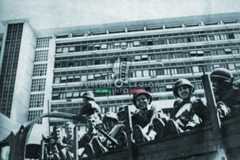
1961 Generals’ Putsch of Algiers: Foreign Legion
Foreign Legion Command
–NO, theLegion Command didn’t join the Putsch
– led byGeneralRené Morel
– a former member ofde Gaulle‘s Free French Forces
– a strongly anti-putschist officer
– however, he had a low authority among his men
– at that time, he was in France

1st Foreign Regiment
–YES, the1er RE joined the Putsch
– commanded byColonelAlbert Brothier
– he was contacted by putschist in late 1960
– he had co-operated with them since January 1961
– April 21, he sent two captains toAlgiers
– to follow the Putsch and to confirm the participation of the Legion
– however, during the Putsch, he became neutral
– he would play it on both sides
– eventually, he went on leave officially
– the 1er RE was led byColonelEtienne Ogier de Baulny
– then deputy commander of the regiment
– he openly supported the Putsch
– there were many pro-putschist elements within the unit
– between them, CaptainBonnel, CaptainBertany or CaptainGlasser
– also CaptainPompidou and CaptainDes Rieux
– the two captains were inAlgiers during the first night of the Putsch
– alsoMajorLouis Fournier
– he assured an EMT (then battalion-size operational unit)
– consisting of three companies
– ready for maintaining order missions


2nd Foreign Infantry Regiment
–YES, the2e REI joined the Putsch
– commanded byColonelBertrand de Sèze
– he was openly for French Algeria
– however, at that time, he was on leave in France
– the unit was led byMajorCharles Met
– he and his companies securedAin Sefra


3rd Foreign Infantry Regiment
–NO, the3e REI didn’t join the Putsch
– commanded byColonelPierre Langlois
– a former member ofde Gaulle‘s Free French Forces
– a strongly anti-putschist officer
– he made it clear that he would not join the Putsch
– there aren’t any accessible information about pro-putschist elements
4th Foreign Infantry Regiment
–YES andNO
– the4e REI joined and also didn’t join the Putsch
– there are only a few accessible information
– commanded byColonelEtienne Georgeon
– ColonelGeorgeon was a strongly pro-putschist officer
– ColonelGeorgeon made it clear to his staff he would join the Putsch
– however, he let them make their own free choice
– between the most active pro-putschist elements, CaptainRoquefeuil
– during the Putsch, he kept connection between the 4e REI and the putschists
– arrested after the Putsch, he was eventually acquitted
–Lt ColonelMichel Vadot didn’t join the Putsch
– then deputy commander of the 4e REI
– he didn’t believe in success of the Putsch
– in early May 1961, he took command of the 4e REI
– there aren’t any other information


5th Foreign Infantry Regiment
–YES, the5e REI joined the Putsch
– commanded byColonelPaul Pfirrmann
– initially, he was pro-putschist
– April 22, he moved toSidi Bel Abbes (Legion’s HQ)
– to share future steps with the putschists
– eventually, he became neutral
– the 5e REI was led byMajorJulien Camelin
– a strongly pro-putschist officer
– in the Legion since 1945
– among first Legion elements to arrive in Indochina in early 1946
– in 1961, he led five 5e REI companies in support of the Putsch
– during the Putsch, “MajorCamelin maintained the regiment’s cohesion”
– the testimony of a company commander, LieutenantLe Pivain
– MajorCamelin and his companies “pacified” GeneralGinestet
– GeneralGinestet was then Chief of the Southern Oran region
– he should be replaced by ColonelPfirrmann


13th Demi-Brigade of the Foreign Legion
–YES, the13e DBLE joined the Putsch
– commanded byColonelAlberic Vaillant
– a very strongly anti-putschist officer
– very loyal tode Gaulle
– in 1943, as Lieutenant, he deserted the Legion to join the Free French
– he made it clear that he would not join the Putsch
– however, his men revolted and joined the Putsch
– led by MajorGendron (according to GeneralGardy)
– he informed the 1er RE that “the 13e DBLE joined the Putsch”
– he also confirmed that he took command in place of ColonelVaillant
– GeneralGardy advised him to call GeneralChalle to receive orders
– between the most active pro-putschists, CaptainMoulinier
– also CaptainPochard or CaptainFourticq-Esqueoute
– others were LieutenantDimke (a German legionnaire, 15+ years of the Legion)
– also LieutenantBalais or LieutenantCharlet
– after the Putsch, a 13e DBLE officer wrote an open letter
– he stated in it that “the majority of 13e DBLE officers were arrested”

1st Foreign Parachute Regiment
–YES, the1er REP joined the Putsch
– commanded byColonelMaurice Guiraud
– at the time, he was on leave in France
– his stance was neutral
– the 1er REP was led byMajorHélie de Saint Marc
– then deputy commander of the regiment
– he was loyal to GeneralChalle
– 1er REP remained the most active and most loyal unit of the Putsch

2nd Foreign Parachute Regiment
–YES, the2e REP joined the Putsch
– commanded byColonelPierre Darmuzai
– a former member ofde Gaulle‘s Free French Forces
– in 1948, he led the very first Legion parachute company in Algeria
– also the only officer commanding all the three main Legion parachute units
– despite well-known rumors led by an antipathy, his stance was neutral
– April 22, he didn’t order any pro- or anti-Putsch activities
– he told his men he understand the stance of putschists
– however, he asked his men to wait and to be disciplined
– he added that, the next day, they would get a free choice to choose a side
– in court, 2e REP officers would confirm it
– when ColonelDarmuzai slept in the garrison town, his men revolted
– during the night of April 22-23, the regiment left its base forAlgiers
– led byMajorBernard Cabiro
– then deputy commander of the regiment
– however, ColonelDarmuzai was disappointed by his unit’s movement
– in court, he called it “a betrayal”
– he also stated that “a such unit should not survive” (2e REP)
– because of that statement, the Legion would be closed for him
– nevertheless, he has remained the only officer to command all the three main Legion airborne units – 1er BEP, 2e REP, 3e BEP/3e REP
– 2e REP was one of the most active Legion units during the Putsch

1st Foreign Cavalry Regiment
–YES, the1er REC joined the Putsch
– commanded byLt ColonelCharles de La Chapelle
– one of the most active Legion officers of the Putsch
– he had co-operated with the putschists since January 1961
– for the record,ColonelHerve Le Barbier de Blignieres
– a former commander of the 1er REC (1958-60)
– the predecessor to Colonelde La Chapelle
– also one of the most active putschists
– 1er REC had the most determined pro-putschist leadership
– it was also the second most active Legion unit of the Putsch


2nd Foreign Cavalry Regiment
–YES, the2e REC joined the Putsch
– commanded byLt ColonelCharles de Coatgoureden
– he was an active pro-putschist
– as a matter of interest, even the 2e REC had the determined leadership
– a former commander of the 2e REC (1957-60) was also openly pro-putschist
– Colonelde Baulny (then deputy commander of the 1er RE)
Foreign Legion Saharan Motorized units
– four Foreign Legion Saharan motorized units
– according to GeneralGardy, “the majority of the Saharan units joined the Putsch”
– that means, that only one Legion Saharan unit didn’t join the Putsch
– there aren’t any available information to find out which one
1st Legion Saharan Motorized Squadron
–YES, the 1er ESPL (1re CSPL until Jan 1961) joined the Putsch
– commanded byCaptainJacques Gaud
– its fresh commander (since mid-February 1961)
– ex-commander of the 2nd Squadron, 1er REC in Tunisia
– the unit is said to be guarding the arrested officials atIn Salah
– after the Putsch, CaptainGaud was immediately removed from command
1961 Generals’ Putsch of Algiers: Aftermath
Generals’ Putsch: Punishments
– about 220 officers were removed from command
– over 110 officers were arrested
– June-July 1961, Generals’ Putsch Trial
– it took place inParis
GeneralMaurice Challe
– sentenced to15 years in prison
– freed in December 1966
– pardoned byde Gaulle in 1968
– he died in 1979
GeneralAndré Zeller
– he surrendered two weeks later, in early May 1961
– sentenced to15 years in prison
– freed in July 1966
– pardoned byde Gaulle in 1968
– he died in 1979
GeneralRaoul Salan
– he fought for French Algeria illegally as partisan
– he was arrested in April 1962
– sentenced todeath
– later changed tolife imprisonment
– freed and pardoned byde Gaulle in 1968
– fully rehabilitated in 1982
– he died in 1984
GeneralEdmond Jouhaud
– he fought for French Algeria illegally as partisan
– he was arrested in March 1962
– sentenced todeath
– later changed tolife imprisonment
– freed in December 1967
– pardoned byde Gaulle in 1968
– fully rehabilitated in 1982
– he died in 1995
GeneralPaul Gardy
– he has never been arrested
– he fought for French Algeria illegally as partisan
– in June 1962, he left Algeria for South America
– sentenced todeathin absentia
– he diedin exile in Argentina in 1975
MajorHélie de Saint Marc (1er REP)
– sentenced to10 years in prison
– freed in December 1966
– pardoned byde Gaulle in 1968
– fully rehabilitated in 1982
– he died in 2013
Lt ColonelCharles de La Chapelle (1er REC)
– sentenced to7 years in prison
– freed in December 1966
– pardoned byde Gaulle in 1968
– fully rehabilitated in 1982
– he died in 2000
Lt ColonelGeorges Masselot (18e RCP)
– sentenced to8 years in prison
– freed in 1965
– pardoned byde Gaulle in 1968
– fully rehabilitated in 1982
– he died in 2002
Lt ColonelPierre Lecomte (14e RCP)
– sentenced to8 years in prison
– freed in 1965
– pardoned byde Gaulle in 1968
– fully rehabilitated in 1982
– he died in 2009
MajorGeorges Robin (GCP-RG)
– sentenced to6 years in prison
– freed in July 1965
– pardoned byde Gaulle in 1968
– fully rehabilitated in 1982
– he died in 2007
Lt ColonelMaurice Emery (GCP of Air)
– sentenced to3 years, on probation (suspended sentence)
MajorJulien Camelin (5e REI)
– sentenced to3 years, on probation (suspended sentence)
MajorBernard Cabiro (2e REP)
– sentenced to1 year, on probation (suspended sentence)
– the higest-ranking officers (generals, colonels) got 5-15 years in prison
– between them, five active generals
–GeneralBigot –15 years in prison
–GeneralNicot –12 years in prison
–GeneralFaure –10 years in prison
–GeneralPetit –5 years in prison
–GeneralGouraud
– then commander of the Constantine region
– likely the most unlucky higher-ranking officer of the Putsch
– at least three times joining the Putsch
– at least three times joiningde Gaulle
– April 22, he officially ordered his units to not join the Putsch
– despite that fact, he was arrested
– sentenced to7 years in prison
– the sixth general,GeneralMentré, was acquitted
– the rest of the arrested officers got 1-5 years in prison at most
– the majority of them got 1-3 years on probation (suspended sentences)
– several of them (mainly lower-ranking officers) were acquitted



Generals’ Putsch: Unit dissolutions
– April 30, 1961, several units were dissolved
– as punishment for their active participation in the Putsch
– more or less, the most elite units of then French Army
1st Foreign Parachute Regiment (1er REP)
14e Chasseurs Parachute Regiment (14e RCP)
18e Chasseurs Parachute Regiment (18e RCP)
Parachute Commando Group – General Reserve (GCP-RG)
Air Parachute Commando Group (GCPA)
10th Parachute Division (10e DP)
25th Parachute Division (25e DP)
Generals’ Putsch: Additional images
– some additional images related to the putsch


—-
Special thanks to:
Joe Van Raamt (a former legionnaire and a member of the 1er REC 1959-64)
—-
Main information & images sources:
Képi blanc magazines
Historia magazines
Historama magazines
Maurice Cottaz:Les procès du putsch d’Alger (Nouvelles Editions, 1962)
Pierre Montagnon:Histoire de la Légion (Pygmalion, 1999)
Fanion Vert et Rouge (Fr)
A.D.I.M.A.D. – Algeria 1830-1962 (Fr)
Jean J. Viala’s site – Algerian War – Chronology (Fr)
ECPAD (Min of Def audiovisual communication and production unit)
Google Maps
Wikipedia.org
———

You can support this website at any time through ourstore. Thank you.
EU-based readers can visit our EU-basedshop, to avoid import charges.
—
More from history of the Foreign Legion:
1863 Battle of Camerone
1908 Forthassa Disaster
1932 Turenne Rail Accident
1954 Battle of Dien Bien Phu
1976 Loyada Hostage Rescue Mission
1978 Battle of Kolwezi
1982 Mont Garbi Accident
—-
The page was updated on: May 10, 2018