FIRST
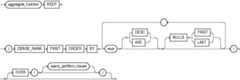
Description of the illustration ''first.gif''
See Also:
"Analytic Functions" for information on syntax, semantics, and restrictions of theORDERBY clause andOVER clauseFIRST andLAST are very similar functions. Both are aggregate and analytic functions that operate on a set of values from a set of rows that rank as theFIRST orLAST with respect to a given sorting specification. If only one row ranks asFIRST orLAST, then the aggregate operates on the set with only one element.
If you omit theOVER clause, then theFIRST andLAST functions are treated as aggregate functions. You can use these functions as analytic functions by specifying theOVER clause. Thequery_partition_clause is the only part of theOVER clause valid with these functions. If you include theOVER clause but omit thequery_partition_clause, then the function is treated as an analytic function, but the window defined for analysis is the entire table.
These functions take as an argument any numeric data type or any nonnumeric data type that can be implicitly converted to a numeric data type. The function returns the same data type as the numeric data type of the argument.
When you need a value from the first or last row of a sorted group, but the needed value is not the sort key, theFIRST andLAST functions eliminate the need for self-joins or views and enable better performance.
The
aggregate_functionargument is any one of theMIN,MAX,SUM,AVG,COUNT,VARIANCE, orSTDDEVfunctions. It operates on values from the rows that rank eitherFIRSTorLAST. If only one row ranks asFIRSTorLAST, then the aggregate operates on a singleton (nonaggregate) set.The
KEEPkeyword is for semantic clarity. It qualifiesaggregate_function, indicating that only theFIRSTorLASTvalues ofaggregate_functionwill be returned.DENSE_RANKFIRSTorDENSE_RANKLASTindicates that Oracle Database will aggregate over only those rows with the minimum (FIRST) or the maximum (LAST) dense rank (also called olympic rank).
See Also:
Table 2-10, "Implicit Type Conversion Matrix" for more information on implicit conversion andLASTThe following example returns, within each department of the sample tablehr.employees, the minimum salary among the employees who make the lowest commission and the maximum salary among the employees who make the highest commission:
SELECT department_id, MIN(salary) KEEP (DENSE_RANK FIRST ORDER BY commission_pct) "Worst", MAX(salary) KEEP (DENSE_RANK LAST ORDER BY commission_pct) "Best" FROM employees GROUP BY department_id ORDER BY department_id;DEPARTMENT_ID Worst Best------------- ---------- ---------- 10 4400 4400 20 6000 13000 30 2500 11000 40 6500 6500 50 2100 8200 60 4200 9000 70 10000 10000 80 6100 14000 90 17000 24000 100 6900 12008 110 8300 12008 7000 7000
The next example makes the same calculation as the previous example but returns the result for each employee within the department:
SELECT last_name, department_id, salary, MIN(salary) KEEP (DENSE_RANK FIRST ORDER BY commission_pct) OVER (PARTITION BY department_id) "Worst", MAX(salary) KEEP (DENSE_RANK LAST ORDER BY commission_pct) OVER (PARTITION BY department_id) "Best" FROM employees ORDER BY department_id, salary, last_name;LAST_NAME DEPARTMENT_ID SALARY Worst Best------------------- ------------- ---------- ---------- ----------Whalen 10 4400 4400 4400Fay 20 6000 6000 13000Hartstein 20 13000 6000 13000. . .Gietz 110 8300 8300 12008Higgins 110 12008 8300 12008Grant 7000 7000 7000