Tango was first introduced to Poland in 1913, with the performance of Victor Jacobi’s operaTarg na Dziewczęta (Girls’ Market) at the New Theatre in Warsaw. Its popularity over the following years grew not from palpable influences, but gramophone records, the radio and newspaper reports.
This popular consumption through media prompted Polish tangos to carve their own position in the history of the nation’s music: with a lack of direct contact, pieces began to veer away from the original Argentinian form, adopting a more melancholic sound influenced heavily byklezmer, and a softer melody and harmony; replacing the underlying rhythm of the stereotypical bandoneon with a proliferation of slides and rigorous vibrato. Theirs was a journey that blossomed along with the Polish state itself – these tangos were bulwarks of a new, revitalised Polish popular culture.
In 1925, Henryk Gold and his brother Artur established the Gold Orchestra, an 8-piece jazz band that played regularly at the Cafe Bodega in Warsaw. At first, the orchestra exclusively played ragtime, but soon, with the echoes of a more exotic yet wistful sound creeping across the continent, it slowly began to dabble with tangos and waltzes, styles that would become the pair’s legacy.
A year later in 1926, Artur Gold and his cousin,Jerzy Petersburski, co-founded the Petersburski & Gold Orchestra. By the end of the decade, it was one of the most renowned dance orchestras in Warsaw, performing in the fashionable Adria restaurant.
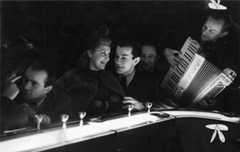
Inside the Adria in Warsaw, 1940, photo: www.audiovis.nac.gov.pl (NAC)


