

Thekfino algorithm was developped for time coursesin order to detect impulse noised outliers and predict the parameter ofinterest mainly for data recorded on the walk-over-weighing systemdescribed in this publication:
E.González-Garcíaet. al. (2018) A mobile and automatedwalk-over-weighing system for a close and remote monitoring ofliveweight in sheep. vol 153: 226-238.https://doi.org/10.1016/j.compag.2018.08.022
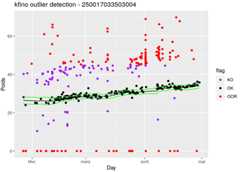
Kalman filter with impulse noised outliers (kfino)is a robust sequential algorithm allowing to filter data with a largenumber of outliers. This algorithm is based on simple latent linearGaussian processes as in the Kalman Filter method and is devoted todetect impulse-noised outliers. These are data points that differsignificantly from other observations.
The method is described in full details in the following arxivpreprint: https://arxiv.org/abs/2208.00961.
To install thekfino package, the easiest is toinstall it directly from GitLab. Open an R session and run the followingcommands:
if (!require("remotes")) { install.packages("remotes")}remotes::install_gitlab("isabelle.sanchez/kfino",host = "forgemia.inra.fr", build_vignettes=TRUE)Once the package is installed on your computer, it can be loaded intoa R session:
library(kfino)help(package="kfino")Please, have a look to the vignettes that explain how to use thealgorithm. The main specifications are:


As a lot of time and effort were spent in creating the kfinoalgorithm, please cite it when using it for data analysis:
https://arxiv.org/abs/2208.00961.
See also citation() for citing R itself.
Thekfino logo was created using thehexSticker package:
Walk-over-weighing system: