


The goal of BlueCarbon is to facilitate the estimation of organiccarbon stocks and sequestration rates from soil/sediment cores from bluecarbon ecosystems. Following the protocols published by the Blue CarboninitiativeHoward etal. (2014).
It includes seven mainfunctionsto (1) estimate core compaction, (2) correct core compaction, (3)estimate sample thickness, (4) estimate organic carbon content fromorganic matter content, (5) estimate organic carbon stocks and (6)sequestration rates, and (7) visualize the error in stockextrapolation.
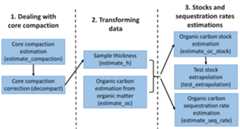
Sampling soil cores by manual percussion often results in thecompaction of the material retrieved. This function(estimate_compaction()) estimates the percentage ofcompaction using measurements taken before and after inserting the corertube (Fig. 2): the length of the corer tube (sampler_length), distancebetween the surface of the soil and the top of the tube in the outside(external_distance) and distance between the surface of the soil and thetop of the tube in the inside of the tube (internal_distance).

Core compaction derived from field extraction can be mathematicallycorrected to estimate the original depth of the samples. This function(decompact()) applies a linear correction (assuming uniformcompaction of the core material) to adjust the sample depth accurately.If dry bulk density was estimated before compaction correction, it canbe provided as a variable and the function will correct itaccordingly.
There is a linear correlation between organic carbon and organicmatter content. This correlation can vary across ecosystems and samplingsites. This function (estimate_oc()) fits a linearregression model between organic matter and organic carbon content ofthe samples and predicts organic carbon values for samples where thelatter information is missing. Estimation of organic carbon is performedusing a linear regression between the logarithm of the organic carboncontent and the logarithm of the organic matter content (log(organiccarbon) \ log(organic matter)), providing an organic carbon value foreach organic matter value. It fits a model for each sampling station,dominant species, and ecosystem. If an organic carbon value is alreadyavailable for a sample, the function returns it. Otherwise, it appliesthe model for the corresponding sampling station. If a model cannot befitted for that station (e.g. because of limited sample size) or if themodel fit is poor, the function instead applies the model for thedominant species. If no suitable species-level model exists, it thenapplies the ecosystem-level model. If no models are available at any ofthese levels, the function defaults to published models:Fourqurean et al. (2012) forseagrasses,Maxwellet al. (2023) for salt marshes, andPiñeiro-Juncal etal. (2025) for mangroves. It is unlikely, but possible, that themodel predicts higher organic carbon than organic matter content. Ifthis occurs, the function issues a warning, and it is recommended todiscard that model.
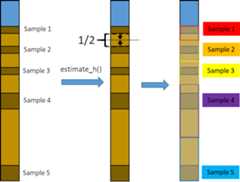
For cores where only selected samples were measured, it is necessaryto assign a carbon density to the unmeasured sections before estimatingthe total stock. This function (estimate_h()) identifiesgaps between samples and, if any are present, divides the space betweenthe previous and next sample, ensuring continuous samples without gapsin the core (Fig. 3). The midpoint between two consecutive samples isestimated from the bottom of the previous sample to the top of the nextsample, preventing the uneven distribution of gaps between samples withdifferent thickness. The stock and sequestration rate estimationfunctions (estimate_oc_stock() andestimate_seq_rate()) already incorporate this function, sothere is no need to run it separately.
Estimates carbon stocks from soil core data down to a specifieddepth, with 100 as the default. If the core does not reach the desireddepth, the function extrapolates the stock using a linear model based onthe relationship between accumulated organic carbon mass and depth. Inthis model, accumulated organic carbon mass (stock) is the targetvariable and depth the explanatory variable (lm(accumulated organiccarbon mass ~ depth)). Therefore, this function will always provideeither a estimated stock (if the core reaches the desired depth) or apredicted stock (if not). However, if the max depth of the core and thedesired depth differ greatly, this predicted depth could differ greatlyfrom the real stock. We recommend that, if possible, the users use thefunctiontest_extrapolation() to assess the error of thisextrapolation, and that they clearly indicate the maximum depth of thecores in the methods section of the resulting research outputs.

This function subset the cores that reach the desired depth,estimates the observed stock, and estimates the stock using the linearmodel on the relationship between accumulated organic carbon mass anddepth. Extrapolations are performed using the top 90, 75, 50 and 25%length of the specified depth. The function then compares the observedstock with the extrapolated stock estimates. Note that this functionrequires that at least some cores reach the desired depth.
Estimates the average organic carbon sequestration rate in the soilover a specified time frame (by default 100). The average sequestrationrate is calculated by dividing the stock at the depth corresponding tothe target time frame by the length of the time frame itself.
BlueCarbon can be installed directly fromCRAN:
install.packages("BlueCarbon")or fromR-universe:
install.packages("BlueCarbon",repos =c("https://ecologyr.r-universe.dev","https://cloud.r-project.org"))Or fromGitHub:
# install.packages("remotes")remotes::install_github("EcologyR/BlueCarbon")If using this package, please cite it:
citation("BlueCarbon")To cite package'BlueCarbon'in publications use: Piñeiro-Juncal N, Astigarraga J, Costa V, Martins M, Rodriguez-SanchezF (2025). _BlueCarbon: Estimation of Organic Carbon Stocks and Sequestration Rates From Soil Core Data_. R package version0.1.1, https://EcologyR.github.io/BlueCarbon/,<https://github.com/EcologyR/BlueCarbon>.A BibTeX entryfor LaTeX users is@Manual{, title= {BlueCarbon: Estimation of Organic Carbon Stocks and Sequestration Rates From Soil Core Data}, author= {Nerea Piñeiro-Juncal and Julen Astigarraga and Valentina Costa and Marcio Martins and Francisco Rodriguez-Sanchez}, year= {2025}, url= {https://github.com/EcologyR/BlueCarbon}, note= {R package version0.1.1, https://EcologyR.github.io/BlueCarbon/}, }Please note that the BlueCarbon project is released with aContributorCode of Conduct. By contributing to this project, you agree to abideby its terms.
The development of this software has been funded by Fondo Europeo deDesarrollo Regional (FEDER) and Consejería de Transformación Económica,Industria, Conocimiento y Universidades of Junta de Andalucía (projectUS-1381388 led by Francisco Rodríguez Sánchez, Universidad de Sevilla).NPJ was supported by a Juan de la Cierva fellowship (JDC2022-048342-I,MCIN/AEI/10.13039/501100011033, European Union“NextGenerationEU”/PRTR”). JA acknowledges funding from the CLIMB-FORESTHorizon Europe Project (No 101059888) funded by the European Union. FRSwas supported by VI PPIT-US from Universidad de Sevilla. MM wassupported by a FCT PhD grant (https://doi.org/10.54499/2020.06996.BD).
