

The goal of scrutiny is to test published summary statistics forconsistency using techniques like GRIM and to check their plausibility.The package makes these methods easy to use in a tidyverse-friendly way.It hopes to help the new field of error detection go mainstream.
You can use the most important parts in theError detection Shinyapp instead.
Besides ready-made tests, scrutiny features a complete system forimplementing new consistency tests. It also has duplication analysis,more general infrastructure for implementing error detection techniques,as well as specialized data wrangling functions. See theArticles tab for vignettes.
Install the package from CRAN:
install.packages("scrutiny")Alternatively, install the development version from GitHub:
remotes::install_github("lhdjung/scrutiny")Here is how to GRIM-test all values in a data frame. When usinggrim_map(), theconsistency column tells youif the means (x) and sample sizes (n) aremutually consistent.
library(scrutiny)# Example data:pigs1#> # A tibble: 12 × 2#> x n#> <chr> <dbl>#> 1 7.22 32#> 2 4.74 25#> 3 5.23 29#> 4 2.57 24#> 5 6.77 27#> 6 2.68 28#> 7 7.01 29#> 8 7.38 26#> 9 3.14 27#> 10 6.89 31#> 11 5.00 25#> 12 0.24 28# GRIM-testing for data frames:grim_map(pigs1)#> # A tibble: 12 × 4#> x n consistency probability#> <chr> <dbl> <lgl> <dbl>#> 1 7.22 32 TRUE 0.68#> 2 4.74 25 FALSE 0.75#> 3 5.23 29 FALSE 0.71#> 4 2.57 24 FALSE 0.76#> 5 6.77 27 FALSE 0.73#> 6 2.68 28 TRUE 0.72#> 7 7.01 29 FALSE 0.71#> 8 7.38 26 TRUE 0.74#> 9 3.14 27 FALSE 0.73#> 10 6.89 31 FALSE 0.69#> 11 5.00 25 TRUE 0.75#> 12 0.24 28 FALSE 0.72Test percentages instead of means:
pigs2#> # A tibble: 6 × 2#> x n#> <chr> <dbl>#> 1 67.4 150#> 2 54.2 150#> 3 54.0 150#> 4 69.8 150#> 5 68.1 150#> 6 55.4 150grim_map(pigs2,percent =TRUE)#> ℹ `x` converted from percentage#> # A tibble: 6 × 4#> x n consistency probability#> <chr> <dbl> <lgl> <dbl>#> 1 0.674 150 FALSE 0.85#> 2 0.542 150 FALSE 0.85#> 3 0.540 150 TRUE 0.85#> 4 0.698 150 FALSE 0.85#> 5 0.681 150 FALSE 0.85#> 6 0.554 150 FALSE 0.85You can choose how the means are reconstructed for testing — below,rounded up from 5. When visualizing results, the plot will adjustautomatically. Blue dots are consistent values, red dots areinconsistent ones:
pigs1%>%grim_map(rounding ="up")%>%grim_plot()
Similarly, use DEBIT to test means and standard deviations of binarydata:
pigs3#> # A tibble: 7 × 3#> x sd n#> <chr> <chr> <dbl>#> 1 0.53 0.50 1683#> 2 0.44 0.50 1683#> 3 0.77 0.42 1683#> 4 0.19 0.35 1683#> 5 0.34 0.47 1683#> 6 0.93 0.25 1683#> 7 0.12 0.33 1683pigs3%>%debit_map()#> # A tibble: 7 × 11#> x sd n consistency rounding sd_lower sd_incl_lower sd_upper#> <chr> <chr> <int> <lgl> <chr> <dbl> <lgl> <dbl>#> 1 0.53 0.50 1683 TRUE up_or_down 0.495 TRUE 0.505#> 2 0.44 0.50 1683 TRUE up_or_down 0.495 TRUE 0.505#> 3 0.77 0.42 1683 TRUE up_or_down 0.415 TRUE 0.425#> 4 0.19 0.35 1683 FALSE up_or_down 0.345 TRUE 0.355#> 5 0.34 0.47 1683 TRUE up_or_down 0.465 TRUE 0.475#> 6 0.93 0.25 1683 TRUE up_or_down 0.245 TRUE 0.255#> 7 0.12 0.33 1683 TRUE up_or_down 0.325 TRUE 0.335#> # ℹ 3 more variables: sd_incl_upper <lgl>, x_lower <dbl>, x_upper <dbl>pigs3%>%debit_map()%>%debit_plot()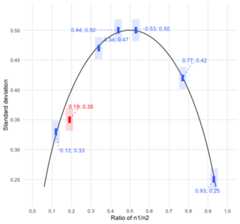
(…) a critical inspection of the published literature should not bemischaracterized as a hobby for the overly cynical, nor as so-called“methodological terrorism”. On the contrary, carefully evaluatingpresented data is a cornerstone of scientific investigation, and it isonly logical to apply this also to the published literature. If we arenot willing to critically assess published studies, we also cannotguarantee their veracity.
— van der Zee et al. (2017, pp. 8-9)
(…) data thugs (…) demand data and if they do not receive it, theycontact editors and universities and threaten to write blogs and tweetsabout the errors uncovered.
— Eric A. Stewart (six retractions; quoted in Pickett 2020,p. 178)
Pickett, J. T. (2020). The Stewart Retractions: A Quantitative andQualitative Analysis.Econ Journal Watch,17(1),152–190.https://econjwatch.org/articles/the-stewart-retractions-a-quantitative-and-qualitative-analysis.
van der Zee, T., Anaya, J., & Brown, N. J. L. (2017). Statisticalheartburn: An attempt to digest four pizza publications from the CornellFood and Brand Lab.BMC Nutrition,3(1), 54.https://doi.org/10.1186/s40795-017-0167-x.