
wildpedigreeexplorerR is an R package designed tosimplify the analysis of wild pedigree data. The package was primarilydeveloped to work with pedigree data generated byCOLONYpedigree reconstruction software. However, it can also accommodatepedigree data from other sources. By combining the reconstructedpedigree with genetic sample metadata, wpeR creates visual and tabularrepresentations of the pedigree, allowing the user to interpret thepedigree in spatial and temporal terms. The main goal of the package isto provide an efficient solution for the analysis of complex wildpedigree data and to help the user to gain valuable insights intogenetic relationships within wild animal populations.
devtools::install_github("GR3602/wpeR")The wpeR package requires two main input datasets for analysis:Pedigree andGenetic samplesmetadata.
| Function call order | Function | Description |
|---|---|---|
| 1a | get_colony() | Organizes COLONY output |
| 1b | get_ped() | Organizes pedigree data |
| 2 | anim_timespan() | Get dates of individuals first and last sample |
| 3 | org_fams() | Organizes animals into families and expands pedigree data |
| 4 | plot_table() | Prepares pedigree data for plotting and spatial representation |
| 5.1 | ped_satplot() | Temporal plot of pedigree |
| 5.2 | ped_spatial() | Get files for spatial representation of pedigree |
####DATA PREPARATION##### Define the path to the pedigree data file.path <- paste0(system.file("extdata", package = "wpeR"), "/wpeR_samplePed")# Retrieve the pedigree data from the get_colony function.ped_colony <- get_colony(path, sampledata, rm_obsolete_parents = TRUE, out = "FamAgg")# Get animal timespan data using the anim_timespan() function.animal_ts <- anim_timespan(wolf_samples$AnimalRef, wolf_samples$Date, wolf_samples$SType, dead = c("Tissue"))# Add animal timespan to the sampledatasampledata <- merge(wolf_samples, animal_ts, by.x = "AnimalRef", by.y = "ID", all.x = TRUE)# Organize families and expand pedigree data using the org_fams function.## families data framefams <- org_fams(ped_colony, sampledata, output = "fams")## extended pedigree data frameped <- org_fams(ped_colony,sampledata, output = "ped")# The example show just one family ## Prepare data for plotting.pt <- plot_table(plot_fams = 1, org_tables$fams, org_tables$ped, sampledata, deadSample = c("Tissue")) ####VISUALIZATION#### ## Get a temporal pedigree plot.ped_satplot(plottable = pt)EXAMPLE Visualization usingkinship2package
# optional pedigre plot pedigree plot from kinship2### extract parent codesparents1 = strsplit(fams[fams$FamID == 1,]$parents, "_")[[1]]### filter the family from pedigreFam1 = ped[(ped$FamID == 1 | ped$id %in% parents1),]### plot using kinship2 plot(kinship2::pedigree(Fam1$id, Fam1$father, Fam1$mother, Fam1$sex))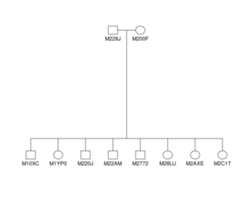
## Create spatial files<!-- ps <- ped_spatial(pt) -->summary(ps)| Object Name | Description | |
|---|---|---|
| mother… | Rpoints | POINT object representing reference samples of each animal. Referencesample for parents is their first sample, reference sample for theoffspring is their last sample within the user defined time frame. |
| father… | ||
| offspring… | ||
| mother… | MovePoints | POINT object representing all samples of a particular animal. |
| father… | ||
| offspring… | ||
| maternity… | Lines | LINESTRING object connecting reference samples of mothers or fatherswith reference samples of their offspring. |
| paternity… | ||
| mother… | MoveLines | LINESTRING object connecting all samples of an individual inchronological order, showcasing the movement or changes in location overtime for the specific animal. |
| father… | ||
| offspring… | ||
| mother… | MovePolygon | POLYGON object representing a convex hull that encloses all the samplesof an individual. It provides a graphical representation of the spatialextent or range covered by the animal based on its sample locations. |
| father… | ||
EXAMPLE Using spatial files together withggplot2,basemapsandggsflabelfor spatial visualization.
 |
|---|
| Spatial representation usingmother/father/offspringRpoints and maternety/paternitylines |
 |
|---|
| Spatial representation usingmother/fatherRpoints/MovePoints/MoveLines |