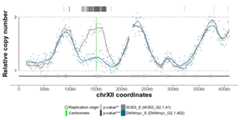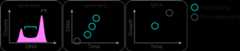
Repliscope is an R package for creating, normalising, comparing andplotting DNA replication timing profiles. The analysis pipeline startswith BED-formatted read count files (output oflocalMapper)obtained by high-throughput sequencing of DNA from replicating andnon-replicating cells. There are three methods of measuring DNAreplication dynamics using relative copy number (Fig): sort-seq,sync-seq and marker frequency analysis (MFA-seq). Sort-seq usesfluorescence-activated cell sorting (FACS) to enrich for non-replicatingand replicating cells from an asynchronous population. Sync-seq requirescells to be arrested in non-replicating cell cycle phase (i.e. G1),followed by release into S phase. Samples are then taken throughout Sphase when cells synchronously synthesise DNA according to thereplication timing programme. In the case of MFA-seq, rapidly dividingcells in exponential growth phase are directly used as the replicatingsample, while a saturated culture serves as a non-replicating controlsample. While the latter approach of obtaining cells is the simplest, italso requires deeper sequencing due to decreased dynamic range and,thus, is more suitable for organisms with small genomes (typically,bacteria).
For best experience, use the Repliscope in interactive mode. To doso, simply run therunGUI() function.
The typical command line analysis using Repliscope starts withloading BED-formatted read count files using theloadBedfunction. Various functions allow removal of genomic bins containing lowquality data (rmChr,rmOutliers). To aid readcount analysis, two visualisation functions are used:plotBed andplotCoverage. Next, read-depthadjusted ratio of reads from the replicating sample to reads in thenon-replicating sample is calculated using themakeRatiofunction; the resulting ratio values are distributed around one. ThenormaliseRatio function is then used to transpose the ratiovalues to a biologically relevant relative DNA copy number scale(typically, from 1 to 2). The normalised ratio values are, essentially,replication timing profiles, where low values indicate late replicationand high values - early replication. TheplotRatio functionhelps to visualise the ratio values as a histogram. Genomic binscontaining unusually high or low ratio values may be removed using thetrimRatio function.smoothRatio uses cubicspline to smooth replication profile data.compareRatioscan be used to calculate difference between two replication profilesusing z-score statistics. Finally, replication profiles are plottedusing theplotGenome function, which also allows forvarious genome annotations.
You can install the released version of Repliscope fromCRAN with:
install.packages("Repliscope")A typical analysis pipeline is below:
repBed <- loadBed('path/to/file1.bed') # read counts from replicating samplenrepRep <- loadBed('path/to/file2.bed') # read counts from non-replicating sampleratio <- makeRatio(repBed,nrepBed) # create ratio between replicating and non-replicating samplesratio <- normaliseRatio(ratio) # normalise the ratio to fit biological scale of one to twoplotGenome(ratio) # plot the resulting replicating profileThe replication profiles may further be annotated with additionalgenomic data, such as location of centromeres, known replication originsor other regions or points of interest. Two replication profiles may becompared to find genomic regions with statistically differentreplication timing. Resulting plots may be saved as pdf files containingeditable vector graphics.