NCC package allows users to simulate platform trials andto compare arms using non-concurrent control data.
Design overview
We consider a platform trial evaluating the efficacy of treatment arms compared to a shared control. Weassume that treatment arms enter the platform trial sequentially. Inparticular, we consider a trial starting with at least one initialtreatment arm, where a new arm is added after every
patients have beenrecruited to the trial (with
).
We divide the duration of the trial into periods, where the periods are the time intervalsbounded by times at which a treatment arm either enters or leaves theplatform.
The below figure illustrates the considered trial design.

Functions
This package contains the following functions:
Data generation
Main functions for datageneration
datasim_bin()simulates data with binary outcomesdatasim_cont()simulates data with continuousoutcomes
Auxiliary functions fordata generation
get_ss_matrix()computes sample sizes per arm andperiodlinear_trend()is the linear time trend function, usedto generate the trend for each patientsw_trend()is the step-wise time trend function, usedgenerate the trend for each patientinv_u_trend()is the inverted-u time trend function,used generate the trend for each patientseasonal_trend()is the seasonal time trend function,used generate the trend for each patient
Data analysis
Frequentist approaches
fixmodel_bin()performs analysis using a regressionmodel adjusting for periodsfixmodel_cal_bin()performs analysis using a regressionmodel adjusting for calendar timepoolmodel_bin()performs pooled analysissepmodel_bin()performs separate analysissepmodel_adj_bin()performs separate analysis adjustingfor periods
Bayesian approaches
MAPprior_bin()performs analysis using the MAP priorapproachtimemachine_bin()performs analysis using the TimeMachine approach
Frequentist approaches
fixmodel_cont()performs analysis using a regressionmodel adjusting for periodsfixmodel_cal_cont()performs analysis using aregression model adjusting for calendar timegam_cont()performs analysis using generalized additivemodelmixmodel_cont()performs analysis using a mixed modeladjusting for periods as a random factormixmodel_cal_cont()performs analysis using a mixedmodel adjusting for calendar time as a random factormixmodel_AR1_cont()performs analysis using a mixedmodel adjusting for periods as a random factor with AR1 correlationstructuremixmodel_AR1_cal_cont()performs analysis using a mixedmodel adjusting for calendar time as a random factor with AR1correlation structurepiecewise_cont()performs analysis using discontinuouspiecewise polynomials per periodpiecewise_cal_cont()performs analysis usingdiscontinuous piecewise polynomials per calendar timepoolmodel_cont()performs pooled analysissepmodel_cont()performs separate analysissepmodel_adj_cont()performs separate analysisadjusting for periodssplines_cont()performs analysis using regressionsplines with knots placed according to periodssplines_cal_cont()performs analysis using regressionsplines with knots placed according to calendar times
Bayesian approaches
MAPprior_cont()performs analysis using the MAP priorapproachtimemachine_cont()performs analysis using the TimeMachine approach
Running simulations
all_models()is an auxiliary wrapper function toanalyze given dataset (treatment-control comparisons) with multiplemodelssim_study()is a wrapper function to run a simulationstudy (treatment-control comparisons) for desired scenariossim_study_par()is a wrapper function to run asimulation study (treatment-control comparisons) for desired scenariosin parallel
Visualization
plot_trial()visualizes the progress of a simulatedtrial
For a more detailed description of the functions, see the vignettesin the R-package website (https://pavlakrotka.github.io/NCC/).
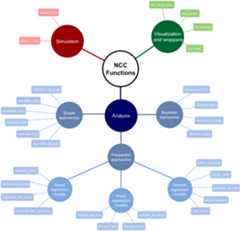
Scheme of the packagestructure
The below figure illustrates theNCC package functionsby functionality.
Installation
To install the latest version of theNCC package fromGithub, please run the following code:
# install.packages("devtools")devtools::install_github("pavlakrotka/NCC",build_vignettes =TRUE)Documentation
Documentation of all functions as well as vignettes with furtherdescription and examples can be found at the package website:https://pavlakrotka.github.io/NCC/
References
[1] Bofill Roig, M., Krotka, P., et al. “Onmodel-based time trend adjustments in platform trials withnon-concurrent controls.” BMC medical research methodology 22.1(2022): 1-16.
[2] Lee, K. M., and Wason, J.“Includingnon-concurrent control patients in the analysis of platform trials: isit worth it?.” BMC medical research methodology 20.1 (2020):1-12.
[3] Saville, B. R., Berry, D. A., et al. “TheBayesian Time Machine: Accounting for Temporal Drift in Multi-armPlatform Trials.” Clinical Trials 19.5 (2022): 490-501
Funding
EU-PEARL (EU Patient-cEntricclinicAl tRial pLatforms) project has received funding from theInnovative Medicines Initiative (IMI) 2 Joint Undertaking (JU) undergrant agreement No 853966. This Joint Undertaking receives support fromthe European Union’s Horizon 2020 research and innovation programme andEFPIA and Children’s Tumor Foundation, Global Alliance for TB DrugDevelopment non-profit organisation, Spring works Therapeutics Inc. Thispublication reflects the authors’ views. Neither IMI nor the EuropeanUnion, EFPIA, or any Associated Partners are responsible for any usethat may be made of the information contained herein.
[8]ページ先頭