Background
Madeline A. Ward published apaperon methods for detecting seasonal influenza epidemics using schoolabsenteeism data. The premise is that there is a school absenteeismsurveillance system established in Wellington-Dufferin-Guelph which usesa threshold-based (10% of students absent) approach to raise alarms forschool illness outbreaks to implement mitigating measures. Two metrics(FAR and ADD) are proposed in that study that were found to be moreaccurate.
Based on the work of Madeline, in 2021 Kayla Vanderkruk along withDrs. Deeth and Feng wrote apaperon improved metrics, namely ATQ (alert time quality), that are moreaccurate and timely than the FAR-selected models. This package is basedoff Kayla’s work that can be foundhere.ATQ study assessed alarms on a gradient, where alarms raisedincrementally before or after an optimal date were penalized for lack oftimeliness.
This ATQ package will allow users to perform simulation studies andevaluate ATQ & FAR based metrics from them. The simulation studywill require information from census data for a region such asdistribution of number of household members, households with and withoutchildren, and age category, etc.
This package is still a work in progress and future considerationsinclude streamlining simulation study workflow and generalizingevaluation of metrics to include real data sets.
Installation:
You can install the development version of ATQ fromGithub
#install.packages("devtools")library(devtools)install_github("vjoshy/ATQ_Surveillance_Package")Key Functions
The ATQ package includes the following main functions:
catchment_sim()- Simulates catchment area data
elementary_pop()- Simulates elementary school populations
subpop_children()- Simulates households with children
subpop_noChildren()- Simulates households without children
simulate_households()- Combines household simulations
ssir()- Simulates epidemic using SSIR model
compile_epi()- Compiles absenteeism data
eval_metrics()- Evaluates alarm metrics
plot()andsummary()- Methods for visualizing and summarizing results
Additionally, the package implements S3 methods for genericfunctions:
plot()andsummary()- These methods are extended for objects returned by
ssir()andeval_metrics() plot()provides visualizations of epidemic simulationsand metric evaluationssummary()offers concise summaries of the simulationresults and metric assessments
- These methods are extended for objects returned by
These functions and methods work together to facilitate comprehensiveepidemic simulation and evaluation of detection models
Please see example below:
# Load the ATQ packagelibrary(ATQ)set.seed(69420)#Simulate number of elementary schools in each catchmentcatch_df<-catchment_sim(16,5,shape =4.68,rate =3.01)# Simulate elementary school populations for each catchment areaelementary_df<-elementary_pop(catch_df,shape =5.86,rate =0.01)# Simulate households with childrenhouse_children<-subpop_children(elementary_df,n =2,prop_parent_couple =0.7,prop_children_couple =c(0.3,0.5,0.2),prop_children_lone =c(0.4,0.4,0.2),prop_elem_age =0.6)# Simulate households without childrenhouse_nochildren<-subpop_noChildren(house_children, elementary_df,prop_house_size =c(0.2,0.3,0.25,0.15,0.1),prop_house_Children =0.3)# Combine household simulations and generate individual-level datasimulation<-simulate_households(house_children, house_nochildren)# Extract individual-level dataindividuals<- simulation$individual_sim# Simulate epidemic using SSIR (Stochastic Susceptible-Infectious-Recovered) modelepidemic<-ssir(nrow(individuals),T =300,alpha =0.298,inf_init =32,rep =10)# Summarize and plot the epidemic simulation resultssummary(epidemic)#> SSIR Epidemic Summary (Multiple Simulations):#> Number of simulations: 10#>#> Average total infected: 41065.5#> Average total reported cases: 826.9#> Average peak infected: 3036.4#>#> Model parameters:#> $N#> [1] 136784#>#> $T#> [1] 300#>#> $alpha#> [1] 0.298#>#> $inf_period#> [1] 4#>#> $inf_init#> [1] 32#>#> $report#> [1] 0.02#>#> $lag#> [1] 7#>#> $rep#> [1] 10plot(epidemic)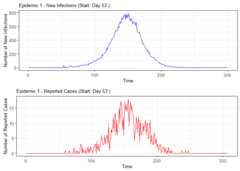
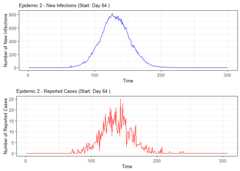
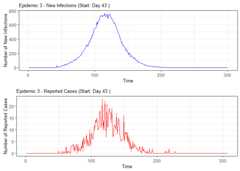
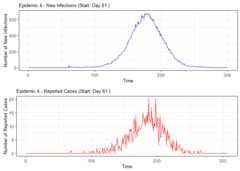
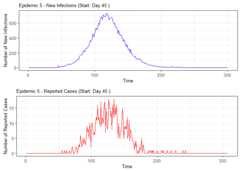
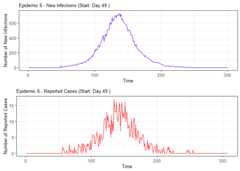
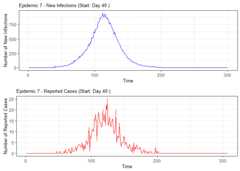

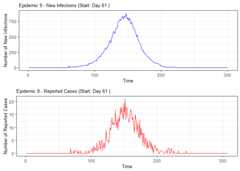
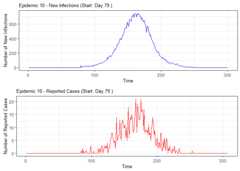
# Compile absenteeism data based on epidemic simulation and individual dataabsent_data<-compile_epi(epidemic, individuals)# Display structure of absenteeism datadplyr::glimpse(absent_data)#> Rows: 3,000#> Columns: 28#> $ Date <int> 1, 2, 3, 4, 5, 6, 7, 8, 9, 10, 11, 12, 13, 14, 15, 16, 17,…#> $ ScYr <int> 1, 1, 1, 1, 1, 1, 1, 1, 1, 1, 1, 1, 1, 1, 1, 1, 1, 1, 1, 1…#> $ pct_absent <dbl> 0.05096603, 0.05190044, 0.05079590, 0.04899765, 0.05083607…#> $ absent <dbl> 636, 661, 628, 627, 623, 624, 607, 603, 657, 673, 616, 667…#> $ absent_sick <dbl> 0, 0, 0, 0, 0, 0, 0, 0, 0, 0, 0, 0, 0, 0, 0, 0, 0, 0, 0, 0…#> $ new_inf <dbl> 0, 0, 0, 0, 0, 0, 0, 0, 0, 0, 0, 0, 0, 0, 0, 0, 0, 0, 0, 0…#> $ lab_conf <dbl> 0, 0, 0, 0, 0, 0, 0, 0, 0, 0, 0, 0, 0, 0, 0, 0, 0, 0, 0, 0…#> $ Case <dbl> 0, 0, 0, 0, 0, 0, 0, 0, 0, 0, 0, 0, 0, 0, 0, 0, 0, 0, 0, 0…#> $ sinterm <dbl> 0.01720158, 0.03439806, 0.05158437, 0.06875541, 0.08590610…#> $ costerm <dbl> 0.9998520, 0.9994082, 0.9986686, 0.9976335, 0.9963032, 0.9…#> $ window <dbl> 0, 0, 0, 0, 0, 0, 0, 0, 0, 0, 0, 0, 0, 0, 0, 0, 0, 0, 0, 0…#> $ ref_date <dbl> 0, 0, 0, 0, 0, 0, 0, 0, 0, 0, 0, 0, 0, 0, 0, 0, 0, 0, 0, 0…#> $ lag0 <dbl> 0.05096603, 0.05190044, 0.05079590, 0.04899765, 0.05083607…#> $ lag1 <dbl> NA, 0.05096603, 0.05190044, 0.05079590, 0.04899765, 0.0508…#> $ lag2 <dbl> NA, NA, 0.05096603, 0.05190044, 0.05079590, 0.04899765, 0.…#> $ lag3 <dbl> NA, NA, NA, 0.05096603, 0.05190044, 0.05079590, 0.04899765…#> $ lag4 <dbl> NA, NA, NA, NA, 0.05096603, 0.05190044, 0.05079590, 0.0489…#> $ lag5 <dbl> NA, NA, NA, NA, NA, 0.05096603, 0.05190044, 0.05079590, 0.…#> $ lag6 <dbl> NA, NA, NA, NA, NA, NA, 0.05096603, 0.05190044, 0.05079590…#> $ lag7 <dbl> NA, NA, NA, NA, NA, NA, NA, 0.05096603, 0.05190044, 0.0507…#> $ lag8 <dbl> NA, NA, NA, NA, NA, NA, NA, NA, 0.05096603, 0.05190044, 0.…#> $ lag9 <dbl> NA, NA, NA, NA, NA, NA, NA, NA, NA, 0.05096603, 0.05190044…#> $ lag10 <dbl> NA, NA, NA, NA, NA, NA, NA, NA, NA, NA, 0.05096603, 0.0519…#> $ lag11 <dbl> NA, NA, NA, NA, NA, NA, NA, NA, NA, NA, NA, 0.05096603, 0.…#> $ lag12 <dbl> NA, NA, NA, NA, NA, NA, NA, NA, NA, NA, NA, NA, 0.05096603…#> $ lag13 <dbl> NA, NA, NA, NA, NA, NA, NA, NA, NA, NA, NA, NA, NA, 0.0509…#> $ lag14 <dbl> NA, NA, NA, NA, NA, NA, NA, NA, NA, NA, NA, NA, NA, NA, 0.…#> $ lag15 <dbl> NA, NA, NA, NA, NA, NA, NA, NA, NA, NA, NA, NA, NA, NA, NA…# Evaluate alarm metrics for epidemic detectionalarm_metrics<-eval_metrics(absent_data,thres =seq(0.1,0.6,by =0.05))# Plot various alarm metricsplot(alarm_metrics$metrics,"FAR")# False Alert Rate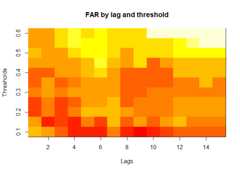
plot(alarm_metrics$metrics,"FATQ")# First Alert Time Quality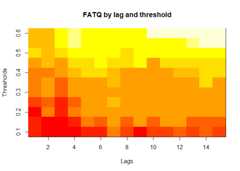
plot(alarm_metrics$metrics,"AATQ")# Average Alert Time Quality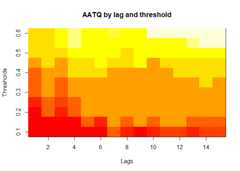
plot(alarm_metrics$metrics,"WAATQ")# Weighted Average Alert Time Quality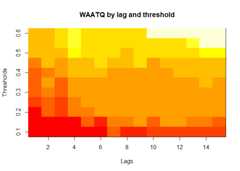
plot(alarm_metrics$metrics,"WFATQ")# Weighted First Alert Time Quality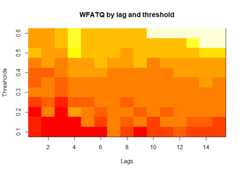
plot(alarm_metrics$metrics,"ADD")# Accumulated Delay Days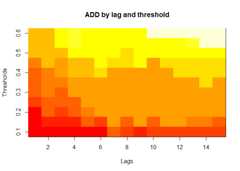
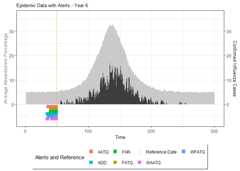
# Summarize alarm metricssummary(alarm_metrics$results)#> Alarm Metrics Summary#> =====================#>#> FAR :#> Mean: 0.5603#> Variance: 0.0191#> Best lag: 9#> Best threshold: 0.1#> Best value: 0.2111#>#> ADD :#> Mean: 25.831#> Variance: 75.0129#> Best lag: 1#> Best threshold: 0.1#> Best value: 6.1111#>#> AATQ :#> Mean: 0.542#> Variance: 0.028#> Best lag: 2#> Best threshold: 0.1#> Best value: 0.1861#>#> FATQ :#> Mean: 0.5451#> Variance: 0.0228#> Best lag: 9#> Best threshold: 0.1#> Best value: 0.1964#>#> WAATQ :#> Mean: 0.5288#> Variance: 0.0313#> Best lag: 1#> Best threshold: 0.15#> Best value: 0.1373#>#> WFATQ :#> Mean: 0.5474#> Variance: 0.0217#> Best lag: 4#> Best threshold: 0.1#> Best value: 0.2516#>#> Reference Dates:#> epidemic_years ref_dates#> 1 1 53#> 2 2 64#> 3 3 43#> 4 4 61#> 5 5 45#> 6 6 49#> 7 7 40#> 8 8 48#> 9 9 61#> 10 10 79#>#> Best Prediction Dates:#> FAR :#> [1] NA 50 42 54 45 40 31 NA 55 52#>#> ADD :#> [1] NA 47 NA 43 24 35 31 26 33 6#>#> AATQ :#> [1] NA 47 NA 46 30 36 30 32 37 31#>#> FATQ :#> [1] NA 50 42 54 45 40 31 NA 55 52#>#> WAATQ :#> [1] NA 48 NA 43 24 35 37 26 37 31#>#> WFATQ :#> [1] NA 46 NA 52 33 37 31 41 55 24# Generate and display plots for alarm metrics across epidemic yearsalarm_plots<-plot(alarm_metrics$plot_data)for(iinseq_along(alarm_plots)) {print(alarm_plots[[i]])}


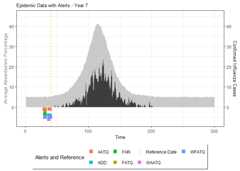


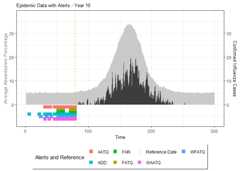
The final outputregion_metric will be a list of 6matrices and 6 data frames. The matrices describe the values of metricsfor respective lag and thresholds.
An optimal lag and threshold value that minimizes each metric isselected and these optimal parameters are used to generate the 6 dataframes associated with the metrics. Simulated information like number oflab confirmed cases, number of students absent, etc, are also includedin the output.
[8]ページ先頭