randotools
randotools

randotools contains functions for creating randomisationlists, and other related tasks, in R.
randotools is available from CRAN:
install.packages("randotools")You can install the development version ofrandotoolsfrom github with:
remotes::install_github("CTU-Bern/randotools")Or from CTU Bern’s package universe
install.packages("randotools",repos =c('https://ctu-bern.r-universe.dev','https://cloud.r-project.org'))Before generating a randomisation list, it can be useful to knowwhether the that will be attained with a certain number of strata isgoing to be appropriate.
library(randotools)set.seed(456)check_plan(50,n_strata =5,n_sim =100)#>#> Number of simulated trials: 100#> Number of participants per trial: 50#> Number of strata: 5#> Blocksizes: 2, 4#> Mean imbalance: 1.66#> Distribution of imbalance:#> imbalance n % cum%#> 0 35 35 35#> 2 49 49 84#> 4 14 14 98#> 6 2 2 100#>#> Worst case imbalance from simulations:#> arm n#> 1 A 22#> 2 B 28In the above example, we a relatively high degree of imbalance for arelatively small sample size, so reducing the blocksize or number ofstrata would be recommended.
Generate the randomisation list itself withrandolist.
set.seed(123)r<-randolist(50,arms =c("Trt1","Trt2"),strata =list(sex =c("Female","Male")))Create a short summary of the randomisation list withsummary.
summary(r)#> ---- Randomisation list report ----#> -- Overall#> Total number of randomisations: 106#> Randomisation groups: Trt1 : Trt2#> Randomisation ratio: 1:1#> Randomisations to each arm:#> Trt1 Trt2#> 53 53#> Block sizes:#> 2 4 6#> 9 13 6#> -- Stratifier level#> Randomisation list is stratified by variables sex#> - 1#> Randomisations per level of sex :#> Female Male#> 54 52#> Balance per level of sex :#> Trt1 Trt2#> Female 27 27#> Male 26 26#> -- Stratum level#> 2 strata are defined:#>#> Female Male#> 54 52#> - Female#> Number of randomisations: 54#> Trt1 Trt2#> 27 27#> Block sizes:#> 2 4 6#> 5 5 4#> - Male#> Number of randomisations: 52#> Trt1 Trt2#> 26 26#> Block sizes:#> 2 4 6#> 4 8 2Export the randomisation list in a database compatible format withrandolist_to_db.
randolist_to_db(r,target_db ="REDCap",strata_enc =list(sex =data.frame(sex =c("Female","Male"),code =1:2)),rando_enc =data.frame(arm =c("Trt1","Trt2"),rand_result =1:2) )Under some scenarios (e.g. minimization), it can be helpful tomonitor the imbalance of the randomisation process.randotools includes some tools to assist with this,specifically in terms of comparing observed imbalance with what might beobserved with simple random allocation.
imbalance_seq_plots shows the evolution of imbalancealong the randomisation sequence:
data(rando_balance)imbalance_seq_plots(rando_balance,"rando_res")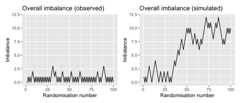
imbalance_test compares the observed imbalance withrandom allocation, providing a p-value, which can then be plotted toinspect the observed (the red line) and simulated imbalances (thebars):
(imb<-imbalance_test(rando_balance,"rando_res"))#> Randomisations to date: 100#> Overall imbalance: 0#> Probability of equal or less imbalance from random allocation: 0.072imbalance_test_plot(imb)
Development of the package was funded in part via a grant from theSwissClinical Trial Organization Statistics and Methodology Platform.
The package logo was created withggplot2 andhexStickerwith icons fromFont Awesome.