This site has been replaced byhttps://coralreef.noaa.gov/digital-corals/. Please bookmark the new page. You will no longer be able to access this site (CoRIS) after 02/23/2026.
Mass coral bleaching events have increased in frequency and severity over the past two decades associated with anomalously high sea surface temperatures. These events have produced wide-spread coral mortality and significant ecological, social and economic impacts to coral reefs and the communities that depend on them. What can local coral reef managers do to address coral bleaching events?
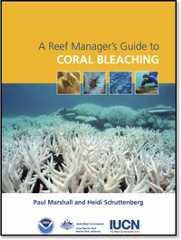
While the fate of coral reefs will be determined by a variety of stressors including the rate and extent of climate change, the new report“A Reef Manager’s Guide to Coral Bleaching” concludes that reef managers have a critical role to play in maximising the resilience of reefs to coral bleaching.
TheReef Manager’s Guide provides information on the causes and consequences of coral bleaching, and management strategies to help local and regional reef managers reduce this threat to coral reef ecosystems.
Produced by the National Oceanic and Atmospheric Administration (NOAA), the Australian Great Barrier Reef Marine Park Authority (GBRMPA), and the International Union for the Conservation of Nature (IUCN), theReef Manager’s Guide includes contributions from over 50 experts in coral bleaching and coral reef management from 30 organizations.
Citation:Marshall P.A. and Schuttenberg, H.Z. (2006). A Reef Manager’s Guide to Coral Bleaching. Great Barrier Reef Marine Park Authority, Australia (ISBN 1-876945-40-0)
Appearing as solitary forms in the fossil record more than 400 million years ago, corals are extremely ancient animals that evolved into modern reef-building forms over the last 25 million years. Continue Reading →
coral reef conservation program
The NOAA Coral Reef Conservation Program (CRCP) is a partnership between the NOAA Line Offices that work on coral reef issues: the National Ocean Service, the National Marine Fisheries Service, the Office of Oceanic and Atmospheric Research, and the National Environmental Satellite, Data and Information Service. The CRCP brings together expertise from across NOAA for a multidisciplinary approach to managing and understanding coral reef ecosystems.
Contact CRCP →
NOAA's Coral Reef Conservation Program SSMC4, 10th Floor 1305 East West Highway Silver Spring, MD 20910
Contact Us
CoRIS: Thank you for visiting NOAA's Coral Reef Information System. Take our websiteuser survey. We welcome your ideas, comments, concerns and suggestions.
NOAA's Coral Reef Information System NOAA/NESDIS E/OC SSMC3, 4th floor 1315 East-West Hwy Silver Spring, MD 20910 coris@noaa.gov