Movatterモバイル変換
[0]ホーム
Russian Gay History
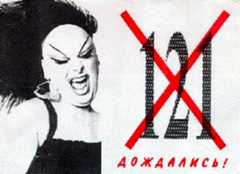
"We've waited long enough!" This was handed out at a gay discoin May 1993, when Article 121, which criminalized gay sex, was eliminatedfrom the Russian criminal code.
Medieval Russia was apparently very tolerant of homosexuality. Thereis evidence of homosexual love in some of the lives of the saints from KievanRus dating to the 11th century. Homosexual acts were treated as a sin bythe Orthodox Church, but there were no legal sanctions against them at thetime, and even churchmen seemed perturbed by homosexuality only in the monasteries.Foriegn visitors to Muscovite Russia in the 16th and 17th centuries repeatedlyexpress their amazement at the open displays of homosexual affection amongmen of every class. Sigismund von Heberstein, Adam Olearius, Juraj Krizhanich,and George Turberville all write about the prevalence of homosexuality inRussia in their travel and memoir literature. The 19th century historianSergei Soloviev writes that "nowhere, either in the Orient or in theWest, was this vile, unnatural sin taken as lightly as in Russia."
The first laws against homosexual acts appeared in the 18th century,during the reign of Peter the Great, but these were in military statutesthat applied only to soldiers. It was not until 1832 that the criminal codeincluded Article 995, which made muzhelozhstvo (men lying with men, whichthe courts interpreted as anal intercourse) a criminal act punishable byexile to Siberia for up to 5 years. Even so, the legislation was appliedonly rarely, especially among the upper classes. Many prominent intellectualsof the 19th century led a relatively open homosexual or bisexual life. Amongthese were the memoirist Philip Vigel, the explorer Nikolai Przhevalsky,the critic Konstantin Leontiev, and the composer Peter Tchaikovsky.
The turn of the century saw a relaxation of the laws, and a correspondingincrease in tolerance and visibility. In 1903 Vladimir Nabokov, father ofthe writer and a founder of the Constitutional Democrat party, publishedan article on the legal status of homosexuals in Russia in which he arguedthat the state should not interfere in private sexual relationships. Theperiod between the revolutions of 1905 and 1917 was the Silver Age in Russianliterature, but something of a golden age for Russian homosexuals. Manyimportant figures led open gay lives, including several members of the ImperialCourt. Sergei Diaghilev and many of the members of the World of Art movementand the Russian ballet were gay. In 1906 Mikhail Kuzmin published his semi-autobiographicalcoming out novel Wings, which became the talk of the literary world in Russia.
Scholars disagree about the effect of the Bolshevik Revolution on homosexualrights. Some argue that the Soviets were at the forefront of humanity indecriminalizing gay sex; others that the Bolshevik asceticism and distastefor sexuality of any kind set the movement back. In fact, the October Revolutionof 1917 did away with the entire Criminal Code, and the new Russian CriminalCodes of 1922 and 1926 eliminated the offence of muzhelozhstvo from thelaw. Unfortunately, decriminalization in the early Soviet period did notmean an end to persecution. The modern Soviet fervor for science meant thathomosexuality was now treated as a subject for medical and psychiatric discourse,an illness to be treated and cured. Furthermore, in the popular mind, homosexualitywas still associated with bourgeois and aristocratic values, with the pre-revolutionarybohemian elite.
The sexual liberation that accompanied the Revolution was to be short-lived.The egalitarian and pro-women policies that had liberalized divorce andmarriage laws and promoted abortion gave way by the early 1930s to Stalinistpro-family policies. It was in this context that the Soviet Union recriminalizedhomosexuality in a decree signed in late 1933. As an article by the writerMaxim Gorky demonstrates, it was also a context in which homosexuality wasconnected with Nazism at a time when German-Soviet relations were strained;Gorky writes, "eradicate homosexuals and fascism will disappear."Of course, the Nazis themselves criminalized homosexuality only a year later.
The new Article 121, which punished muzhelozhstvo with imprisonmentfor up to 5 years, was followed by raids and arrests at the height of theStalinist terror. The numbers of men arrested are not known, but by the1980s there were about 1000 every year. The Soviet Union had the largestpopulation of incarcerated men in the world, and given the importance ofprison culture for Soviet culture as a whole, it is likely that prison homosexualityplayed a part in forming Soviet gay culture. In Soviet prisons there wasa class of men called opushchennye (degraded) who were required to fulfillthe sexual needs of the rest. On the one hand, they were at the lowest rungof the social ladder, but they were sometimes protected by their lovers.And not only men charged with Article 121 were opushchennye: any prisonercould be degraded by ritualized rape -- for losing at cards, over an insult,or even because his beauty made him an attractive sex object.
Article 121 was often used throughout the Soviet period to extend prisonsentences and to control dissidents. Among those imprisoned were the filmdirector Sergei Paradjanov and the poet Gennady Trifonov. Threat of prosecutionwas also used to blackmail homosexuals into informing for the police andthe KGB. Needless to say, gay men in Russia kept a low profile in the Sovietperiod, many restricting their gay activities to small circles of provenfriends. Still, there were some public cruising areas in the larger citiesand one or two bars known to be popular with gay men, though the threatof arrest or blackmail always loomed. Another threat by the 1980s was thegangs of gay-bashers who robbed and beat gay men, often with the encouragementof the police. They knew that if they were brought to court, it was theirvictims who would be put in prison.
In 1984 a handful of gay men in Leningrad attempted to form the firstorganization of gay men. They were quickly hounded into submission by theKGB. It was only with Gorbachev's glasnost that such an organization couldcome into existence in 1989-90. The Moscow Gay & Lesbian Alliance was headedby Yevgeniya Debryanskaya, and Roman Kalinin became the editor of the firstofficially registered gay newspaper, Tema. Organizations and publicationsproliferated. The summer of 1991 saw the first international conference,film festival, and demonstrations for gay rights in Moscow and Leningrad.This was followed almost immediately by the attempted coup. Reversion toa more conservative regime would clearly have threatened their recent gains,and legend has it that many gay activists manned the barricades protectingthe Russian White House and that Yeltsin's decrees were printed on the xeroxmachines of the new gay organizations.
The collapse of the Soviet Union that soon followed the failed couponly accelerated the progress of the gay movement. Occasional gay discoswere held, more gay publications appeared, gay plays were staged. In 1993a new Russian Criminal Code was signed -- without Article 121. Men who hadbeen imprisoned under the article began to be released. Gay life in Russiatoday is in the process of normalization. Capitalism has brought the firstgay businesses--bars, discos, saunas, even a travel agency. While life inthe provinces remains hard for gay men, Russian gays in the cities are beginningto create a community.
Bibliography
This text was prepared forThe Encyclopedia of Homosexuality,2nd Edition, Garland Press.
 Back to Russian GayCulture
Back to Kevin Moss'sHome Page
[8]ページ先頭