 'Violence in Northern Ireland, 1969 - June 1989' | ||||||||||||||||||||||||||||||||||||||||||||||||||||||||||||||||||||||||||||||||||||||||||||||||||||||||||||||||||||||||||||||||||||||||||||||||||||||||||||||||||||||||||||||||||||||||||||||||||||||||||||||||||||||||||||||||||||||||||||||||||||||||||||||||||||||||||||||||||||||||||||||||||||||||||||||||||||||||||||||||||||||||||||||||||||||||||||||||||||||||||||||||||||||||||||||||||||||||||||||||||||||||||||||||||||||||||||||||||||||||||||||||||||||||||||||||||||||||||||||||||||||||||||||||||||||||||||||||||||||||||||||||||||||||||||||||||||||||||||||||||||||||||||||||||||||||||||||||||||||||||||||||||||||||||||||||||||||||||||||||||||||||||||||||||||||||||||||||||||||||||||||||||||||||||||||||||||||||||||||||||||||||||||||||||||||||||||||||||||||||||||||||||||||||||||||||||||||||||||||||||||||||||||||||||||||||||||||||||||||||||||||||||||||||

| Year | ||||||
| 1969 | ||||||
| 1970 | ||||||
| 1971 | ||||||
| 1972 | ||||||
| 1973 | ||||||
| 1974 | ||||||
| 1975 | ||||||
| 1976 | ||||||
| 1977 | ||||||
| 1978 | ||||||
| 1979 | ||||||
| 1980 | ||||||
| 1981 | ||||||
| 1982 | ||||||
| 1983 | ||||||
| 1984 | ||||||
| 1985 | ||||||
| 1986 | ||||||
| 1987 | ||||||
| 1988 | ||||||
| TOTAL | ||||||
Source:RUC official data.
Source: Drawn from Table A3.1
Source: Drawn from Table A3.1
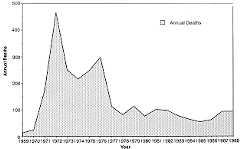
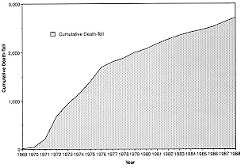
The death-toll after the Anglo-lrish Agreement (AIA) was signed(November 1985) confirms the overall downward trend since theearly and mid-1970sif one takes a long-term view. An averageof 82 deaths in the years 1986-8 compares with an average of 85deaths per annum since 1977. However, there is a perceptible upwardtrend in the death-toll after the AIAif one takes a short-termview and compares the death-toll in the three years 1986-8 (61,93, 93) with the toll in 1983-5 (77, 64, 54) - although we shalldiscuss below whether this upward trend was caused by the AIA.One way to put the apparent impact of the AIA in long-term perspectiveis by inspecting Figure A3.2, the cumulative annual death-toll.The post-AIA death-toll seems to have restored the post-1976 trendafter the brief fall in the years 1983-5.
There are three basic explanations for the fall-off in deathssince the early and mid-1970s. First, loyalist paramilitarieshave ceased to engage in sectarian killings of Catholics on thesame scale as they did in the years 1971-6. Many of them havebeen arrested and jailed, and their organizations have becomemore factionalized, corrupt, and directionless. Second, nationalistparamilitaries have also changed their strategies and organizationsin ways which have reduced the annual death-toll. Many of themhave also been arrested and jailed; and their organizations havebecome smaller and structured in cells or 'active service units'(Bishop and Mallie 1987). The 'cell structure' was partly adoptedin response to declining popularity in nationalist areas but alsofor strategic reasons - to avoid penetration by the security forces.The Provisional IRA have aimed primarily to attack 'military targets'(i.e. members of the security forces) since the mid-1970s, andhave consequently reduced their use of bombs in urban areas- atactic which killed many civilians, both Catholic and Protestant,in the early 1970s. Finally, more effective surveillance and knowledgeon the part of the security forces may have dampened the potentiallevels of violence. However, this final explanation has to bequalified in the light of firm evidence that the actions of thesecurity forces have frequently, if sometimes unintentionally,raised the levels of violence.
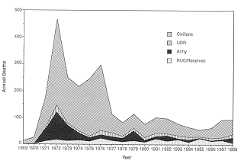
Time-series trends in deaths are available in a crude form fromRUC data. Figure A3.3 confirms the downward trend in civiliandeaths since the 1971-6 period - although RUC data do not enableus to follow victims by religions category over time. It alsoshows a dramatic falling off in the number of deaths sustainedby the British Army (excluding the Ulster Defence Regiment). Finally,since the early 1980s the local security forces (the RUC/RUC Reserveand the UDR) have suffered an increasing proportion of the deathssustained by the security forces. In part this trend reflects'Ulsterization'-the Northern Ireland Office's policy preferencefor local as opposed to British forces-but it also suggests aswitch in the targets chosen by nationalist paramilitaries. 'Ulsterization'and the rising death-toll of local security forces are naturallyand predictably related.
Source: RUC
The IIP provide a detailed breakdown of the status of victims,as well as categorizing the agents responsible for deaths (seeTable A3.2), whereas the RUC merely record whether or not victimswere members of the security forces. We can only speculate asto the reasons the RUC fail to provide similarly detailed information.For the present the IIP data base is of much greater use in clarifyingthe distribution of victims and of responsibility for their deaths.
| Category of Victim | unidentified | |||||
| Security forces | ||||||
| Nationalist paramilitaries | ||||||
| Loyalist paramilitaries | ||||||
| Civilians: | ||||||
| Catholic | ||||||
| Protestant | ||||||
| Religion unknown | ||||||
| Total | ||||||
| TOTAL | ||||||
| As % of all deaths | ||||||
| As % of civilian deaths | ||||||
| Civilian deaths as % of all deaths | ||||||
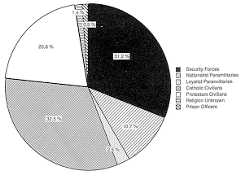
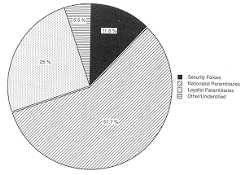
Inspection of Figures A3.4-12, all of which are based on the IIPdata base (i.e. Table A3.2, which runs from 1969 to June 1989),illustrates the story. Figure A3.4 presents a pie-chart showingthe status of victims over the two decades. Surprisingly, in viewof British public perceptions, the largest single category ofvictims has been Catholic civilians (32.5 per cent), who justshade members of the security forces (31.2 per cent). Given thatProtestant civilians outnumber Catholic civilians in the NorthernIreland population by approximately 3 to 2, it is evident thatCatholic civilians (896 deaths) have suffered bothabsolutelyandrelatively more than Protestant civilians (57-5 deaths).Catholic deaths have been 59.3 per cent of all civilian deathswhereas Protestant deaths represent 38.1 per cent of all civiliandeaths. There are four simple explanations for this variance.First, Catholic civilians are the primary targets of loyalistparamilitaries (502), whereas the security forces - includingthe British Army - are the primary targets of nationalist paramilitaries.Second, the local security forces (the RUC, the RUC Reserves,and the UDR) are recruited primarily from Protestant civilians,and thus the simple comparison of Catholic and Protestant civiliandeath-rates obscures the number of victims suffered by the Protestantcommunity as a whole. Third, a rather high number of Catholiccivilians (173) have been killed by nationalist paramilitaries,whether mistakenly, as 'collateral by-products' of other actions,or deliberately in the 'disciplining' of their own community.However, loyalists have also killed a rather high number of Protestantcivilians (110). Finally, Catholic civilians are far more likelyto be killed, mistakenly or otherwise, by members of the securityforces (148) or by nationalist paramilitaries (173), because armedcombat between the latter two groupings is more likely to takeplace in predominantly Catholic areas.
What is also clear from Figure A3.4 is that nationalist paramilitaryviolence is primarily strategic rather than simply sectarian -especially after 1972-3. More members of the security forces (862)are killed than Protestant civilians (575), and since the formerare overwhelmingly killed by nationalist paramilitaries (834,and see Figure A3.8 below), it follows that nationalist paramilitariespartially fulfill their objective of fighting 'a war of nationalliberation', as opposed to a mere sectarian war. However, Protestantsunderstandablyinterpret killings of Protestant membersof the local security forces as sectarian, and, as we shall seenationalist paramilitaries have also killed a very considerablenumber of Protestant civilians (377, and see Figure A3.12 below).
Figure A3.4 also shows that nationalist (10.7 per cent) and loyalistparamilitaries (2.5 per cent) combined (13.2 per cent) have sufferedfewer deaths than either religious category of civilian. Theyhave also sustained fewer deaths than the security forces. Theparamilitaries' low share of the overall death-toll presumablyexplains why their activities are relatively easily sustained-althoughit is also clear that nationalist paramilitaries have died morethan four times as frequently as loyalist paramilitaries.
Source: Drawn from IIPAgenda Database
Source: Drawn from IIPAgenda Database
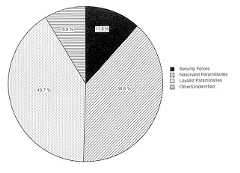
The pie-chart in Figure A3.5 breaks down the agents responsiblefor all deaths on the basis of IIP data. It shows, contrary towhat Irish-American nationalist propagandists imply, that thesecurity forces have been responsible for only 327 deaths or 11.8per cent of the overall death-toll. Even if they were to be (wrongly)held responsible for all the deaths by other agencies and by unidentifiedagents, their overall level of responsibility for deaths wouldstill be considerably less than either of the two categories ofparamilitaries. What Figure A3.5 shows is that the security forceskill less than half as many people as loyalist paramilitariesand that loyalist paramilitaries kill less than half as many peopleas nationalist paramilitaries. It confirms that nationalist paramilitariesare responsible for more than half of all deaths (1,593 deathsin total), partially confirming the British perception that theyare the primary antagonists in the conflict.
However, a slightly different picture emerges if we remove deathssuffered by the security forces in order to examine the agentsresponsible for civilian deaths. The pie-chart shown in FigureA3.6 reveals that loyalist paramilitaries have killed slightlymore civilians than nationalist paramilitaries (623 compared to572,), and that both sets of paramilitaries have been responsiblefor nearly 80 per cent of all civilian deaths. Moreover, a verylarge share of the deaths due to other or unidentified agents(8.9 per cent) can reasonably be attributed to loyalist and nationalistparamilitaries.
Source: Drawn from IIPAgenda Database
Source: Drawn from IIPAgenda Database
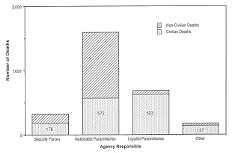
Figure A3.7 shows 'Civilian Deaths as a Proportion of Deaths byAgency'. It is perhaps the most revealing bar-chart. It showsthat the security forces kill a civilian 1 time in 2, i.e. theyare 'efficient and effective'-if not always law-abiding - only1 time in 2. This demonstrable evidence of incompetence, error,or malevolence (depending upon one's point of view) is made somewhatmore palatable by the low overall share of the death-toll attributableto the security forces. However, the low ratio of 'appropriate'to 'wrongful' killings - especially the disproportionate wrongfulkillings of Catholics - helps explain why the security forcesare poorly regarded by Northern Ireland Catholics.
Nationalist paramilitaries (the IRAs (both Official and Provisional),INLA, and IPLO), as Figure A3.7 also shows, by far exceed allother agents in responsibility for killings. Moreover, they killnon-civilians just over 3 times in 5, a 'kill ratio' which alsoindicates a high degree of incompetence, error, or malevolencewith respect to civilians. Although they are more likely to killtheir declared targets than the security forces it is also truethat the absolute level of civilian deaths which they have caused(572) is very close to the number of civilians killed by loyalistparamilitaries (623). Although nationalist paramilitary killingsare primarily 'non-sectarian' it is obvious that they also killa very high number of Protestant civilians. Time-series data (inthe IIP database) do show, however, that nationalists have killedproportionately higher numbers of non-civilians in the last decade.
The final striking feature of Figure A3.7 is that loyalist paramilitarieskill civilians almost exclusively. This feature of their activitieshas been consistent since their first eruption (Boulton 1973;Dillon and I,ehane 1973). It is also easy to explain. Catholiccivilians are easier to identify than nationalist paramilitaries.They are also softer targets. They are therefore killed in actsof 'representative violence' (Wright 1987) which are meant todeter Catholics from supporting the IRA or other nationalist organizations.Thus although loyalist killing appears more random and less instrumentalthan nationalist killing it too is generally 'rational', i.e.goal-governed behaviour based upon attention to the consequencesof action. This point is reinforced by considerable event-dataevidence which shows that loyalists have engaged in systematically'retributive' rather than purely random killing. However, therehave also been a high number of psychopathic killings by supposedlypolitically motivated loyalists. (The same psychopathic propensityis also true-although to a lesser extent-of nationalist paramilitants.)The most barbaric of these activities were carried out by the'Shankill butchers' (Dillon 1989).
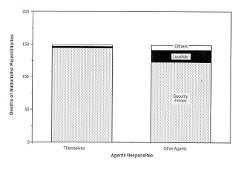
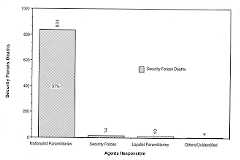
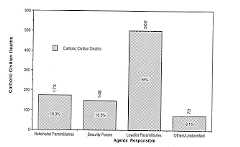
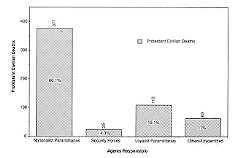
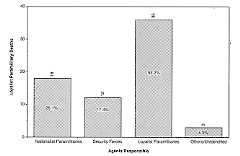
The next set of Figures (A3.8-12) displays the agents responsiblefor the deaths of the five main groupings to have sustained highdeath-tolls (nationalist paramilitaries, members of the securityforces, Catholic civilians, Protestant civilians, and loyalistparamilitaries). Figure A3.8 demonstrates a very striking featureof the deaths of nationalist paramilitaries. Nationalist paramilitariesthemselves kill almost as many nationalist paramilitaries (146)as all other agencies combined (149). There are three explanationsfor this surprising fact. First, nationalist paramilitary organizations,like all guerrilla and terrorist organizations, engage in a highdegree of 'internal disciplinary' killing, i.e. the executionof (often merely alleged) informants and wayward (or unreliable)members. Second, there has been a high degree of faction-fightingwithin nationalist organizations. The Provisional IRA and theOfficial IRA fought one another in the early 1970s. The OfficialIRA and the breakaway Irish National Liberation Army killed eachother's members in 1975, and more recently in the spring of 1987INLA imploded in an internal feud which accompanied the formationof IPLO. Third, in the racist language of the British securityforces, many of the deaths of nationalist paramilitaries havebeen due to 'Paddy factors', i.e. bungled actions, such as blowingthemselves up by mistake. Such actions were especially commonin the Provisional IRA's early days. Since the completion of theirorganizational 'learning curve' such deaths are now less common,especially given that explosives like Semtex are apparently easierto handle. However, raw and inexperienced IRA recruits are stillvulnerable to 'own goals'.
Source: Drawn from IIPAgenda Database
Source: Drawn from IIPAgenda Database
Source: Drawn from IIPAgenda Database
Source: Drawn from IIPAgenda Database
Source: Drawn from IIPAgenda Database
Figure A3.9, which identifies the killers of the security forces,shows that responsibility rests overwhelmingly (97 per cent) withnationalist paramilitaries. The 'Brit factor' ('own goals' orsoldiers running amok in barracks) is apparently very low. Bycontrast Catholic civilians, as shown in Figure A3.10, are killedby a diverse group of agents. Loyalist paramilitaries have killedover half of them. However, nationalist paramilitaries have killedalmost 1 in 5 Catholic civiliansand have killed more ofthem than members of the security forces. Figure A3.11 shows thatnationalist paramilitaries have killed two-thirds of the Protestantcivilians who have died in the 'troubles'. However, loyalist paramilitarieshave also been responsible for 1 in 5 of the civilian deaths withintheir own community. This figure includes those killed in erroror as part of 'internal disciplining' of their community. Finally,Figure A3.12 demonstrates the remarkable fact thatover halfof all deaths (36 out of 69) suffered by loyalist paramilitarieshave been caused by other loyalist paramilitaries.
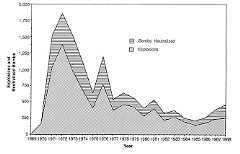
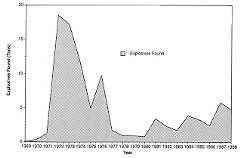
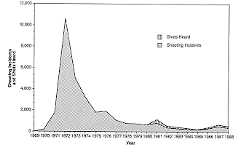
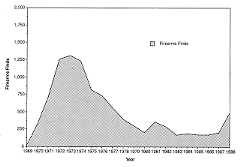
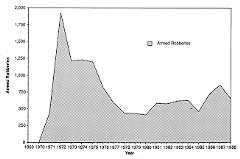
Political violence in Northern Ireland has extended far beyondkillings or executions. Data are also available from the RUC oninjuries sustained due to the 'troubles', as well as the annualnumber of explosions, the number of bombs neutralized, the scaleof findings of explosives, the number of shooting incidents, thenumber of firearms finds, the number of armed robberies, and themoney taken in armed robberies. The graphics in Figures A3.13-19illustrate these indicators in turn.
They all show the same pattern as the death-toll data. Very highindicators of violent activity are evident in the years 1971-6with 'normalization' thereafter. The years 1976-7 were turning-pointsin the scale of all violence-not simply deaths-for three mainreasons. First, the security forces' improved knowledge and capabilitiesenabled them to dampen down the levels of violence. In particularthe ending of internment without trial appears to have helpedreduce nationalist militancy after 1976. Second, loyalist paramilitariesdramatically lowered their assassinations and attacks on Catholiccivilians. They did so because they believed that the unionistcommunity had beaten back the threat to the integrity of NorthernIreland posed by the civil rights demonstrations, the abolitionof Stormont, and the Sunningdale agreement. The opportunitiesfor easy killings had also been reduced by the very extensiveresettlement and segregation of Catholics and Protestants afterthe early years of the 'troubles'- in fact the largest forcedpopulation movements in Western Europe since the aftermath ofWorld War II. Finally, nationalist paramilitaries, especiallythe IRA, reorganized in 1976-7 and changed their strategy. Thenew cell structure reduced the scale of IRA activities. Combinedwith their shift from bombing civilian, shopping, and urban centresto attacking military targets the scale of the violence fell inconsequence. The propensity of this 'military' violence to causedeaths or injuries to civilians was much lower than the previouscombination of 'economic' and 'military' violence.
Over 20,000 people have suffered serious injuries since 1969.In a small population of one-and-a-half million people the socialimpact of such violence is easily imagined. The trends in injuries(Figure A3.13) apparently show that civilians have borne the bruntof the conflict over time. However, the RUC data are unhelpfulhere because they classify both sets of paramilitaries as civilians.Moreover, in the first three years (1968-70) the RUC data-setimplies that no civilians were injured at all (i.e. no data wascollected on the question). The data-set is also unhelpful becausethe RUC do not declare how they tabulate their figures. Originallythey referred to injuries caused by terrorism, whereas they nowrefer to injuries due to the 'security situation' (sic!).In other words it is unclear whether injuries caused by the securityforces are included in the figures. It appears that they are,although this would seem to imply that the RUC used to classifyinjuries caused by the security forces as due to terrorism!
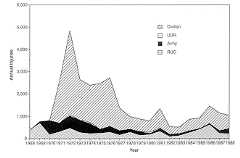
Source: Drawn from RUC data
Source: Drawn from RUC data
Figure A3.14, which shows numbers of explosions and bombs neutralizedover time, reveals a similar pattern to all other indicators-i.e.peaks between 1971 and 1976 followed by secular declines thereafter.However, there is no evidence from this figure that 'bomb neutralization'has improved. This fact suggests that there was reason in PeterBrooke's controversial declaration in 1989 that the IRA couldnot be militarily defeated. Indeed the data on bomb neutralizationappear to suggest a deterioration in the capacities of the securityforces after 1986. We are unable to confirm whether this trendmay be due to increased supplies of Semtex explosives (which aremore difficult to detect), reduced use of warnings by nationalistparamilitaries, or even changes in data collection. The figureson weights of explosives found (Figure A3.15) are of questionablesignificance because technological changes have made the relationshipsbetween bomb weight and potency of bomb somewhat indeterminate.[1]However, explosives finds by the security forces do appear tomirror the general level of violence.
Source: Drawn from RUC data
Source: Drawn from RUC data
The evidence on 'shooting incidents' and 'shots heard' (apparentlya recent distinction in RUC data collection) is presented in FigureA3.16. While showing a similar trend to other patterns of violencesuch data by its very nature is much less credible than otherindicators of violence. The firearms finds data shown in FigureA3.17 are much more credible and show much the same trend as otherindicators of violence, i.e. high figures in the early 1970s followedby decline thereafter. However, whether or not this trend suggestsimproved control by the security forces or, conversely, greaterability to hide arms on the part of paramilitaries remains a mootpoint.
Source: Drawn from RUC data
Source: Drawn from RUC data
Sources: Calculated from RUC data and Department of Trade and Industry data
(Central Statistical Office)
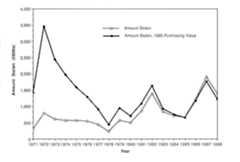
The final RUC data on long-run trends in political violencetabulate armed robberies (Figure A3.18). Since Northern Irelandhad extraordinarily low rates of 'ordinary, decent' crime beforethe late 1960s almost all of the rise in armed robberies is attributableto the political climate of the 'troubles'. Armed robberies areone important source of finance for paramilitary organizations.Other sources include genuine voluntary donations, protectionrackets, 'legitimate' front enterprises, and, in the case of theIRA, funds from Irish-American organizations (Holland 1987). Unfortunatelythe RUC data-unsurprisingly-does not break down the agents responsiblefor armed robberies so we have no way of knowing the relativeproportion of nationalist to loyalist armed robberies. However,what is evident is that the trend in armed robberies displaysa similar pattern to the other indicators of violence. There alsoappears to have been a sharp increase in 1986, the year afterthe Anglo-lrish Agreement-much sharper than the increase in thedeath-rate. Having adjusted the RUC data we can also see in FigureA3.19 the annual real value of these armed robberies-after adjustingthe nominal values into 1985 prices.
Ultra-nationalists and unionists are both hostile to the Anglo-lrishAgreement. They also share a common interest, albeit for differentreasons, in demonstrating that the Anglo-lrish Agreement has notworked in one central respect: the promotion of peace, security,and stability. Consequently these critics of the AIA argue thatsince November 1985 violence, insecurity, and instability haveactually increased. They have some evidence to support their case.Table A3.3 shows that deaths, injuries, shooting incidents, explosionsand armed robberies have all gone up significantly in the threeyears after the AIA by comparison with the three years in therun-up to the Hillsborough accord. Injuries and shooting incidentshave gone up by over 50 per cent, armed robberies by 30 per centand deaths by just over 25 per cent.
| Year | |||||
| 1983 | |||||
| 1984 | |||||
| 1985 | |||||
| Total | |||||
| 1986 | |||||
| 1987 | |||||
| 1988 | |||||
| Rise | |||||
| % | |||||
There can be no doubt that some of the increased violence is attributableto political reactions to the Agreement. There can also be nodoubt that in part the rise in violence is explicable by self-fulfillingprophecy. The paramilitaries hostile to the AIA have been doingtheir best to undermine it. Moreover, unionist demonstrationsagainst the Agreement restored some of the 'street politics' ofthe early 1970s, and led to increased injuries. Loyalist paramilitariesalso increased their assassinations of Catholic civilians afterhaving been dormant for a long time. They also engaged in large-scaleintimidation of Catholic civilians and, in the spring of 1986,of RUC officers.
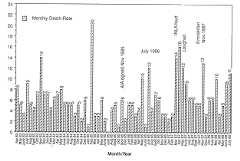
However, it would be a mistake to attribute all the rise in violencein the three years after 1985 to the Agreement itself, just asit would be a mistake to assume that the decline in indicatorsof violence before November 1985 would have continued indefinitelyhad there been no change in the constitutional status quo. Themonthly death data in the years preceding and succeeding the AIAare shown in Table A3.4 (second column). They are also representedin the histogram Figure A3.20. Inspecting the data in its rawmonthly form makes the upward trend after the Agreement much lessevident than in the annual data. Moreover, as inspection of themonths for 1987 reveals, it is evident that the monthly death-tollwas raised considerably in several cases by episodes which arenot directly linked to the Agreement: the INLA feud in the spring,the deaths of an IRA unit in a stake-out at Loughall in earlysummer, and the (allegedly mistaken) IRA killing of Protestantcivilians at Enniskillen in November of the same year.
| Month/year | ||||||
| 1983 | ||||||
| April | ||||||
| May | ||||||
| June | ||||||
| July | ||||||
| August | ||||||
| September | ||||||
| October | ||||||
| November | ||||||
| December | ||||||
| 1984 | ||||||
| January | ||||||
| February | ||||||
| March | ||||||
| April | ||||||
| May | ||||||
| June | ||||||
| July | ||||||
| August | ||||||
| September | ||||||
| October | ||||||
| November | ||||||
| December | ||||||
| 1985 | ||||||
| January | ||||||
| February | ||||||
| March | ||||||
| April | ||||||
| May | ||||||
| June | ||||||
| July | ||||||
| August | ||||||
| September | ||||||
| October | ||||||
| November | ||||||
| December | ||||||
TABLE A3.4.(Cont.)
| Month/year | ||||||
| 1986 | ||||||
| January | ||||||
| February | ||||||
| March | ||||||
| April | ||||||
| May | ||||||
| June | ||||||
| July | ||||||
| August | ||||||
| September | ||||||
| October | ||||||
| November | ||||||
| December | ||||||
| 1987 | ||||||
| January | ||||||
| February | ||||||
| March | ||||||
| April | ||||||
| May | ||||||
| June | ||||||
| July | ||||||
| August | ||||||
| September | ||||||
| October | ||||||
| November | ||||||
| December | ||||||
| 1988 | ||||||
| January | ||||||
| February | ||||||
| March | ||||||
| April | ||||||
| May | ||||||
| June | ||||||
| July | ||||||
Source: (2nd col.) IIP,Agenda Database.
Calculated as in Hartwig and Dearing (1979: 36-9).
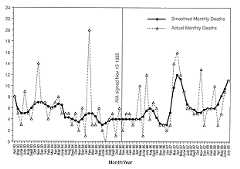
When the monthly death data are smoothed, using the standard techniquein exploratory data analysis of running medians and harming (Hartwigand Dearing 1979: 36-9), a pre-Agreement downward trend and apost-Agreement upward trend in deaths are much more apparent (seeFigure A3.21). However, the rise is not especially dramatic. Indeedmuch of the deterioration in the smoothed monthly figures comesafter the spring of 1986 - after the IRA received extensive reinforcementsofmatériel from Libya. Finally, one might evenargue that the impact of the AIA has been relatively low-key giventhe ferocity of unionist opposition to it. The predictions ofa loyalist backlash on the scale of the early 1970s have so farnot been fulfilled - even though loyalist paramilitary killingshave increased since November 1985.
Source: Calculated from IIP,Agenda Database
Source: Calculated from IIP,Agenda Database
Judging by the preliminary and unconfirmed figures for 1989, thedeath-toll in Northern Ireland will fall by comparison with the previous two years - although the IRA have caused many deaths outside Northern Ireland, in places as diverse as England, TheNetherlands, and West Germany. Indeed the Provisional IRA maywell have decided that campaigning outside Northern Ireland against'soft' British military targets is a more effective way of destabilizingthe AIA. However, within Northern Ireland, policy-makers in the1990s, benefiting from the improved security cooperation betweenthe British and Irish states, have good reasons to believe thatthe scale of the conflict can be reduced to its pre-Hillsboroughlevels-although they have no reason for being too sanguine.
Notes
[1] It is wholly unclear from the RUC data whether or not the weightof explosives finds are expressed in TNT impact-weight or simpleweight in pounds.
 | |||
| |||
|


 | ||