| ||||||||||||||
The White Buddhist: Henry Steel Olcott and the Sinhalese Buddhist Revival
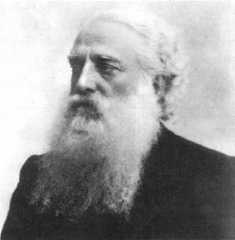
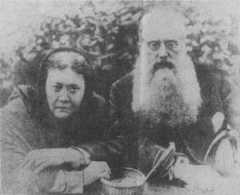
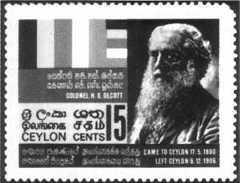
By Stephen Protheroach yearon February 17, Buddhists throughout Sri Lanka lightbrass lamps and offer burning incense to commemorate the anniversary of thedeath of an American-born Buddhist hero. In Theravadan temples, saffron-robedmonks bow down before his photograph, and boys and girls in schoolhouses acrossthe country offer gifts in his memory. "May the merit we have gained by thesegood deeds," they meditate, "pass on to Colonel Olcott, and may he gainhappiness and peace." Disinterested historians describe Henry Steel Olcott asthe president-founder of the Theosophical Society, one of America's firstBuddhists, and an important contributor to both the Indian Renaissance in Indiaand the Sinhalese Buddhist Revival in Ceylon (now Sri Lanka). Less objectiveobservers have allotted Olcott an even more central place in sacred history. Aprime minister of Ceylon praised Olcott as "one of the heroes in the strugglefor our independence and a pioneer of the present religious, national, andcultural revival." In the land of his birth,Olcott has been less graciously received. TheNew York Timesdenounced him during his lifetime as "an unmitigatedrascal"—"a man bereft of reason" whose "insanity, though harmless, is,unfortunately, incurable." TheDictionaryof American Biography,noting that Olcott has been considered "a fool, aknave, and a seer," concludes that he was probably "a little of all three." DESCENDED FROMPuritans, Henry Steel Olcott was born in 1832 into apious Presbyterian household in Orange, New Jersey. After a short stint at whatis now New York University, Olcott went west toward the frontier in search ofyouthful adventures. In Ohio, at the age of twenty, he became a convert tospiritualism. Soon he was championing a host of other causes, includingantislavery, agricultural reform, women s rights, cremation, and temperance.He worked for a time as an experimental fanner, served a stint in the Army, andeven worked as an investigator on the special commission charged withscrutinizing President Lincoln's assassination. But he eventually returned toNew York City, where he supported himself as a journalist and insurancelawyer. In 1874, while covering reports of spirits materializing at a farmhousein Chittenden, Vermont, he struck up a friendship with Russian occultist HelenaPetrovna Blavatsky. One year later, he and Blavatsky co-founded theTheosophical Society, an organization that would soon play a major role inintroducing Americans to the ancient wisdom of the East. AFTER MOVING THEMSELVESand their society to India in 1879, Olcottand Blavatsky decided it was time tovisit Ceylon. They arrived in Colombo on May 16, 1880. Apparently, their reputationshad preceded them, since they received what Olcott later described as a royalwelcome: A huge crowd awaited us and rent the air with their united shout of"Sadhu! Sadhu!" A white cloth was spread for us from the jetty steps to theroad where carriages were ready, and a thousand flags were frantically waved inwelcome. Shortly after this reception,on May 25, at the Wijananda Monasteryin Galle, Olcott and Blavatsky each knelt before a huge image of the Buddha and"tookpansil"by reciting in brokenPali the Three Refuges and the Five Precepts of Theravada Buddhism, thusbecoming the first European-Americans to publicly and formally become layBuddhists. Later Olcott underscored thedifference between what he termed a "regular Buddhist" and "a debased modemBuddhist sectarian." "If Buddhism contained a single dogma that we werecompelled to accept, we would not have taken thepansilnor remained Buddhists ten minutes," he explained. "Our Buddhismwas that of the Master-Adept Gautama Buddha, which was identically the WisdomReligion of the Aryan Upanishads, and the soul of all the ancientworld-faiths." Even on the day of his conversion to Buddhism, Olcott wasdiscriminating between the "false" Buddhism of the Sinhalese people, which wasin his view modem, debased, sectarian, and creedal, and his ostensibly trueBuddhism — ancient, pure, nonsectarian,and nondogmatic. DURING HIS FIRSTvisit to the island, Olcott founded seven laybranches and one monastic branch of the Buddhist Theosophical Society (BTS). Hewas explicit about modeling his Asian work after Christian examples: "As the Christians have their Society forthe diffusion of Christian knowledge, so this should be a society for thediffusion of Buddhist knowledge." Olcott also founded, again on Christianmodels, Buddhist secondary schools and Sunday schools affiliated with the BTS,thus initiating what would become a long and successful campaign forWestern-style Buddhist education in Ceylon. Thanks to these efforts, Olcottand Blavatsky left Ceylon in July of 1880 as folk heroes. They had met a numberof high-ranking monks, chief among them Hikkaduve Sumangala, who would soonbecome Olcott's most faithful Sinhalese ally. Equally important, Olcott andBlavatsky had been embraced by a large number of Sinhalese laypeople. OLCOTT HAD PLANNEDupon his arrival in India in 1879 to spend sometime learning about Hinduism and Buddhism from Eastern experts, then to returnto America, where he would devote the rest of his life to promoting Theosophyand building up the Theosophical Society. But the celebrity status that Olcottachieved during his first Ceylon tour led him to reevaluate his plans.Gradually he was coming to see himself more as a teacher than as a student. Hewas also coming to view India as his home. But perhaps most important, he wasbeginning to emerge from behind Blavatsky's formidable shadow. Because the touritself highlighted Olcott's oratorical skills rather than Blavatsky'sparlor-room charisma, Olcott garnered as much influence, if not as much fame,as his traveling companion. Before their departure the Sinhalese people werepraising Blavatsky, but they were also hailing Olcott as one of their own —"The White Buddhist." OLCOTT SET SAILfor Ceylon in April 1881 for a second tour. Togetherwith Mohottivatte Gunananda, the monk who had spearheaded the first phase ofthe Sinhalese Buddhist revival, he crisscrossed the western province for eightmonths in a bullock cart of his own design. Villagers flocked, according toOlcott, to witness the mechanical wonders of this device, complete withlockers for furniture and books, canvas roof to keep out rain, and cushionedcentral compartment with removable planks that could seat eight for dinner orsleep four. All testified to Olcotts Yankee ingenuity. When not impressing theSinhalese with his cleverness and hard work, Olcott looked the part of theanti-Christian missionary. He sold merit cards and solicited subscriptions tosupport his National Education Fund, wrote and distributed anti-Christian andpro-Buddhist tracts, and secured support for his educational reforms fromrepresentatives of the island's three monastic sects. Olcott remained disturbed bywhat he perceived as the shocking ignorance of the Sinhalese about Buddhism."This was an odd sort of judgment for a recent convert who had purportedly cometo Asia not to teach but to learn. It was, however, a judgment that Olcottshared with many nineteenth-century academic Orientalists. Like Olcott,pioneering Buddhologists such as Rhys Davids (whom Olcott eagerly read) tendedto reduce the Buddhist tradition to what the Buddha did and what the Buddhistscriptures said. This tendency permitted them to praise the ancient wisdom ofthe East and to condemn its modern manifestations—to view Asian religioustraditions much like Calvin viewed the human race: as fallen from some Edenicpast. It was Olcott's uncritical and unconscious appropriation of this aspectof academic Orientalism that led him to the rather absurd conclusion thatCeylon's Buddhists knew little, if anything, about "real" Buddhism. Like hishated missionaries and his beloved Orientalists, Olcott assumed the right todefine what Buddhism really was. Unlike them, however, he assumed the duty tostir the Sinhalese masses from their ignorance, to instill in them his own creolerepresentation of their Buddhist faith. IN DEVISING HISstrategyfor this didactic mission, Olcott turned yet again to the missionary example.He decided to compile for use in his Buddhist schools a catechism of basicBuddhist principles, "on the lines of the similar elementary handbooks soeffectively used among Western Christian sects," both Protestant and Catholic.Olcott'sThe Buddhist Catechism,whichwould eventually go through more than forty editions and be translated intoover twenty languages, is in many ways the defining document of his Buddhism.It first appeared, in both English and Sinhalese, on July 24, 1881. Hugelyinfluential, it is still used today in Sri Lankan schools. While Olcott himselfcharacterized hisCatechismas an"antidote to Christianity," a shocking reliance on that tradition was evidentin its explicitly Christian questions: Q.Was the Buddha God? A. No. Buddha Dharma teaches no "divine" incarnation. Q.Do Buddhists accept the theory that everything has been formed out of nothing by a Creator? A. We do not believe in miracles; hence we deny creation, and cannot conceive of a creation ofsomething out of nothing. Olcott's ostensiblynon-Christian Buddhism sounded like liberal Protestantism. More than an antidoteto Christianity, Olcott'sCatechismwasa borneopathic cure, treating the scourge of Christianity with a dose of thesame. His critique of Christianity shared many elements with liberalProtestants' critique of Christian orthodoxy, including a distrust of miracles,an emphasis on reason and experience. a tendency toward self-reliance, and adisdain for hell. Like their Jesus, his Buddha was a quintessential Christiangentleman: sweet and convincing, the very personification of "self-culture anduniversal love. RETURNING TO COLOMBOonJuly 18, 1882, for his third Ceylon tour. Olcott discovered that the BuddhistTheosophical Society was "lifeless" and the revival was ‘at a standstill.' Ofthe 13,000 rupees that had been pledged to the National Education Fund, only100 had been collected. More ominously, a contingent of Roman Catholic missionarieshad converted a well near a Buddhist pilgrimage site into a Lourdes-likehealing shrine. Olcott feared "a rush of ignorant Buddhists into Catholicism."In an attempt to break the Catholic monopoly over this crucial segment of thereligious marketplace, Olcott pleaded for a monk to step forward and performhealings "in the name of lord Buddha." But when no monk came forward, hedecided to do the work himself. Olcott's first healing in Asiaoccurred on August 29, 1882. When a man said to be totally paralyzed in one armand partially disabled in one leg approached him after a lecture, Olcottrecalled his youthful experiments with mesmerism and made a few perfunctorypasses over the man's arm. The next day the man returned with reports ofimproved health, and Olcott began to treat him systematically Soon the mancould, in Olcott's words, "whirl his bad arm around his head, open and shut hishand, jump with both feet, hop on the paralyzed one, kick equally highagainst the wall with both, and run freely." News of the Co]Qnel's healingpowers spread across the island "as a match to loose straw" and his fundraisingtour was immediately transformed into a roadshow featuring the miraculoushealing hands of the instantly charismatic "White Buddhist." Olcott publiclyattributed his healings to the Buddha. Privately he credited the Germanphysician Franz Mesmer. Now that Olcott possessed agift on a par with Blavatsky's conjuring abilities, scores of patients lined upoutside the Theosophical Society headquarters in Adyar (a suburb of Madras),and on an 1882 tour of Bengal Olcott supposedly treated 2,812 patients. Soon,however, the seemingly insatiable needs of his followers overwhelmed Olcott.His popularity became a burden and when, toward the end of 1883, theTheosophical Masters (adepts with whom Blavatsky is supposed to havecommunicated telepathically) handed down an order to stop the healings, Olcotthappily complied. Before his healing tours of1882 and 1883, Olcott had recruited most of his Sinhalese and Indian followersfrom among the English-speaking middle classes. But his celebrated curespopularized his message, especially in Ceylon, where he may have inspiredmessianic expectations among Sinhalese peasants. OLCOTT SOLIDIFIED HIS ROLE as a leader of the Sinhalese BuddhistRevival in the wake of a tragic Buddhist-Christian riot that occurred on March25, 1883, in Kotahena, a Catholic stronghold of Colombo. On that day aBuddhist procession marched through the streets on the way to Mohottivatte Gunananda'snewly decorated monastery, the Deepaduttama Vihara, where a new Buddha imagewas to be dedicated. When the procession approached a Roman Catholic cathedrallocated a few hundred yards from the temple, the cathedral bell sounded,followed almost immediately by bells in other Catholic churches in the area. Asif in response to a signal, about a thousand men descended on the processionand a bloody brawl ensued. Authorities summoned eighty policemen, but theirbatons were no match for the clubs, swords, and stones of the mob. During thethree-hour melee, one man was killed and forty others were injured. As the Governor's RiotsCommission investigated the affair, Catholics and Buddhists took each other tocourt. Numerous cases were filed, but authorities eventually dropped allcharges because of a lack of "reliable evidence." After it had become clear that the Catholics would not be tried, a groupof Sinhalese monks and laypeople cabled Olcott urging him to come to Ceylon.Upon his arrival on January 27, 1884, Olcott organized a Buddhist Defense Committee, which elected him anhonorary member and charged him to travel to London as its representative, "toask for such redress and enter into such engagements as may appear to him judicious."Thus, for the first time Olcott's role as an intermediary between East and Westbecame apparent, not only to himself but to Buddhists and colonialadministrators alike. Before he left for London, agroup of high-ranking Buddhist monks gave Olcott a solemn farewell ceremony, inwhich they authorized him "to register as Buddhists persons of any nation whomay make to him application, to administer the Three Refuges and Five Preceptsand to organize societies for the promotion of Buddhism." The first person ofEuropean descent to be 4iven such an honor, Olcott thus became the first Buddhistmissionary to the West. WHEN OLCOTT ARRIVED in London inApril 1884, British colonial officials were already well acquainted with him.In a Woe 26, 1883, letter covering theReportof the Riots Commission,Governor Longden discussed Olcott while reviewingthe root causes for the brawl. The most important such cause was, in Longden'sview, the revival of Buddhism. There could be, he wrote, "no doubt" about the"genuineness" of the revival. Signs of it were everywhere: The outer evidence of it is to be seen in the rebuilding of oldshrines,. . .the larger offeringsmade to the Temples. Within the Buddhist Church the revival is signalized by agreater number of ordinations held with greater publicity, the care with whichthe Buddhist doctrines are being taught in the Pali language in the VidyodayaCollege and in the monasteries, and the preparation of Buddhist Catechisms inthe native and even in the English language. Longden appended to his reporta copy of Olcott'sCatechismandremarked that the Colonel had "very warmly espoused the cause of Buddhism." Thecreole nature of Olcott's actions was not lost on Longden, who remarked thatthe Colonel "brought the energy of Western propagandism to [the revival's]aid." In a subsequent dispatch toColonial Secretary Derby, Longden again mentioned Olcott, but now in moreominous terms. It was only a matter of time, he wrote, before one or twoindividuals would arise and take control of Buddhist affairs on the island.Given the "negligent character of the Sinhalese mind," he reasoned, it waslikely that non-Asian Buddhists would fill these leadership roles. In May of 1884, almost a yearafter Longden had warned his superiors about the Colonel, Olcott arrived inLondon. Though officials were wary of augmenting his already significantinfluence, he was able to meet with Lord Derby's assistant undersecretary, R.H. Meade. Shortly thereafter he sent a memo to Lord Derby, demanding: (1) thatCatholics accused of instigating the riot be brought to trial; (2) thatBuddhists be guaranteed the right to exercise their religion freely; (3) thatWesak—the full moon day on which the Sinhalese commemorate the Buddha'sbirth, enlightenment, and death—be declared a public holiday; (4) that allrestrictions against the use of tom-toms and other musical instruments inreligious processions be removed; (5) that Buddhist registrars be appointed;and (6) that the question of Buddhist temporalities (the supposedly negligentcontrol of Buddhist properties by monks) be resolved. Olcott enclosed with hismemo some accompanying documents that testified to the "discontent anddespair" that had in his view gripped the island's Buddhists following the Kotahenariots. He hinted that, if ignored, their dissatisfaction might result in arebellion. Only two of Olcott's requestswere speedily granted. In the fall of 1884, colonial officials agreed to pursue"more of a hands off policy" regarding the use of tom-toms and other musicalinstruments in religious processions; and on April 28, 1885, Wesak became anofficial holiday in British Ceylon. Following the negotiations withMeade, Olcott wrote to the chairman of the Buddhist Defense Committee andinformed him, over-optimistically, that his mission had been a completesuccess. Olcott's Sinhalese supporters concluded that the British proclamationof Wesak as a public holiday was "primarily due to Colonel Olcott's appeal,"and on April 28, 1885, during the first government-recognized celebration ofthe Buddha's birthday', the now-venerable name of Olcott was invoked frequentlyand with great devotion. DESPITE CLAIMS THATOlcott initiated the Sinhalese Buddhist Revival, his connection with themovement was, as he himself recognized, neither as originator (creditMohottivatte Gunananda) nor as culminator (credit Anagarika Dharmapala) but asorganizer and articulator. It was Olcott who agitated for Buddhist civilrights, and who gave the revival its organizational shape by founding voluntaryassociations, publishing and distributing tracts, and, perhaps most important,establishing schools. It was he who articulated most eloquently the "ProtestantBuddhism" synthesis. The most Protestant of all early "Protestant Buddhists," Olcottwas a culture broker with one foot planted in traditional Sinhalese Buddhismand the other in liberal American Protestantism. By creatively combining thesetwo sources, along with other influences such as theosophy, academicOrientalism, and metropolitan gentility, he helped to craft a new form ofBuddhism that thrives today not only in Sri Lanka but also in the UnitedStates. Download this article as a PDF documentFromThe White Buddhist: The Asian Odyssey of Henry Steel Olcott,IndianaUniversity Press.
[8]ページ先頭 ©2009-2026 Movatter.jp
|