2016 Amish Population: Two New Settlements In South America
Each year the Young Center for Anabaptist and Pietist Studies publishes Amish population estimates on theirAmish Studies web site.
 As of today those are not yet available. Howeverthis AP report previews some of the details of the population survey, with input fromsenior scholar Steven Nolt.
Here are3 takeaways from the article:
1. South America – First–and somewhat surprisingly–there are now two Amish settlements in South America, inBolivia andArgentina.
How did this come about? From the report:
The two small South American settlements were both founded last fall after longstanding Mennonite communities in those countries reached out to North American Amish to explore affiliation, said Steven Nolt, a senior scholar at the center who helped coordinate the population survey.
Those Old Colony Mennonites, culturally conservative and with roots in a group that emigrated from the old Russian empire to Canada in the 1800s, left Canada in the 1920s over a dispute about teaching their children in English and landed in Mexico and other parts of Latin America, Nolt said.
In recent years, their members in Bolivia and Argentina have faced financial problems and isolation, so they wrote to an Amish publisher in Canada and eventually got in touch with a New Order Amish group in Ohio that permits its members, under certain circumstances, to make airplane trips.
After ministers with the Ohio Amish visited South America, they sent two families to settle there to create communities the existing Mennonites can join. North American Amish generally do not proselytize or do mission work. They also have sent teams to help with building projects. The Bolivian community, known as Colonia Naranjita, is about 75 miles southwest of Santa Cruz, while the settlement in rural northwestern Argentina is located east of Catamarca.
Nolt describes this as quite an unusual occurrence.
Amish have previously settled in Latin America on a handful of occasions, though none of those communities survived.
2. Canada – Canada is now up tothree provinces with an Amish presence. As we’ve covered here on the site,Prince Edward Island has attracted a small group of Amish, who have set up two separate settlements on PEI.
Canada’s smallest province joins recent addition New Brunswick, and Ontario, home to Amish for nearly 200 years.
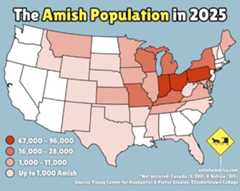
3. Rapid Growth Continues – The estimated total Amish population is now308,000. In 1992, the population was just124,000. The Amish as a whole have a growth rate of about 18% over the past five years.
Amish currently live in31 states, andthree Canadian provinces. And with the addition of Bolivia and Argentina, horse-and-buggy Amish communities can be found in a total offour countries.

Get the Amish in your inbox
Join 15,000 email subscribers. No spam. 100% free
Similar Posts
Shipshewana Mayfest Buggy Race
You might remember a previous post on July 4th buggy races in the Elkhart-Lagrange Amish settlement. As one reader shares Topeka is not the only spot in northern Indiana holding an annual buggy race: Shipshewana has a celebration called Mayfest each year. Mayfest includes several different events one of which is a buggy race. The buggy race involves teams of 4 individuals. Two team members ride…
Lovina Eicher: Water Pump Challenges In An Amish Home
In her latest, Lovina Eicher, an Amish mother of eight who writes the Lovina’s Amish Kitchen column, explains a challenge of everyday Amish life – making sure the water pump is working reliably enough for a shower. Lovina’s household’s water pump is run by a battery, in this case a solar powered-one. Lately in her Michigan community the sun hasn’t been doing its job, which…
Rules of a Godly Life
‘Be friendly to all and a burden to no one. Live holy before God; before yourself, moderately; before your neighbors, honestly. Let your life be modest and reserved, your manner courteous, your admonitions friendly, your forgiveness willing, your promises true, your speech wise, and share gladly the bounties you receive.’ Source: Rules of a Godly Life, cited in Amish Roots, John A. Hostetler
300 Amish Move 10-Ton Barn 900 Feet In 20 Minutes
Some Amish have a neat thing they do when they need to move a structure like a pole barn. They marshall the community’s arms and legs and, deploying a bit of sweat and maybe a few tears, they simply pick up the structure in unison and carry it to wherever it needs to be. We’ve seen this in video versions on several occasions. Now, columnist…
5 Tips When Planning an Amish Wedding
Planning an Amish wedding for a few hundred guests, and want to make sure the special day goes off without a hitch? You’ve never found yourself in that situation, you say? Well, if you ever did, you might do well to pick up a copy of Das Hochzeit Büchlein: A Wedding Preparation Booklet. This handy guide was produced by members of the Lancaster County Amish community. It’s…

A Place to Stay (Part 3): Found by the Amish
Author and Amish taxi driver Haley Straw shares part three of a four-part Christmas series. It follows the true story of a young boy from Chicago, whose longing for warmth and belonging sends him on an unlikely winter journey toward an Amish community he’d only read about in a library book. This retelling draws from the original “Please Let Me Stay” account shared in a private family history book….
Leave a ReplyCancel reply
11 Comments
Dan
I recently visited the Ohio New Order Amish settlement that started the South American settlements. People there told me about the huge cultural differences between the Amish and the Old Colony Mennonites there. What they said didn’t sound very promising.
By the way, settlements of the Noah Hoover Mennonites in Belize show that it is possible to form new groups consisting of Anabaptists with a Pennsylvania German and a Plautdietsch background. But it seems to be a difficult process in which both sides have to adapt.
Al in Ky
Thanks for this information. I will share it with a couple of Amish friends who are always interested in updated information about growth of Amish settlements.
In scribes’ letters from some New Order settlements in Ohio, I quite often read that they are given update reports at their Sunday School meetings about developments of the Amish settlements in South America.
OSIAH HORST
Amish and Old Colony
Dan, my guess is the ones that will make it work are in South America and the people you spoke with are the naysayers. Everytime a project like that is started there are those who can’t see how it could possibly work. The people who don’t think it can work generally are not the ones who make it work.
It will certainly take serious effort on the part of both groups to have asuccessful outcome. I would agree that the cultural differences are a huge
obstacle.Osiah, your point is a good one not only for this situation but in general. In any undertaking there are realities which can make success easier or more difficult, but the attitude of those involved and the support they get from others can often be that extra ingredient that really does make a difference.
It would be nice to see these groups succeed, and perhaps open the door for others like it in future. I know that the Old Colony Mennonites can benefit from what the “native Amish” side of the equation can offer (we have seen this in one important example in the school programs) but I would think the gain will go both ways as is often the case when two cultures come together.
I wish the projects in Bolivia and Argentina all the best and I think it is worth a trial.
I just learned a few weeks ago a little bit more about another project in Latin America that is just starting near a very large Old Colony Mennonite settlement. Three families – two ex Amish and one Seeker – are going to start a new community there.
Unfortunately no one has even started to learn Plautdietsch, no one speaks Standard German actively and only one person speaks Spanish. I was intrigued by their zeal and I will try to follow what’s going on there, and I also wish all the best to this project, but I could not help to think by myself: “why don’t they prepare a bit better”.
Very often much money, energy, and enthusiasm is spend in vain only because people are not really prepared for what they are doing. It’s really a pity!
Julie Turner
Amish Down Under
Hi Eric,
We have Beachy Amish- Mennonites here in Austr4alia too.Ok
New Order Aren't Amish
I think it’s worth noting, because it’s a huge leap from New Order to Old Order, that their practically different groups altogether.
In my opinion, the New Order are more mainstream Mennonite than Amish. Their the people you grew up around in PA, who liked to dress like Amish, but never really were.
The New Order for the most part lack any true connection to being Amish. Most Old Oder Amish can trace their ancestors back all the way to foundation of their subgroup, whereas almost all New Order are drifters having either left the Amish or converted to what they thought was the Amish.
Real Amish do not look for others to join, do not set up colonies in Ireland, do not visit Israel, do not sing NYC Christmas carols and Joy To The World in Times Square, do not go on TV shows, etc.
Almost all of which I mentioned are New Order. New Order do not speak German unless they’re former Amish or their parents passed it on to them, but it’s not mandatory. Clothing is also much less a priority. Other things I’ve noticed that separate New Order from Old Order are the New Order churches tend to be actual churches, not like the Amish by-weekly church attendance in homes. New Order almost never drive horses, but they do use electricity like everyone else.
The Old Colony Mennonites in Argentina have probably met New Order, and I think they will be led astray from their own principles thinking they found real Amish, only to be converted to the New Order pseudo-Amish lifestyle. The New Order are struggling deeply to hold on to their veneer of Amishness, and they must, because for them it’s big business and helps lure people to their faith by letting them think their actually connecting with a real Amish fellowship. The New Order are facing the same problems the mainstream Mennonites faced decades ago. Their trying to still be Amish as the Mennonites have tried to still be Mennonite, this despite neither the New Order or the mainstream Mennonites actually living like either group. They both faced the problem of sinking birth rates, and to make up for it they need to convert others to maintain their numbers, but still fail. The Old Order don’t because they grow naturally.
It sounds silly, I know. If you lived around the Amish every day of your life, only then can you really see how hard New Order Amish try to put on the Amish front, and it’s so very easy to separate them from the real Amish who hustle and bustle on the farms and among themselves, and than the self righteous New Order who general U.S public see more of than the actual Old Order, because almost TV shows feature them as though they were the real thing.
Don Curtis
New Orders and Old Orders?
I read your comment and even though it is my son who is Amish and not me I know enough about the Amish to realize that your’re way off base in your thinking. My son is a part of the New Order Amish at Belle Center, Ohio. He speaks Pennsylvania Dutch, fluently. All of them do. It is the first language the children learn. Their church services are in German and in the homes. They drive horses and buggies. Bicycles are allowed but not on Sunday. Farming is done with horses. Tractors are not allowed for field work or on the roads. Dress standards are like traditional Amish. Unlike Holmes County, the men and boys wear suspenders and hats are mandatory for church and during the week as well. My son does not have electricity. He has propane lights and refrigeration. Maybe you are thinking of the Beachy Amish. Although I don’t know that they should be considered as “self-rightous.”
Mark -- Holmes Co.
Well said, Don! And you pointed out a few of the differences between the Belle Center New Order community and the larger, more progressive Holmes Co. New Order groups.
New Orders Aren't Amish?
Are you confusing the New Order Amish with someone else? We have quite a few New Orders in our area and I never thought of them as not being Amish. The New Orders did split away from the Old Orders, but though the Old Orders still outnumber them in Holmes County, their population is increasing and they still have strong ties to the Old Orders through relatives, as friends, as neighbors, co-workers, and a shared school system.
New Orders DO speak “PA Dutch” as do the Old Orders and do maintain High German, even teaching better reading and comprehension in their Sunday Schools. (That is one difference — New Orders have Sunday School on the in-between Sundays, but so do some Old Orders.)
There are some New Order communities who have a church-house, but most do not. In our community the New Orders still host church, Sunday school, weddings, viewings & funerals in their homes like the Old Orders. New Order clothing might not be as traditional as Old Order, but many non-Amish people would not spot the differences right away. If anything, New Order clothing in our area might even be plainer than Old Order. While Old Order women here do not always wear a cape & apron, a New Order woman always wears the cape and the New Orders don’t seem to battle the thin fabrics and tighter dresses we see on some Old Order women & girls. There are three separate groups of New Orders in our area. Though one small group does use electricity, most do not. The New Orders have taken a stricter stance on things like the cell phone than the larger groups of Old Orders. Though they use bikes and it is not uncommon to see New Orders on the road with tractors, they certainly DO use horse & buggy! Their buggies do have rubber tires & sliding doors, but so do Old Orders in some communities. New Orders have taken a stronger opposition to tobacco, alcohol, lax courtship standards, and youth being less supervised than many Old Orders. Though the New Orders might be easier for a convert to adjust to, most of the converts who are Amish church members are members in Old Order churches.
The New Orders are more apt to go out and witness. Such things as singing in NYC or participating in mission trips, visit Israel, or start communities in other countries, but I disagree that this makes them “less Amish.” It’s a different kind of Amish, but as a member of the Old Order I do not see the New Orders as being outside of our community of faith and appreciate my New Order friends, co-workers, and neighbors.
Bill Rushby
New Order Amish
For the “scoop” on the origins and ethos of the New Order Amish, see https://www.questia.com/library/journal/1G1-218190812/the-new-order-amish-and-para-amish-groups-spiritual
I think that “OK’s” portrayal of New Order Amish sound like some other group, not like the New Order folks I know. IMHO Don Curtis and Mark come way closer to the New Orders as I know them.